- The First 25 Japanese Words in Final Fantasy I
This is the perfect place to start building your Japanese vocabulary base with words and phrases from Final Fantasy I 『ファイナルファンタジーI』. Instead of a random word list, you will learn
- 帰ろう (かえろう, kaerou): Meaning, Translation, Examples
帰ろう (かえろう, kaerou) means “let’s go home” or “let’s return“. It’s the casual volitional form of the verb 帰る (かえる, kaeru, “to go home”) and used to express the speaker’s
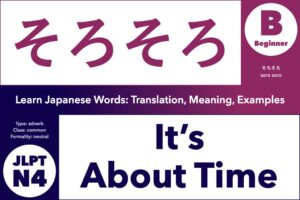
- そろそろ (soro soro): Meaning, Translation, Examples
そろそろ (soro soro) means “soon”, “about time” or “gradually”. It’s a common adverb used when the speaker feels that the right moment to act has arrived or is approaching. It
- ね (ne): Meaning, Translation, Examples
ね (ne) is a sentence-ending particle used to seek agreement, confirmation, or shared understanding. It softens statements and makes speech sound friendly and conversational, similar to “right?”, “isn’t it?”, or
- んす (n su): Meaning, Translation, Examples
んす (n su) is a very casual spoken contraction, mainly used in informal conversation to soften statements, seek confirmation, or add an explanatory tone. It comes from のです (no desu),
- いい (ii): Meaning, Translation, Examples
いい (ii) means “good“, “nice“, or “okay“. It’s a common i-adjective used to show approval, permission, or a positive evaluation. Depending on context, it can mean something is acceptable, allowed,
- 本当に (ほんとうに, hontou ni): Meaning, Translation, Examples
本当に (ほんとうに, hontou ni) means “really” or “truly“. It is an adverb that adds emphasis and sincerity to what the speaker is saying. In everyday Japanese, it is commonly used
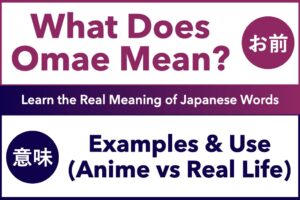
- What Does Omae (お前) Mean in Japanese? Examples & Use
You’ve probably come across the Japanese word omae (お前, おまえ) in anime, manga, or casual conversations. It is often translated as “you” but the meaning of omae in Japanese depends
- で (de): Meaning, Translation, Examples
で (de) is a core particle used to show where an action happens, how something is done, or under what condition or situation an action takes place. It has no
- 食べた (たべた, tabeta): Meaning, Translation, Examples
食べた (たべた, tabeta) means “ate” or “have eaten“. It’s the plain past tense of the verb 食べる (たべる, taberu), meaning “to eat”. 食べた is used in casual speech to state
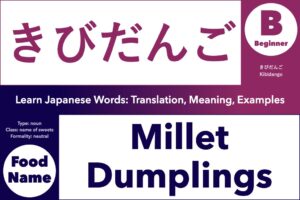
- きびだんご (kibidango): Meaning, Translation, Examples
きびだんご (kibidango) is the name of a traditional Japanese sweet that translates as “millet dumplings” in English. It is made from millet flour or rice flour mixed with sugar and
- 25 Beginner Japanese Words from Demon Slayer
Are you a Demon Slayer (鬼滅の刃) fan who wants to learn Japanese anime and manga vocabulary? In this post, I will help you learn 25 beginner-friendly Japanese words taken directly
- Konnichiwa Meaning: How to Use & Reply (Japanese Greetings)
The Japanese greeting konnichiwa (こんにちは) is usually one of the first Japanese words people learn. You probably already know that it translates as “hello“, but its meaning and usage are
- HANA『BAD LOVE』Lyrics (Word Translations & Song Meaning)
Are you an international HONEY looking for the English translation and meaning of HANA‘s song BAD LOVE? You are in the right place. In this post, I break down the
- 12 Japanese Words for Love – How to Choose the Right Phrase
If you have ever wondered what the Japanese word for love is, the answer will surprise you. While in English, we can use the word “love” and the single phrase
- 岡山 (おかやま, Okayama): Meaning, Translation, Examples
岡山 (おかやま, Okayama) is a proper noun that refers to Okayama City and Okayama Prefecture in western Japan. The name comes from the kanji 岡 (おか, oka) meaning “hill” and
- 昨日 (きのう, kinou): Meaning, Translation, Examples
昨日 (きのう, kinou) means “yesterday” in Japanese. It’s a common time word used to talk about events that happened the day before today. In Japanese sentences, 昨日 often appears at
- くれて (kurete): Meaning, Translation, Examples
くれて (kurete) means “give (to me) (and) …” or “Kindly do … for (me)!“. It’s the te-form of the verb くれる (kureru), meaning “to give“. It’s used when someone does
- ありがとう (arigatou): Meaning, Translation, Examples
ありがとう (arigatou) means “thanks”. It’s a casual expression used with friends, family, or people close to you to show gratitude. It can follow a verb in the te-form (〜てありがとう) to
- 支えて (ささえて, sasaete): Meaning, Translation, Examples
支えて (ささえて, sasaete) means “support (and) …” or “Support (me/it)!“. It’s the te-form of the verb 支える (ささえる, sasaeru), meaning “to support”. It’s used to describe physical or emotional support,
- いつも (itsumo): Meaning, Translation, Examples
いつも (itsumo) means “always” or “all the time”. It’s used before a verb, action, or state to describe things that happen regularly or repeatedly. The adverb can also express an
- しました (shimashita): Meaning, Translation, Examples
しました (shimashita) means “did” or “have done.” It’s the past polite form of the verb する (suru), meaning “to do.” It’s used to politely state that an action has been
- 閉幕する (へいまく する, heimaku suru): Meaning, Translation, Examples
閉幕する (へいまく する, heimaku suru) means “to draw the curtain on” or “to come to an end.” It’s the suru-verb form of 閉幕 (へいまく, heimaku), which refers to a formal
- 閉幕 (へいまく, heimaku): Meaning, Translation, Examples
閉幕 (へいまく, heimaku) means “falling of the curtain” or “the closing” of an event. It refers to the formal end of a festival, performance, or large gathering. The word carries
- が (ga): Meaning, Translation, Examples
が (ga) is a core particle that marks the subject of a sentence. It shows who or what performs an action or is being described. It has no single fixed
- 二十五 (にじゅうご, nijyuugo): Meaning, Translation, Examples
二十五 (にじゅうご, nijyuugo) means “25” or “twenty-five” in Japanese. It’s a basic number used for dates, ages, and general counting. In modern writing, Japanese also use the numerals 25 or
- フェス (fesu): Meaning, Translation, Examples
フェス (fesu) means “fest” or “fest.“. It’s the shortened form of フェスティバル (fesutibaru), meaning “festival,” and is commonly used for large-scale music events or concerts with multiple artists. While the
- 思い出 (おもいで, omoide): Meaning, Translation, Examples
思い出 (おもいで, omoide) means “memories” or “recollection.” It refers to something remembered from the past, often with an emotional or nostalgic feeling. It can describe personal experiences, moments, or events
- の (no): Meaning, Translation, Examples
の (no) means “…of…” or “…‘s …” It is a versatile particle mainly used to show possession, belonging, or a descriptive connection between two or more nouns. It can also
- 最後の (さいご の, saigo no): Meaning, Translation, Examples
最後の (さいご の, saigo no) means “latest,” “last…,” or “final…” It’s the noun 最後 (さいご, saigo) plus the particle の (no), which turns it into a modifier for the noun
- 最後 (さいご, saigo): Meaning, Translation, Examples
最後 (さいご, saigo) means “last,” “end,” or “final.” It refers to a conclusion of a time period, sequence, or event. As a noun, it can stand on its own, but
- 夏 (なつ, natsu): Meaning, Translation, Examples
夏 (なつ, natsu) means “summer” in Japanese. It refers to the hottest season of the year, typically from July to September in Japan. The word is used as a basic
- お誕生日 (おたんじょうび, o-tanjoubi): Meaning, Translation, Examples
お誕生日 (おたんじょうび, otanjoubi) means “(your) honorable birthday.” It combines the honorific prefix お (o) with 誕生日 (たんじょうび, tanjoubi). This respectful form is used when referring to someone else’s birthday. The
- おめでとう (omedetou): Meaning, Translation, Examples
おめでとう (omedetou) means “Congrats!” or “Congratulations!” and is used to casually celebrate good news, achievements, or happy occasions. It can be used on its own or paired with an event,
- ありがとうございました (arigatou gozaimashita): Meaning, Translation, Examples
ありがとうございました (arigatou gozaimashita) means “thank you (for what you did).” It’s the past polite form of ありがとうございます (arigatou gozaimasu), which is the basic Japanese phrase for “thank you.” It expresses
- ファンミーティング (fan miitingu): Meaning, Translation, Examples
ファンミーティング (fan miitingu) means “fan meeting,” “fanmeet,” or “meet and greet.” It’s a compound of ファン (fan) and ミーティング (miitingu) and refers to an event where artists, idols, or creators
- 初 (はつ, hatsu): Meaning, Translation, Examples
初 (はつ, hatsu) means “first,” “initial,” or “beginning.” It marks the very first occurrence or the starting point of an event, state, or experience, emphasizing that something is happening for
- 来ました (きました, kimashita): Meaning, Translation, Examples
来ました (きました, kimashita) means “came,” “has come,” or “arrived.” It’s the past polite form of the verb 来る (くる, kuru), meaning “to come.” The form is used to politely express
- さあさあ (saa saa): Meaning, Translation, Examples
さあさあ (saa saa) means “come on” or “here you go” in Japanese. It is a lively and energetic interjection used to urge, invite, or prompt someone to take action. The
- みなさん (Mina-san): Meaning, Translation, Examples
みなさん (皆さん, mina-san) means “everyone” or “all” in Japanese. It’s a polite, respectful way to address a group, often used with audiences, coworkers, or classmates. In informal situations, the casual
- おはようございます (Ohayou Gozaimasu): Meaning, Translation, Examples
おはようございます (ohayou gozaimasu) means “good morning” in Japanese. It’s a polite greeting used mainly in the morning, with teachers, coworkers, or anyone you want to show respect to. Since it’s
- Beginner Guide: Learn 1000 Basic Japanese Words Quickly (Kanji & Romaji)
I have created this list of 1,000 basic Japanese words for beginners and people who want to start learning Japanese. I wanna help you acquire the most commonly used yet
- Learn Japanese: 1000 Most Common Words in 100 Days (Part 2)
This is the second part (2 / 10) of my free course and my easy step-by-step guide to help you learn the 1000 most common Japanese words in 100 days. I hope you are ready
- Suru (する): Meaning, Conjugation, Japanese Examples
Your go-to page for the Japanese verb suru (する) and its polite form shimasu (します). Here you find all of the word’s meanings, some useful and common phrases with translations,
- Learn Japanese: 1000 Most Common Words in 100 Days (Guide)
This is my free course and an easy step-by-step guide to help you learn the 1000 most common Japanese words in 100 days. The key to learning Japanese and becoming
- 6 Ways to Say “Red” in Japanese (Kanji & Hiragana)
The Japanese color I’m going to teach you in this blog post is “red”. I will show you 6 common ways to say “red” in Japanese including the real meaning, kanji, hiragana, and English translations of
- 10 Ways to Say “Milk” in Japanese (Soy Milk, Oat Milk)
In today’s vocabulary lesson I cover how to say “milk” in Japanese. You’ll learn the most important and commonly used words for “milk” in Japanese, their English translations, and how
- 8 Ways to Say “Green” in Japanese (Translation & Kanji)
Today I’m going to teach you the Japanese word for “green”. As with the other color words before, you are not just going to learn one translation but 8 ways
- 9 Ways to Say “Blue” in Japanese (Translations & Kanji)
The color “blue” is next on our quest to learn all the basic colors in Japanese. In this post, I will show you 9 common ways to say “blue” in
- 6 Ways to Say “White” in Japanese (Kanji & Hiragana)
The next Japanese color word on our list is “white“. I will show you 6 different ways to say “white” and the “color white” in Japanese. As usual, you will
- 4 Ways to Say “Samurai” in Japanese (Kanji & Meanings)
I thought that answering the question of how to say “samurai” in Japanese would be one of the easiest blog posts to write for me. However, did you know that
- 4 Ways to Say “Black” in Japanese (Translations & Kanji)
I have written this blog post for you to teach you the best ways to say “black” in Japanese. There are 4 words for “black” and the “color black” that
- 14 Ways to Say “God” in Japanese (Best Words & Kanji)
If you have been wondering about the right way to say “god” in Japanese, you have come to the perfect source. In this vocabulary lesson, I am going to tell
- 5 Ways to Say “King” in Japanese (Correct Word & Kanji)
I have written this blog post for all of you who want to know how to say “king” in Japanese. There are 5 Japanese words that are typically used when
- 6 Ways to Say “Death” in Japanese (Kanji & Meaning)
In this word and vocabulary lesson, I am going to tell you how to say “death” in Japanese. As usual, the Japanese language has a bunch of words and kanji
- 9 Ways to Say “Water” in Japanese (Best Words & Kanji)
In today’s vocabulary lesson I’m going to show you the 9 most common ways to say “water” in Japanese. Depending on whether you want to talk about drinking water, hot
- 5 Ways to Say “Fire” in Japanese (Best Words & Kanji)
In this vocabulary lesson, you will learn how to say “fire” in Japanese. There are a couple of words you can use depending on whether you want to talk about
- 5 Ways to Say “Demon” in Japanese (Best Words & Kanji)
Today’s vocabulary lesson is about the Japanese word for “demon” or “demons“. You’re not only going to learn the 5 common ways to say “demon” in Japanese, but I will
- 3 Ways to Say “Dragon” in Japanese (Cool Words & Kanji)
In today’s vocabulary lesson, you are going to learn how to say “dragon” in Japanese. Generally speaking, there are 3 Japanese words for “dragon“, but each of them has a
- 10 Ways to Say “Tea” in Japanese (Detailed Guide & Kanji)
In this vocabulary lesson, you will learn how to say “tea” in Japanese. I will show you a total of 10 words that are used for the most popular types
- 4 Ways to Say “Shadow” in Japanese (Best Words & Kanji)
In today’s vocabulary lesson you will learn 4 ways to say “shadow” in Japanese. There are different Japanese words you use when talking about the shape of a person’s shadow,
- 7 Ways to Say “Bathroom/Toilet” in Japanese (Complete Guide)
In today’s vocabulary lesson you are going to learn 7 ways how to say “bathroom“, “restroom“, and “toilet” in Japanese. In this complete guide, I will show you which Japanese
- 5 Ways to Say “Breakfast” in Japanese (Hiragana & Kanji)
In today’s vocabulary lesson you will learn how to say “breakfast” in Japanese. I will teach you the 5 most commonly used words, their meaning, English translation, and how to
- 5 Ways to Say “Butterfly” in Japanese (Best Words & Kanji)
In this vocabulary lesson, you will learn how to say “butterfly” in Japanese. Since the Japanese language has a couple of words for “butterfly“, I want to go over the
- 5 Ways to Say “Cat” in Japanese (Complete Guide & Kanji)
In today’s blog post, I will tell you how to say “cat” in Japanese. Since there are a couple of words that can be used, you will get to know
- Meaning of “Dayo” in Japanese & English (How to Use)
Today’s blog post is all about the English meaning of the Japanese expression “dayo” (だよ). The phrase and its related expressions “Nandayo“, “Dame dayo“, and “Da yo ne” are often
- 6 Ways to Say “Dog” in Japanese (Complete Guide & Kanji)
In today’s vocabulary blog post, you will get to know how to say “dog” in Japanese. As usual, there are a couple of words that can be used, so I’m
- 6 Ways to Say “Sea” in Japanese – Best Words Plus Kanji
If you want to know how to say “sea” or “ocean” in Japanese, you have come to the right place. In my blog post, I’m going to show you the
- 10 Ways to Say “Star” in Japanese (Best Words & Kanji)
In this blog post, I am going to tell you a variety of words that are used to say “star” or “stars” in Japanese. Since there are a couple of words I
- 9 Ways to Say “Moon” in Japanese (Best Words & Kanji)
In this blog post, I am going to answer the question of how to say “moon” in Japanese. In comparison to my other vocabulary lessons, I have a pretty simple
- 9 Best Ways to Say “Sun” in Japanese (Words & Kanji)
In this vocabulary lesson, you will learn how to say “sun” in Japanese. Since the Japanese language has quite a few words for “sun“, I want to go over the
- 11 Ways to Say “Sky” in Japanese – Best Words Plus Kanji
In this vocabulary lesson, I will explain to you how to say “sky” in Japanese. Did you know that there are more than 11 Japanese words that mean “sky“? With
- 9 Common Ways to Say Cute in Japanese (Kawaii & More)
“Kawaii” (かわいい, 可愛い) doesn’t only mean “cute” it is also of the cutest Japanese words, in my opinion. But did you know that there are so many other similar Japanese
- Oishii: Japanese Meaning, English Translation, How to Use
In today’s blog post, I’m going to cover the detailed meaning and translation of the Japanese word “oishii” (美味しい). It is one of the most commonly used words to describe
- 12 Best Ways to Say “Delicious” in Japanese (Oishii & More)
Did you know that there are actually more than 47 ways to say “delicious” or “tasty” in Japanese? Each prefecture in Japan has its own distinctive expression to state that
- All About “Nani Kore”: Japanese Meaning & Translation
In today’s blog post, I will tell you all about the meaning of the Japanese expression “Nani kore” (何これ, なにこれ). Luckily, the English translation of “Nani kore” is pretty straightforward,
- Soro Soro: Japanese Meaning, English Translation, How to Use
This is my detailed guide about the meaning and English translation of the Japanese expression “soro soro” (そろそろ). Some of you wanted to know what “soro soro” means in Japanese
- The Real Meaning of “Sayonara” – Why You Shouldn’t Use It
I’m pretty sure you have learned or heard that “sayonara” (さようなら) is used to say goodbye in Japan. However, in Japanese the phrase “sayonara” has actually a deeper, slightly sad
- Umai: Japanese Meaning, English Translation, How to Use
After watching “Demon Slayer Mugen Train” in Japanese and hearing Rengoku say “umai“, I decided that I have to write a blog post about what the word means in Japanese.
- Yatta: Japanese Meaning, English Translation, How to Use
Maybe you know the word “yatta” from a certain Japanese song, maybe you know it from anime. In this blog post, I am going to tell you everything you need
- Yokatta: Japanese Meaning, English Translation, How to Use
This is an in-depth guide about the Japanese word “yokatta” (よかった, 良かった). In this blog post, I have covered for you the word’s meanings, English translations, and the most common
- The Meaning of Doki Doki in Japanese & English (How to Use)
Have you ever watched an anime, read a manga, or played the game “Doki Doki Literature Club” and wondered what the Japanese word “doki doki” (ドキドキ) means? I have certainly
- The Meaning of “Baka” in Japanese: Real Life, Anime, TikTok
“Baka” is a word that is used in nearly every anime and manga and now it has also become a viral trend on TikTok. So what does the Japanese word
- The Meaning of “Ohayo (Gozaimasu)” in Japanese (Greetings)
Since “Ohayo” (おはよう) is another extremely common and important Japanese greeting, today’s lesson is all about its meaning and and translation. I’m not only go cover the more casual greeting,
- The Meaning of “Konbanwa” in Japanese (Basic Greetings)
In today’s lesson, I’m going to tell you everything you need to know about the meaning and translation of the Japanese greeting “konbanwa” (こんばんは). Before we discuss in detail what
- The Meaning of “Domo” in Japanese (Domo Arigato, Domo Domo)
If you have ever heard the word “Domo” (どうも) in an anime or when traveling in Japan and wondered what it means in Japanese you have come to the right
- The Meaning of “Arigato” in Japanese (vs Arigato Gozaimasu)
Today I’m going to tell you all you need to know about the meaning of the two Japanese expressions “arigato” (ありがとう) and “arigato gozaimasu” (ありがとうございます). Compared to other basic Japanese
- The Real Meaning of “Suki” in Japanese (Like & Love)
I’m sure that many of you have always wanted to know the real meaning of the Japanese word “suki” (好き). Does it mean “like” or does it mean “love“? Especially
- The Real Meaning of “Genki” in Japanese (With Examples)
Have you ever wondered what the Japanese word “genki” (元気) and the phrases “Ogenki desu ka?” and “Genki desu!” mean?. Then you have come to the right place. In today’s
- The Meaning of “Dame” in Japanese (Dame Desu, Dame Dayo)
In today’s blog post I will clarify the meaning of the Japanese word “dame” (ダメ, 駄目) and the related phrases “dame desu“, “dame da“, “dame dayo“, and “dame dame“. Since
- The Meaning of “Daisuki” – Say “I Love (You)” in Japanese
I have noticed that there is a lot of confusion about the meaning of the Japanese word “daisuki” (大好き). Does it mean “love” or just “like“? In this detailed blog
- What Does “Nandayo” Mean in Japanese? A Detailed Guide
“Nandayo” is an often-used phrase in Japanese, so I have decided to write this blog post to explain its meaning in detail. I know that the phrase doesn’t seem to
- 5 Ways to Say “I Like You” in Japanese (Suki vs Daisuki)
One of the most commonly asked questions I receive from my readers is how to say “I like you” in Japanese. So in today’s blog post, I’m finally going to
- The Meaning of “Oyasumi” – Saying Good Night in Japanese
In today’s blog post, I will tell you all about the meaning and translation of the two Japanese expressions “Oyasumi” (おやすみ) and “Oyasuminasai” (おやすみなさい). Luckily, it is very simple to
- What Does Yabai (やばい) Mean in Japanese? A Detailed Guide
The Japanese word yabai (やばい) caused me a lot of confusion because of its many meanings and contradictory English translations. If you look up the word “yabai” in a dictionary
- The Meaning of Sugoi (すごい) & How to Use it in Japanese
I’m sure that sugoi (すごい, 凄い) is another Japanese word that you have always wanted to know what it means. Like me, you must have heard and/or seen it at
- 26 Ways to Say Goodbye in Japanese (Casually & Formally)
I once did the big mistake to say goodbye to my Japanese friend using the word “Sayonara” and hurt him a lot without realizing it. There are so many ways
- 26 Ways to Say Hello in Japanese (Casual & Formal Greetings)
I thought I knew my Japanese greetings before moving to Japan. However, I just realized that nowadays I use totally different phrases to say hello to my friends and when
- 15 Ways to Say “Happy Birthday” in Japanese (Birthday Wishes)
There are plenty of reasons why you would want to know how to say “Happy Birthday” in Japanese. Whether you want to wish a happy birthday to a close Japanese
- What Does “Aishiteru” Mean? And Why Japanese Rarely Say It
One of the most used Japanese phrases in romantic anime, manga, movies, and Japanese dramas is “Aishiteru“. But while it is fairly easy to translate the phrase into English words,

 This is the perfect place to start building your Japanese vocabulary base with words and phrases from Final Fantasy I 『ファイナルファンタジーI』. Instead of a random word list, you will learn
 帰ろう (かえろう, kaerou) means “let’s go home” or “let’s return“. It’s the casual volitional form of the verb 帰る (かえる, kaeru, “to go home”) and used to express the speaker’s
 そろそろ (soro soro) means “soon”, “about time” or “gradually”. It’s a common adverb used when the speaker feels that the right moment to act has arrived or is approaching. It
 ね (ne) is a sentence-ending particle used to seek agreement, confirmation, or shared understanding. It softens statements and makes speech sound friendly and conversational, similar to “right?”, “isn’t it?”, or
 んす (n su) is a very casual spoken contraction, mainly used in informal conversation to soften statements, seek confirmation, or add an explanatory tone. It comes from のです (no desu),
 いい (ii) means “good“, “nice“, or “okay“. It’s a common i-adjective used to show approval, permission, or a positive evaluation. Depending on context, it can mean something is acceptable, allowed,
 本当に (ほんとうに, hontou ni) means “really” or “truly“. It is an adverb that adds emphasis and sincerity to what the speaker is saying. In everyday Japanese, it is commonly used
 You’ve probably come across the Japanese word omae (お前, おまえ) in anime, manga, or casual conversations. It is often translated as “you” but the meaning of omae in Japanese depends
 で (de) is a core particle used to show where an action happens, how something is done, or under what condition or situation an action takes place. It has no
 食べた (たべた, tabeta) means “ate” or “have eaten“. It’s the plain past tense of the verb 食べる (たべる, taberu), meaning “to eat”. 食べた is used in casual speech to state
 きびだんご (kibidango) is the name of a traditional Japanese sweet that translates as “millet dumplings” in English. It is made from millet flour or rice flour mixed with sugar and
 Are you a Demon Slayer (鬼滅の刃) fan who wants to learn Japanese anime and manga vocabulary? In this post, I will help you learn 25 beginner-friendly Japanese words taken directly
 The Japanese greeting konnichiwa (こんにちは) is usually one of the first Japanese words people learn. You probably already know that it translates as “hello“, but its meaning and usage are
 Are you an international HONEY looking for the English translation and meaning of HANA‘s song BAD LOVE? You are in the right place. In this post, I break down the
 If you have ever wondered what the Japanese word for love is, the answer will surprise you. While in English, we can use the word “love” and the single phrase
 岡山 (おかやま, Okayama) is a proper noun that refers to Okayama City and Okayama Prefecture in western Japan. The name comes from the kanji 岡 (おか, oka) meaning “hill” and
 昨日 (きのう, kinou) means “yesterday” in Japanese. It’s a common time word used to talk about events that happened the day before today. In Japanese sentences, 昨日 often appears at
 くれて (kurete) means “give (to me) (and) …” or “Kindly do … for (me)!“. It’s the te-form of the verb くれる (kureru), meaning “to give“. It’s used when someone does
 ありがとう (arigatou) means “thanks”. It’s a casual expression used with friends, family, or people close to you to show gratitude. It can follow a verb in the te-form (〜てありがとう) to
 支えて (ささえて, sasaete) means “support (and) …” or “Support (me/it)!“. It’s the te-form of the verb 支える (ささえる, sasaeru), meaning “to support”. It’s used to describe physical or emotional support,
 いつも (itsumo) means “always” or “all the time”. It’s used before a verb, action, or state to describe things that happen regularly or repeatedly. The adverb can also express an
 しました (shimashita) means “did” or “have done.” It’s the past polite form of the verb する (suru), meaning “to do.” It’s used to politely state that an action has been
 閉幕する (へいまく する, heimaku suru) means “to draw the curtain on” or “to come to an end.” It’s the suru-verb form of 閉幕 (へいまく, heimaku), which refers to a formal
 閉幕 (へいまく, heimaku) means “falling of the curtain” or “the closing” of an event. It refers to the formal end of a festival, performance, or large gathering. The word carries
 が (ga) is a core particle that marks the subject of a sentence. It shows who or what performs an action or is being described. It has no single fixed
 二十五 (にじゅうご, nijyuugo) means “25” or “twenty-five” in Japanese. It’s a basic number used for dates, ages, and general counting. In modern writing, Japanese also use the numerals 25 or
 フェス (fesu) means “fest” or “fest.“. It’s the shortened form of フェスティバル (fesutibaru), meaning “festival,” and is commonly used for large-scale music events or concerts with multiple artists. While the
 思い出 (おもいで, omoide) means “memories” or “recollection.” It refers to something remembered from the past, often with an emotional or nostalgic feeling. It can describe personal experiences, moments, or events
 の (no) means “…of…” or “…‘s …” It is a versatile particle mainly used to show possession, belonging, or a descriptive connection between two or more nouns. It can also
 最後の (さいご の, saigo no) means “latest,” “last…,” or “final…” It’s the noun 最後 (さいご, saigo) plus the particle の (no), which turns it into a modifier for the noun
 最後 (さいご, saigo) means “last,” “end,” or “final.” It refers to a conclusion of a time period, sequence, or event. As a noun, it can stand on its own, but
 夏 (なつ, natsu) means “summer” in Japanese. It refers to the hottest season of the year, typically from July to September in Japan. The word is used as a basic
 お誕生日 (おたんじょうび, otanjoubi) means “(your) honorable birthday.” It combines the honorific prefix お (o) with 誕生日 (たんじょうび, tanjoubi). This respectful form is used when referring to someone else’s birthday. The
 おめでとう (omedetou) means “Congrats!” or “Congratulations!” and is used to casually celebrate good news, achievements, or happy occasions. It can be used on its own or paired with an event,
 ありがとうございました (arigatou gozaimashita) means “thank you (for what you did).” It’s the past polite form of ありがとうございます (arigatou gozaimasu), which is the basic Japanese phrase for “thank you.” It expresses
 ファンミーティング (fan miitingu) means “fan meeting,” “fanmeet,” or “meet and greet.” It’s a compound of ファン (fan) and ミーティング (miitingu) and refers to an event where artists, idols, or creators
 初 (はつ, hatsu) means “first,” “initial,” or “beginning.” It marks the very first occurrence or the starting point of an event, state, or experience, emphasizing that something is happening for
 来ました (きました, kimashita) means “came,” “has come,” or “arrived.” It’s the past polite form of the verb 来る (くる, kuru), meaning “to come.” The form is used to politely express
 さあさあ (saa saa) means “come on” or “here you go” in Japanese. It is a lively and energetic interjection used to urge, invite, or prompt someone to take action. The
 みなさん (皆さん, mina-san) means “everyone” or “all” in Japanese. It’s a polite, respectful way to address a group, often used with audiences, coworkers, or classmates. In informal situations, the casual
 おはようございます (ohayou gozaimasu) means “good morning” in Japanese. It’s a polite greeting used mainly in the morning, with teachers, coworkers, or anyone you want to show respect to. Since it’s
 I have created this list of 1,000 basic Japanese words for beginners and people who want to start learning Japanese. I wanna help you acquire the most commonly used yet
 This is the second part (2 / 10) of my free course and my easy step-by-step guide to help you learn the 1000 most common Japanese words in 100 days. I hope you are ready
 Your go-to page for the Japanese verb suru (する) and its polite form shimasu (します). Here you find all of the word’s meanings, some useful and common phrases with translations,
 This is my free course and an easy step-by-step guide to help you learn the 1000 most common Japanese words in 100 days. The key to learning Japanese and becoming
 The Japanese color I’m going to teach you in this blog post is “red”. I will show you 6 common ways to say “red” in Japanese including the real meaning, kanji, hiragana, and English translations of
 In today’s vocabulary lesson I cover how to say “milk” in Japanese. You’ll learn the most important and commonly used words for “milk” in Japanese, their English translations, and how
 Today I’m going to teach you the Japanese word for “green”. As with the other color words before, you are not just going to learn one translation but 8 ways
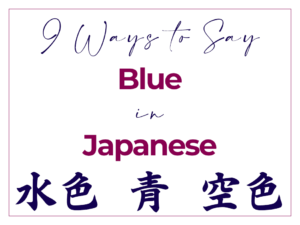 The color “blue” is next on our quest to learn all the basic colors in Japanese. In this post, I will show you 9 common ways to say “blue” in
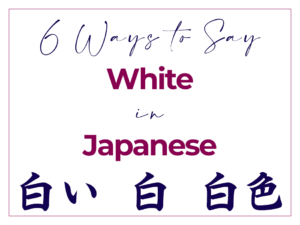 The next Japanese color word on our list is “white“. I will show you 6 different ways to say “white” and the “color white” in Japanese. As usual, you will
 I thought that answering the question of how to say “samurai” in Japanese would be one of the easiest blog posts to write for me. However, did you know that
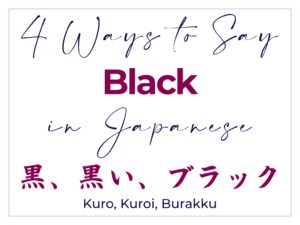 I have written this blog post for you to teach you the best ways to say “black” in Japanese. There are 4 words for “black” and the “color black” that
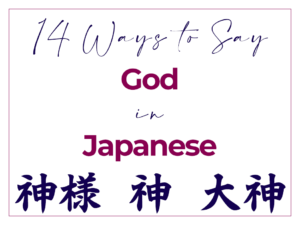 If you have been wondering about the right way to say “god” in Japanese, you have come to the perfect source. In this vocabulary lesson, I am going to tell
 I have written this blog post for all of you who want to know how to say “king” in Japanese. There are 5 Japanese words that are typically used when
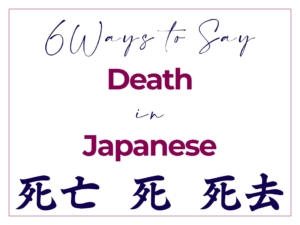 In this word and vocabulary lesson, I am going to tell you how to say “death” in Japanese. As usual, the Japanese language has a bunch of words and kanji
 In today’s vocabulary lesson I’m going to show you the 9 most common ways to say “water” in Japanese. Depending on whether you want to talk about drinking water, hot
 In this vocabulary lesson, you will learn how to say “fire” in Japanese. There are a couple of words you can use depending on whether you want to talk about
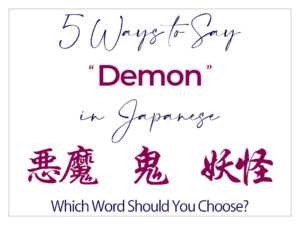 Today’s vocabulary lesson is about the Japanese word for “demon” or “demons“. You’re not only going to learn the 5 common ways to say “demon” in Japanese, but I will
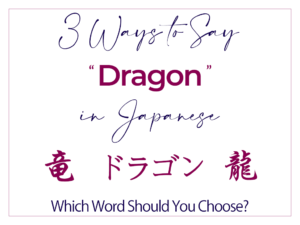 In today’s vocabulary lesson, you are going to learn how to say “dragon” in Japanese. Generally speaking, there are 3 Japanese words for “dragon“, but each of them has a
 In this vocabulary lesson, you will learn how to say “tea” in Japanese. I will show you a total of 10 words that are used for the most popular types
 In today’s vocabulary lesson you will learn 4 ways to say “shadow” in Japanese. There are different Japanese words you use when talking about the shape of a person’s shadow,
 In today’s vocabulary lesson you are going to learn 7 ways how to say “bathroom“, “restroom“, and “toilet” in Japanese. In this complete guide, I will show you which Japanese
 In today’s vocabulary lesson you will learn how to say “breakfast” in Japanese. I will teach you the 5 most commonly used words, their meaning, English translation, and how to
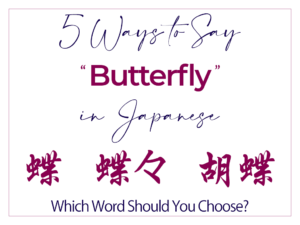 In this vocabulary lesson, you will learn how to say “butterfly” in Japanese. Since the Japanese language has a couple of words for “butterfly“, I want to go over the
 In today’s blog post, I will tell you how to say “cat” in Japanese. Since there are a couple of words that can be used, you will get to know
 Today’s blog post is all about the English meaning of the Japanese expression “dayo” (だよ). The phrase and its related expressions “Nandayo“, “Dame dayo“, and “Da yo ne” are often
 In today’s vocabulary blog post, you will get to know how to say “dog” in Japanese. As usual, there are a couple of words that can be used, so I’m
 If you want to know how to say “sea” or “ocean” in Japanese, you have come to the right place. In my blog post, I’m going to show you the
 In this blog post, I am going to tell you a variety of words that are used to say “star” or “stars” in Japanese. Since there are a couple of words I
 In this blog post, I am going to answer the question of how to say “moon” in Japanese. In comparison to my other vocabulary lessons, I have a pretty simple
 In this vocabulary lesson, you will learn how to say “sun” in Japanese. Since the Japanese language has quite a few words for “sun“, I want to go over the
 In this vocabulary lesson, I will explain to you how to say “sky” in Japanese. Did you know that there are more than 11 Japanese words that mean “sky“? With
 “Kawaii” (かわいい, 可愛い) doesn’t only mean “cute” it is also of the cutest Japanese words, in my opinion. But did you know that there are so many other similar Japanese
 In today’s blog post, I’m going to cover the detailed meaning and translation of the Japanese word “oishii” (美味しい). It is one of the most commonly used words to describe
 Did you know that there are actually more than 47 ways to say “delicious” or “tasty” in Japanese? Each prefecture in Japan has its own distinctive expression to state that
 In today’s blog post, I will tell you all about the meaning of the Japanese expression “Nani kore” (何これ, なにこれ). Luckily, the English translation of “Nani kore” is pretty straightforward,
 This is my detailed guide about the meaning and English translation of the Japanese expression “soro soro” (そろそろ). Some of you wanted to know what “soro soro” means in Japanese
 I’m pretty sure you have learned or heard that “sayonara” (さようなら) is used to say goodbye in Japan. However, in Japanese the phrase “sayonara” has actually a deeper, slightly sad
 After watching “Demon Slayer Mugen Train” in Japanese and hearing Rengoku say “umai“, I decided that I have to write a blog post about what the word means in Japanese.
 Maybe you know the word “yatta” from a certain Japanese song, maybe you know it from anime. In this blog post, I am going to tell you everything you need
 This is an in-depth guide about the Japanese word “yokatta” (よかった, 良かった). In this blog post, I have covered for you the word’s meanings, English translations, and the most common
 Have you ever watched an anime, read a manga, or played the game “Doki Doki Literature Club” and wondered what the Japanese word “doki doki” (ドキドキ) means? I have certainly
 “Baka” is a word that is used in nearly every anime and manga and now it has also become a viral trend on TikTok. So what does the Japanese word
 Since “Ohayo” (おはよう) is another extremely common and important Japanese greeting, today’s lesson is all about its meaning and and translation. I’m not only go cover the more casual greeting,
 In today’s lesson, I’m going to tell you everything you need to know about the meaning and translation of the Japanese greeting “konbanwa” (こんばんは). Before we discuss in detail what
 If you have ever heard the word “Domo” (どうも) in an anime or when traveling in Japan and wondered what it means in Japanese you have come to the right
 Today I’m going to tell you all you need to know about the meaning of the two Japanese expressions “arigato” (ありがとう) and “arigato gozaimasu” (ありがとうございます). Compared to other basic Japanese
 I’m sure that many of you have always wanted to know the real meaning of the Japanese word “suki” (好き). Does it mean “like” or does it mean “love“? Especially
 Have you ever wondered what the Japanese word “genki” (元気) and the phrases “Ogenki desu ka?” and “Genki desu!” mean?. Then you have come to the right place. In today’s
 In today’s blog post I will clarify the meaning of the Japanese word “dame” (ダメ, 駄目) and the related phrases “dame desu“, “dame da“, “dame dayo“, and “dame dame“. Since
 I have noticed that there is a lot of confusion about the meaning of the Japanese word “daisuki” (大好き). Does it mean “love” or just “like“? In this detailed blog
 “Nandayo” is an often-used phrase in Japanese, so I have decided to write this blog post to explain its meaning in detail. I know that the phrase doesn’t seem to
 One of the most commonly asked questions I receive from my readers is how to say “I like you” in Japanese. So in today’s blog post, I’m finally going to
 In today’s blog post, I will tell you all about the meaning and translation of the two Japanese expressions “Oyasumi” (おやすみ) and “Oyasuminasai” (おやすみなさい). Luckily, it is very simple to
 The Japanese word yabai (やばい) caused me a lot of confusion because of its many meanings and contradictory English translations. If you look up the word “yabai” in a dictionary
 I’m sure that sugoi (すごい, 凄い) is another Japanese word that you have always wanted to know what it means. Like me, you must have heard and/or seen it at
 I once did the big mistake to say goodbye to my Japanese friend using the word “Sayonara” and hurt him a lot without realizing it. There are so many ways
 I thought I knew my Japanese greetings before moving to Japan. However, I just realized that nowadays I use totally different phrases to say hello to my friends and when
 There are plenty of reasons why you would want to know how to say “Happy Birthday” in Japanese. Whether you want to wish a happy birthday to a close Japanese
 One of the most used Japanese phrases in romantic anime, manga, movies, and Japanese dramas is “Aishiteru“. But while it is fairly easy to translate the phrase into English words,