
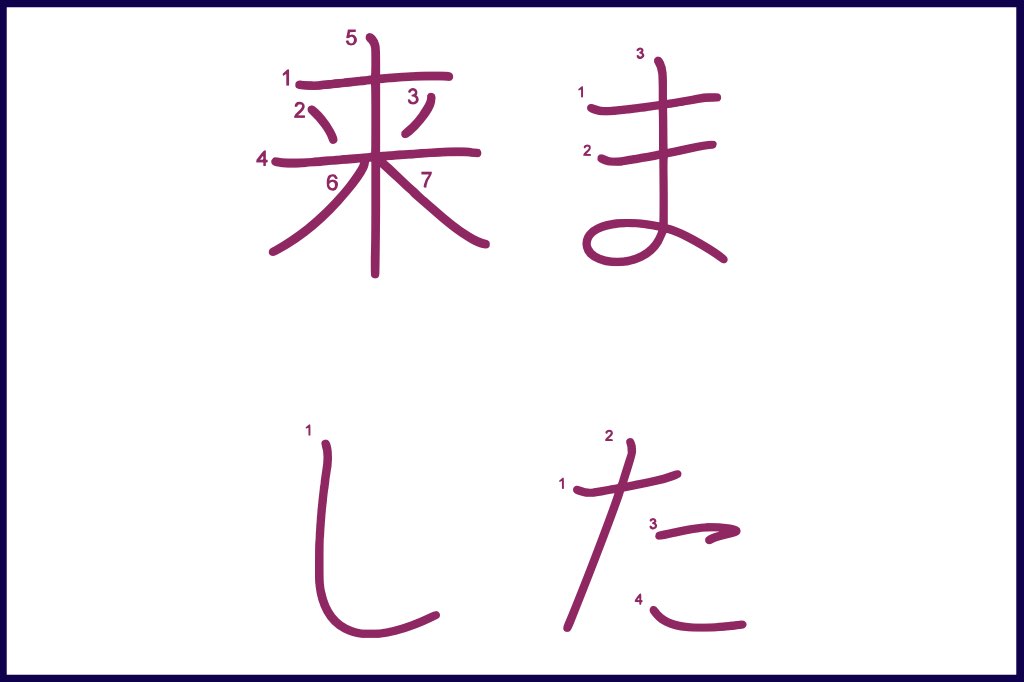
来ました (きました, kimashita) means “came,” “has come,” or “arrived.” It’s the past polite form of the verb 来る (くる, kuru), meaning “to come.” The form is used to politely express that someone or something has arrived or come to a place. It’s taught at the JLPT N5 level and politer than 来た (きた, kita).
来ました
きました
kimashita
came, has come
In this post, you will find all the translations and meanings of 来ました (きました, kimashita) and learn how to use it naturally in daily conversations. I’ll share many example sentences so you can talk about someone having come or arrived in the past tense like a native speaker.
来ました Means “Came” in Japanese
Word: 来ました
Kana: きました
Romaji: kimashita
Meaning: came, has come
Type: verb (past tense)
Class: common, JLPT N5
Formality: polite language (teineigo)
Dictionary Form: 来る (くる, kuru, “to come”)
1. English Translations of 来ました
| 来ました |
|---|
| 来る → 来ます → 来ました |
| [verb] came, has come arrived, has arrived approached, has approached |
2. Japanese Meaning of 来ました
来ました (きました, kimashita) means “came” or “has come“.
It is the past polite form of the Japanese verb 来る (くる, kuru), which means “to come.”
It’s used in formal or polite speech to express that someone has come to a place or arrived somewhere.
It’s more formal than it’s casual counterpart 来た (きた, kita), which is commonly used with friends or in informal speech.
Simple Conjugation Table of 来ました
| 来ました | Japanese | Reading | Meaning |
|---|---|---|---|
| Present | 来る | くる kuru | come |
| Past Tense | 来た | きた kita | came, has come |
| Polite Present | 来ます | きます kimasu | come |
| Polite Past Tense | 来ました | きました kimashita | came, has come |
3. How to Use 来ました in a Sentence
- (place)に来ました。
- (place)から来ました。
- (person/thing)が来ました。
Example Sentences
| さあさあ来ました Waterfall!!!🌊 |
|---|
| さあさあ きました Waterfall!!!🌊 |
| Finally, (the time) has come! Waterfall!!! 🌊 Come on, here it is! Waterfall!!! 🌊 |
| Saa saa kimashita Waterfall!!! 🌊 |
| Free Lesson: J-Pop Stars #1 (MAZZEL, Naoya) |
More examples will be added in the future…