
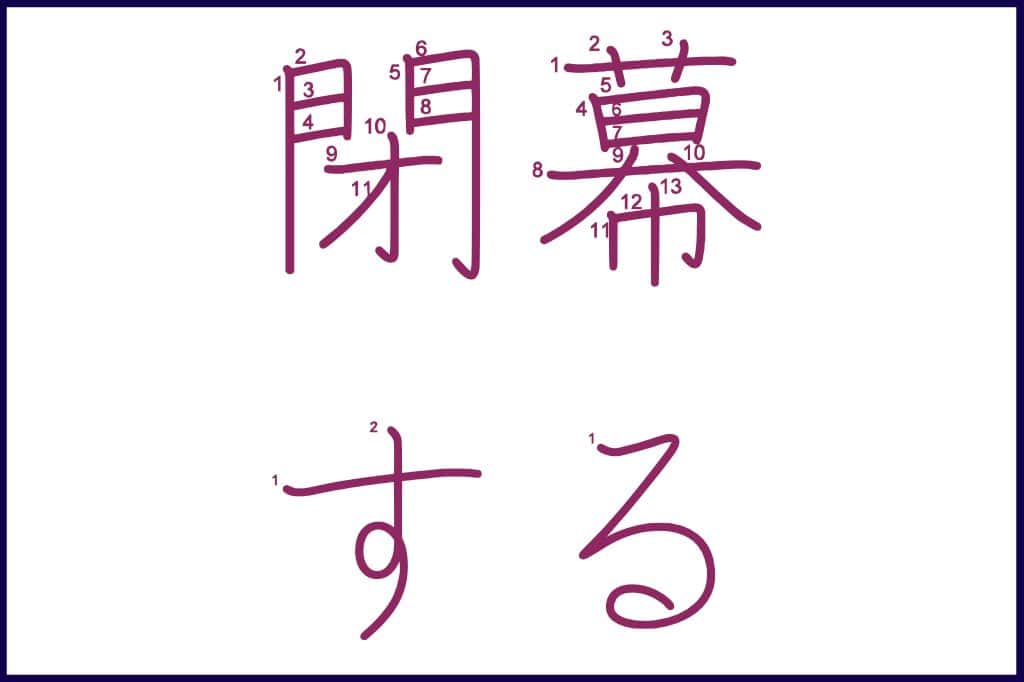
閉幕する (へいまく する, heimaku suru) means “to draw the curtain on” or “to come to an end.” It’s the suru-verb form of 閉幕 (へいまく, heimaku), which refers to a formal closing. The verb adds a refined, graceful nuance and is used when events, festivals, or performances finish in an official, ceremonial way.
閉幕する
へいまく する
heimaku suru
to come to an end
In this post, you will discover the full meaning and all translations of 閉幕する (へいまく する, heimaku suru). I will show you how this verb is used to describe the official or ceremonial closing of events, performances, and festivals, and provide plenty of example sentences so you can use it naturally and confidently like a native speaker in formal contexts.
閉幕する Means “to Come to an End” in Japanese
Word: 閉幕する
Kana: へいまくする
Romaji: heimaku suru
Meaning: to come to an end
Type: noun
Class: common, JLPT N4
Formality: neutral, general use
1. English Translations of 閉幕する
| 閉幕する |
|---|
| 閉幕 → 閉幕する |
| [nounする] the curtain falls, to draw the curtain on, to close the curtain on, to bring down the curtain on to come to an end, to come to a close |
2. Japanese Meaning of 閉幕する
閉幕する (へいまく する, heimaku suru) means “to draw the curtain on,” “to close the curtain on,” or “to come to an end.”
It is formed by combining the noun 閉幕 (へいまく, heimaku) with the verb する (suru, “to do”), turning it into a suru verb.
閉幕する (へいまく する, heimaku suru) is used to describe the official, ceremonial ending of an event, such as a festival, concert, exhibition, competition, or large-scale project.
The nuance is dignified and intentional, similar to saying “to conclude” or “to formally wrap up” in English, rather than simply “to end.”
Grammatically, 閉幕する is an intransitive verb, and the event itself is marked with が.
3. How to Use 最後 in a Sentence
- (sentence) が閉幕する。
- (sentence) が閉幕しました。
Example Sentences
| BMSG FES 25が閉幕しました。 |
|---|
| BMSG フェス にじゅうご が へいまく しました。 |
| BMSG FES 25 has come to an end. The curtain has fallen on BMSG FES 25. The curtain has closed on BMSG FES 25. |
| BMSG fesu nijyuugo ga heimaku shimashita. |
| Free Lesson: J-Pop Stars #5 (SKY-HI) |
More examples will be added in the future…