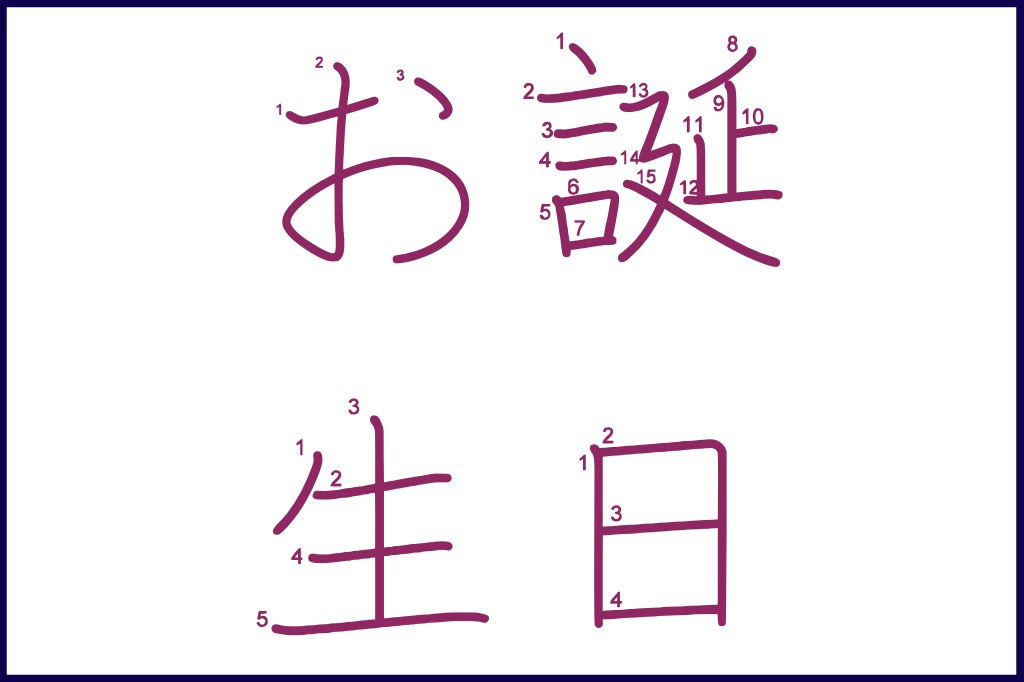
お誕生日 (おたんじょうび, otanjoubi) means “(your) honorable birthday.” It combines the honorific prefix お (o) with 誕生日 (たんじょうび, tanjoubi). This respectful form is used when referring to someone else’s birthday. The plain form 誕生日 is used for oneself or in casual contexts and is taught at the JLPT N5 level.
お誕生日
おたんじょうび
o-tanjoubi
(your) honorable birthday
In this post, you will find all the translations and meanings of お誕生日 (おたんじょうび, otanjoubi) and learn how to use this honorific phrase in real-life situations. I’ll share many example sentences so you can confidently talk about birthdays and celebrate someone else’s special day, just like a native speaker.
お誕生日 Means “(Your) Honorable Birthday” in Japanese
Word: お誕生日
Kana: おたんじょうび
Romaji: o-tanjoubi
Meaning: (your) birthday
Type: noun (honorific)
Class: common, JLPT N5
Formality: polite language (teineigo)
1. English Translations of お誕生日
| お誕生日 |
|---|
| 誕生日 → お誕生日 |
| [noun (honorific)] birthday, (your) honorable birthday |
2. Japanese Meaning of お誕生日
お誕生日 (おたんじょうび, o-tanjoubi) means “birthday” or more accurately “(your) honorable birthday.”
It’s a polite and respectful way to refer to someone else’s birthday.
The word is made of two parts: the honorific prefix お (o), which adds politeness and courtesy, and 誕生日 (たんじょうび, tanjoubi), the standard Japanese word for “birthday.”
Using the honorific prefix in front of nouns doesn’t change the meaning. It simply makes the word or expression more refined and considerate.
Since お (o) adds respect toward the listener or another person, it’s normally used when talking about someone else’s birthday not your own.
The neutral, everyday way to say “birthday” in Japanese is 誕生日 (たんじょうび, tanjoubi). This form can be used when referring to your own birthday and other casual contexts.
Like with other nouns, お誕生日 can take either the polite copula です (desu) or the casual copula だ (da). Using です makes your sentence sound more formal, polite, or respectful. Using だ sounds more casual, direct, and natural in everyday conversation with close friends and family.
- Formal situations: お誕生日です
- Casual situations: お誕生日だ
3. How to Use お誕生日 in a Sentence
- お誕生日おめでとう!
- お誕生日おめでとうございます!
- (sentence) お誕生日だ。
- (sentence) お誕生日です。
Example Sentences
| お誕生日おめでとう🎉🎂🎁 |
|---|
| おたんじょうび おめでとう🎉🎂🎁 |
| Happy birthday! 🎉🎂🎁 Congratulations on (your) birthday! 🎉🎂🎁 |
| O-tanjoubi omedetou 🎉🎂🎁 |
| Free Lesson: J-Pop Stars #3 (JO1, Ruki) |
| 本当にお誕生日おめでとうございます。 |
|---|
| ほんとう に おたんじょうび おめでとう ございます |
| A very happy birthday to you. Wishing you a very happy birthday. |
| Hontou ni o-tanjoubi omedetou gozaimasu. |
| STARGLOW (Adam) |
More examples will be added in the future…