
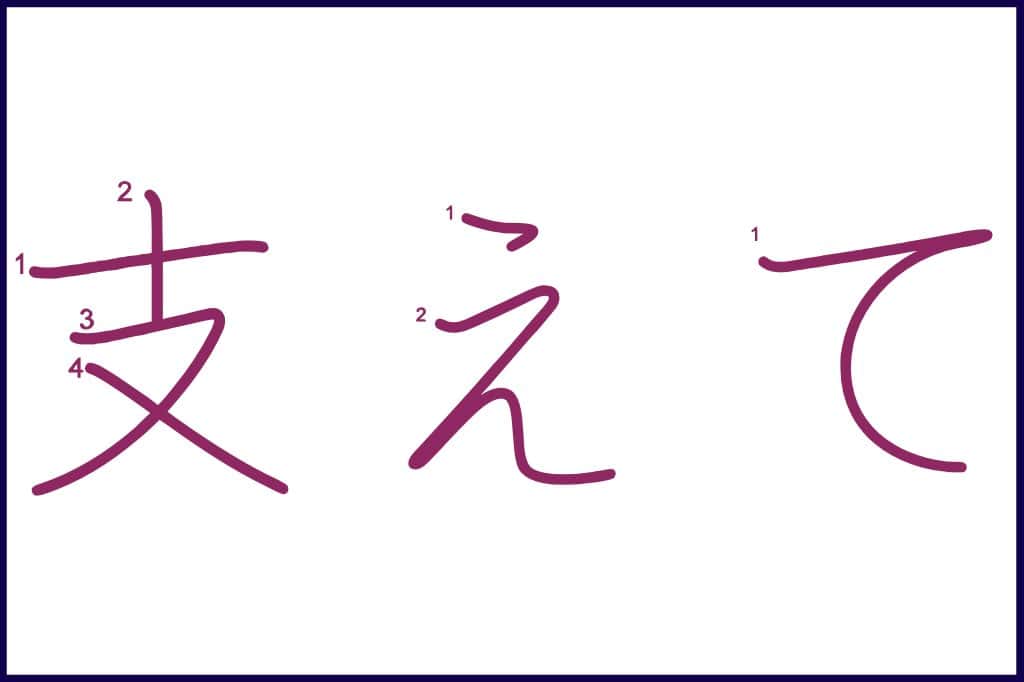
支えて (ささえて, sasaete) means “support (and) …” or “Support (me/it)!“. It’s the te-form of the verb 支える (ささえる, sasaeru), meaning “to support”. It’s used to describe physical or emotional support, and to connect this action to what follows or to function as a command. It’s taught at the JLPT N3 level.
支えて
ささえて
sasaete
support (and) …, Support (me/it)!
In this post, you will learn the full meaning and common translations for 支えて (ささえて, sasete) and see how the verb in its te-form is used in real Japanese sentences to describe physical support, emotional encouragement, and ongoing help. I will provide plenty of examples to help you use the Japanese word 支えて naturally in your speaking and writing, just like a native speaker.
支えて Means “Support (and) …” or “Support (me/it)!” in Japanese
Word: 支えて
Kana: ささえて
Romaji: sasaete
Meaning: support (and) …, Support (me/it)!
Type: verb (te-form)
Class: common, JLPT N3
Formality: neutral, general use
Dictionary Form: 支える (ささえる, sasaeru, “to support”)
1. English Translations of 支えて
| 支えて |
|---|
| 支える → 支えて |
| [verb (te-form)] support (and) …, sustain (and) …, help (and) …, prob (and) …, underlay (and) …, hold someone up (and) …, defend (and) … |
2. Japanese Meaning of 支えて
支えて (ささえて, sasaete) means “support (and) …“, “help (and) …“, or “Support (me/it)!“.
This Japanese word is the te-form of the verb 支える (ささえる, sasaeru, “to support”).
- 支える (dictionary form)
- 支えた (past tense 〜た)
- 支えて (te-form 〜て)
支えて can refer to physical support, such as holding something up or keeping it steady.
However, in modern Japanese, it is most often used metaphorically, to express emotional support, mental encouragement, or standing by someone during difficult times.
As a te-form, which is one of the most important verb forms in Japanese, 支えて works like a hook.
It connects the action of supporting to another action, verb, or grammatical pattern, allowing the sentence to continue smoothly.
Since the te-form has so many functions, it doesn’t have a fixed English translation.
You can loosely think of it as meaning “support (and) …” or “by supporting“, with the full meaning and translation depending on what follows.
When the te-form appears at the end of a sentence, it can also function as a command, meaning “Support (me)!” or “Hold (it)!“.
Simple Conjugation Table of 支えて
| 支えて | Japanese | Reading | Meaning |
|---|---|---|---|
| Present | 支える | ささえる, sasaeru | support |
| Te-Form | 支えて | ささえて, sasaete | support (and) …, Support (me/it)! |
| Past Tense | 支えた | ささえた, sasaeta | supported, has support |
3. How to Use 支えて in a Sentence
- (sentence) 支えて!
- (noun) を支えて (sentence)。
- (sentence) 支えて (helper verb)。
Example Sentences
| いつも支えてくれてありがとう |
|---|
| いつも ささえて くれて ありがとう |
| Thanks for always supporting me. Thanks for your constant support. |
| Itsumo sasaete kurete arigatou. |
| Free Lesson: J-Pop Stars #6 (Chanmina, ちゃんみな) |
More examples will be added in the future…