
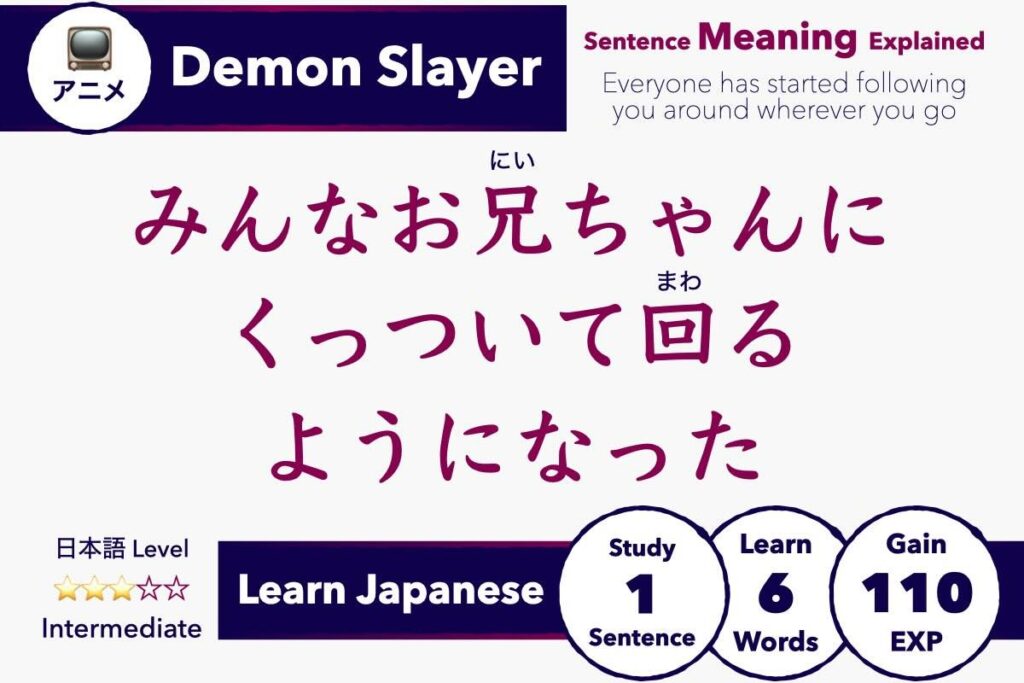
Just as Tanjiro sets off to sell charcoal in town, Nezuko fondly tells him 『みんなお兄ちゃんにくっついて回るようになった』. But what does her gentle remark in Demon Slayer (Kimetsu no Yaiba) actually mean? In this sentence breakdown, I’ll explain the meaning and help you understand every word.
Demon Slayer
みんなお兄ちゃんにくっついて回るようになった
Meaning: Everyone has started following you around wherever you go
Romaji: Minna o-nii-chan ni kuttsuite mawaru you ni natta
What sounds like a simple observation actually carries a quiet emotional weight. By pairing 『くっついて (kuttsuite)』 and 『回る (mawaru)』 with the change-of-state pattern 『ようになった (you ni natta)』, Nezuko gently shows how much their younger siblings depend on Tanjiro.
Meaning | Vocab | Translation | Usage
Demon Slayer: Sentence Meaning & Scene Context
みんなお兄ちゃんにくっついて回るようになった
みんな おにいちゃん に くっついて まわる ように なった
Minna o-nii-chan ni kuttsuite mawaru you ni natta
Credit Attribution
- Sentence from Demon Slayer: Kimetsu no Yaiba (© Koyoharu Gotouge / Shueisha)
- Audio file generated with VOICEVOX:四国めたん
Meaning: Nezuko tells Tanjiro that everyone has started sticking close to him wherever he goes. She says it lightly, like a fond observation, but it hints at how much the family now leans on their big brother. There’s warmth in her words, and a quiet sense of how much he means to them.
Scene: Tanjiro waves goodbye to his family and is walking off with a basket of charcoal on his back. Nezuko approaches him while carrying their youngest brother, Rokuta, and explains that he misses their father. She says this line fondly before seeing Tanjiro off with a warm smile.
Vocabulary & Grammar
| Word | Reading | Meaning | Notes |
|---|---|---|---|
| みんな | minna | everyone, all | Refers to all the younger siblings in the Kamado family. |
| お兄ちゃん | おにいちゃん o-nii-chan | big brother, older brother (affectionate but respectful) | Nezuko uses this affectionate family title instead of 「you」. |
| に | ni | to, onto (target marker) | Marks Tanjiro as the target everyone clings to. |
| くっつく | kuttsuku | to stick, to cling, to stay close | Appears here in the te-form: 『くっついて (kuttsuite)』. |
| 回る | まわる mawaru | to go around, to revolve around, to orbit | Paired with the te-form, it means doing an action continuously as you move around. |
| ようになる | you ni naru | to come to, to start to, to reach the point of | Appears here in the past tense: 『ようになった (you ni natta)』. |
Kanji:
兄(あに)
回(まわ.る)
1. みんな (minna)
- Type: Noun
- Reading: みんな
- Meaning: everyone, all
『みんな (minna)』 acts as the subject, with the particle 「が (ga)」 dropped, which is standard in warm, everyday spoken Japanese. It’s a warm word that bundles people into one group, so it feels affectionate rather than formal. Nezuko chooses it because she’s describing the whole family at once rather than pointing out any single person.
2. お兄ちゃん (o-nii-chan)
- Type: Noun
- Reading: おにいちゃん
- Meaning: big brother, older brother (affectionate but respectful)
Nezuko uses 『お兄ちゃん (o-nii-chan)』, meaning 「big brother」, to refer to Tanjiro by his family role instead of 「you」. The polite prefix 『お (o)』 and affectionate suffix 『ちゃん (chan)』 give the word a warm, endearing feel, reflecting their close sibling bond. This wording shows how Nezuko sees Tanjiro as her beloved big brother.
Nuance Note: Tanjiro calls himself 「兄ちゃん (nii-chan)」 in his vow to save Nezuko, and Shigeru uses it in this same scene. Adding the 『お (o)』 prefix sounds more respectful, while dropping it sounds rougher and more direct.
3. に (ni)
Nezuko’s Sentence: お兄ちゃんに (o-nii-chan + ni)
Target Particle: に
- Pattern: [person or place] + に
- Translates as: to, toward, onto
- Function: marks the target or destination of an action
『に (ni)』 marks Tanjiro as the one everyone sticks to, setting up the verb that follows. Verbs about sticking, following, and gathering often take 『に』, so it gives the line a sense of people drawing in around one person. Nezuko’s choice keeps Tanjiro as the clear centre of everyone’s attention.
4. くっつく|くっついて (kuttsuite)
- Type: Verb
- Reading: くっつく
- Meaning: to stick, to cling, to stay close
Nezuko’s Sentence: くっつく → くっついて (kuttsuku → kuttsuite)
Te-Form: Vて
- Pattern: [verb]て
- Translates as: …and…, …and then…
- Function: connects an action verb to a subsequent verb
Here 『くっつく (kuttsuku)』 takes its te-form 『くっついて (kuttsuite)』 so it can link straight into 『回る (mawaru)』. It’s a casual, physical word used for things that stick together, like magnets or tape, so it makes the siblings sound glued to Tanjiro in a cute, playful way. Nezuko picks it over a plainer word like 「ついていく (tsuite iku)」 because it shows how tightly they hang on.
5. 回る (mawaru)
- Type: Verb
- Reading: まわる
- Meaning: to go around, to revolve around, to orbit
『回る (mawaru)』 follows 『くっついて (kuttsuite)』 and adds the idea of going around, so the pair means sticking to someone as they move about. On its own, it means 「to turn」, but after a te-form verb it gives a feeling of doing something in many places. Nezuko includes it to show that the clinging isn’t a one-off, since the younger siblings follow Tanjiro wherever he goes.
6. ようになる|ようになった (you ni natta)
- Type: Expression
- Reading: ようになる
- Meaning: to come to, to start to, to reach the point of
Nezuko’s Sentence: ようになる → ようになった (you ni naru → you ni natta)
Change-of-State Pattern: ようになる
- Pattern: [verb in plain form] + ようになる
- Translates as: come to…, start to…, have reached the point of…
- Function: shows that a habit or situation has gradually changed
『ようになった (you ni natta)』 turns the clinging into a habit that has developed over time, and the past tense 『なった (natta)』 says the change has already happened. It adds a quiet sense of 「lately」, so the line sounds like a fond observation rather than a plain description. Nezuko uses it to share something she’s noticed about how things at home have shifted.
Now Try Building Your Own Sentences
Pattern
[verb in dictionary form] ようになった
Romaji: _____ you ni natta
Meaning: (I) have started [doing action].
| Word Swap | New Sentence | Meaning |
|---|---|---|
| 笑う warau to laugh | 笑うようになった Warau you ni natta | I’ve started laughing. |
| 話す hanasu to speak | 話すようになった Hanasu you ni natta | I’ve started speaking. |
| 信じる shinjiru to believe | 信じるようになった Shinjiru you ni natta | I’ve started believing. |
| 手伝う tetsudau to help | 手伝うようになった Tetsudau you ni natta | I’ve started helping out. |
| 勉強する benkyou suru to study | 勉強するようになった Benkyou suru you ni natta | I’ve started studying. |
Grammar:
に
て-form
ようになる
English Translations
| English | Translation Notes & Cultural Nuance |
|---|---|
| LITERAL TRANSLATIONS | |
| Everyone came to follow big brother around. | Keeps Nezuko referring to Tanjiro by his family title 『お兄ちゃん』 while rendering 『ようになった』 directly as a past change of state. |
| Everyone came to stick close to big brother and follow (him) around. | Preserves Nezuko’s third-person perspective and reflects both physical actions in the compound verb 『くっついて回る』. |
| NATURAL TRANSLATIONS | |
| Everyone has started following you around. | Swaps 「Big Brother」 for 「you」 to sound natural in conversational English while keeping the change-of-state feeling in 「started」. |
| Everyone has started following you around wherever you go. | Combines the change of habit in 『ようになった』 with the going-around feel of 『回る』. |
| Everyone has started clinging to you and following you around. | Brings out the affectionate, attached quality of 『くっついて (kuttsuite)』 alongside the continuous movement of 『回る (mawaru)』. |
| Everyone has started sticking to you like glue these days. | Captures the vivid, tactile image of 『くっついて』 using a natural English idiom while reflecting the recent shift in family routine. |
| Everyone has started to stick to you and follow you around like a shadow. | Expresses both the close physical attachment of 『くっついて』 and the constant motion from place to place implied by 『回る』. |
My Preferred Translation: 「Everyone has started following you around wherever you go」 captures Nezuko’s delivery best. It perfectly reflects the gradual shift in routine from 『ようになった (you ni natta)』 and the physical attachment of 『くっついて回る (kuttsuite mawaru)』
If you want a more natural and looser translation, 「Everyone has started sticking to you like glue these days」 is a great choice that trades literal phrasing for vivid everyday warmth, smoothly converting her third-person use of 『お兄ちゃん (o-nii-chan)』 into natural English dialogue.
Usage & Nuance
みんなお兄ちゃんにくっついて回るようになった
Casual
○●○○○
Polite
Masculine
○○●○○
Feminine
Composed
○●○○○
Emotional
Soft-Spoken
●○○○○
Determined
Can You Say This in Everyday Life? Nezuko’s line is completely natural spoken Japanese that you can use with close friends and family. However, because it uses the plain past tense 『なった (natta)』 and the affectionate family title 『お兄ちゃん (o-nii-chan)』, you only need to make minor polite tweaks depending on who you are talking to:
1. In Casual Conversations
みんなお兄ちゃんにくっついて回るようになったよね
- Romaji: Minna o-nii-chan ni kuttsuite mawaru you ni natta yo ne
- Meaning: Everyone has started following you around wherever you go, haven’t they?
Adding 「よね (yo ne)」 at the end makes it a warm, chatty observation. Use it with friends or family you’re close to.
2. In Polite Situations
皆さんがあの方について回るようになりましたね
- Romaji: Mina-san ga ano kata ni tsuite mawaru you ni narimashita ne
- Meaning: Everyone has started following that person around, haven’t they?
Swaps in 「皆さん (mina-san)」, 「あの方 (ano kata)」 and 「なりました (narimashita)」 for a courteous tone, and 「ついて (tsuite)」 replaces the cuter 『くっついて (kuttsuite)』. Use it with coworkers, neighbours, or anyone you don’t know well.
Learn More Japanese
And that is 『みんなお兄ちゃんにくっついて回るようになった』! Every word, from the physical image of 『くっついて回る』 to the change-of-state pattern 『ようになった』, hints at how much of an anchor Tanjiro has become for his family in Demon Slayer.
Once 『ようになる』 clicks, you can describe your own progress too, like 「日本語が話せるようになった (nihongo ga hanaseru you ni natta)」, meaning 「I’ve become able to speak Japanese」. It’s one of the most useful ways to talk about change in everyday Japanese.
Until next time, keep your ears open for the next Demon Slayer line!
それじゃ、またね〜
Alex