
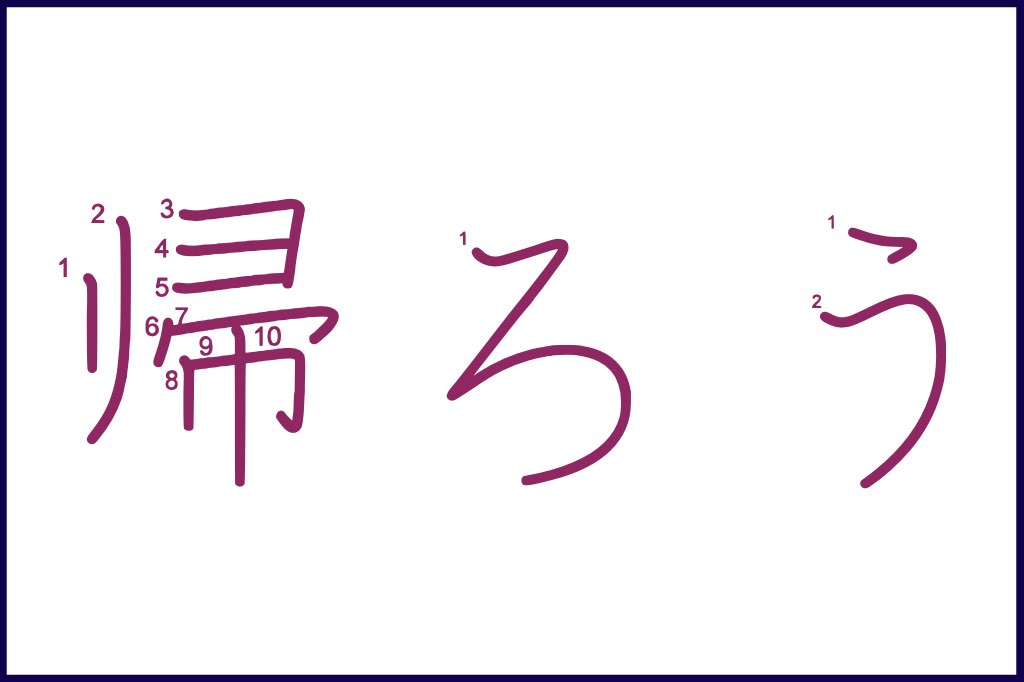
帰ろう (かえろう, kaerou) means “let’s go home” or “let’s return“. It’s the casual volitional form of the verb 帰る (かえる, kaeru, “to go home”) and used to express the speaker’s intention or make a gentle suggestion. It sounds friendly and is common in everyday conversations with friends or family.
帰ろう
かえろう
let’s go home, let’s return
In this post, you will learn the full meaning and usage of the Japanese word 帰ろう (かえろう, kaerou). I will explain how this common verb is used in its volitional form in everyday Japanese to suggest returning or going home. With plenty of example sentences, you will soon be able to understand and use 帰ろう naturally and confidently.
帰ろう Means “Let’s Go Home” in Japanese
Word: 帰ろう
Kana: かえろう
Romaji: kaerou
Meaning: let’s go home
Type: verb (volitional form)
Class: common word, JLPT N4
Formality: informal, casual language
Dictionary Form: 帰る (かえる, kaeru, “to go home”)
1. English Translations of 帰ろう
| 帰ろう |
|---|
| 帰る → 帰ろう |
| [verb (volitional)] let’s return, let’s go back, let’s go home |
2. Japanese Meaning of 帰ろう
帰ろう (かえろう, kaerou) means “let’s go home”, “let’s return“, or “let’s go back“. It’s used to express one’s intention to head home or to gently suggest to thers to go back.
It is the casual volitional form of the verb 帰る (かえる, kaeru, “to go home”).
- 帰る (dictionary form)
- 帰ろう (casual volitional form 〜よう)
- 帰ります (polite present tense ~ます)
- 帰りましょう (polite volitional form 〜ましょう)
帰ろう is commonly used in relaxed, everyday conversations with friends, family, or people of the same social level. When you use it, it feels personal, natural, and conversational.
In polite or formal situations, 帰りましょう (かえりましょう) is more appropriate, especially when speaking to seniors, colleagues, or people you don’t know well.
Simple Conjugation Table of 帰ろう
| 帰ろう | Japanese | Reading | Meaning |
|---|---|---|---|
| Present | 帰る かえる | kaeru | to go home |
| Volitional | 帰ろう かえろう | kaerou | let’s go home |
| Polite Present | 帰ります かえります | kaerimasu | go home (polite) |
| Polite Volitional | 帰りましょう かえりましょう | kaerimashou | Shall we go home?, let’s go home (polite) |
Volitional Form ~よう
The volitional form 〜よう is often used when the speaker wants to do something together with someone else, or when softly proposing an action rather than giving a command.
帰る → 帰ろう
帰る (かえる, kaeru) is a godan verb (u-verb) so its casual volitional is formed by shifting its last syllable (る) to its corresponding o-row syllable (ろ) and adding う.
- 帰る (dictinary form)
- Shift る → ろ
- Add う
- 帰ろう (volitional form)
3. How to Use 帰ろう in a Sentence
- (place)に 帰ろう。
- (person)と 帰ろう。
- (sentence) 帰ろう。
Example Sentences
| そろそろ帰ろう |
|---|
| そろそろ かえろう |
| It’s about time to go home. |
| Soro soro kaerou |
| Free Lesson: Anime #2 (Attack on Titan, Mikasa) |
More examples will be added in the future…