
Are you a DXTEEN fan who wants to learn Japanese with J-Pop stars you love? In Lesson 7, I translate a real Japanese sentence from Ken, explaining the words and grammar step by step. My beginner-friendly lesson series will help you understand Japanese posts, captions, and messages from DXTEEN members and other J-Pop idols in no time.
昨日岡山できびだんご食べた🤓
By the end of this lesson, you will be able to read and fully understand the Japanese words and grammar Ken uses here. This innovative, fan-focused learning style is perfect for international NICO and all J-Pop fans who want to level up their Japanese skills and communicate with their favourite J-pop stars in Japanese.
So let’s start learning Japanese with the DXTEEN members!
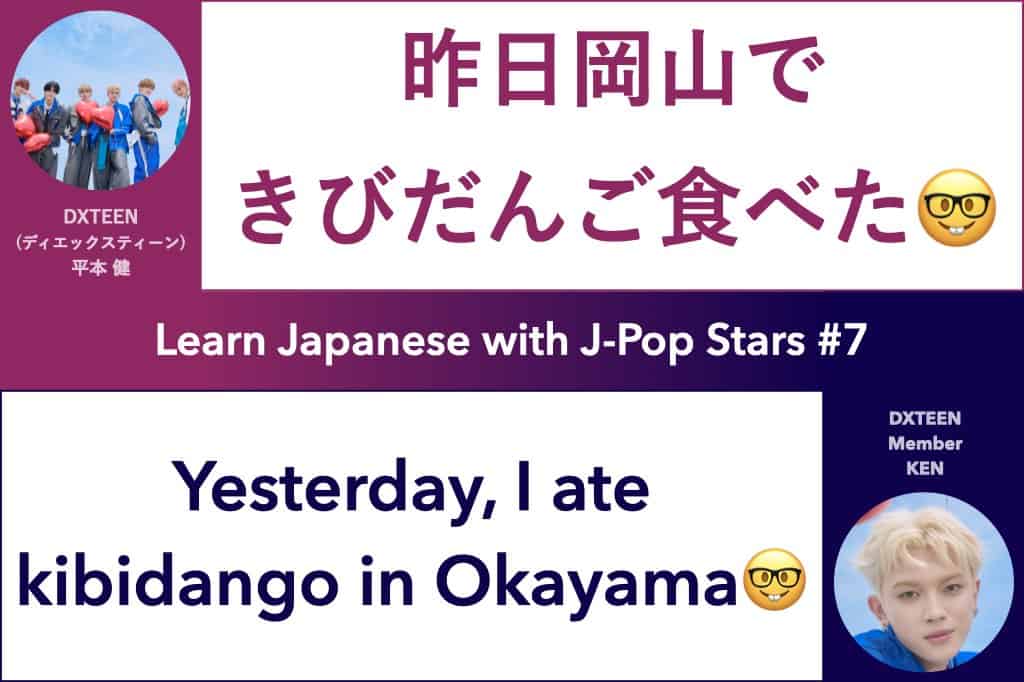
Learn Japanese with J-Pop Stars #7 (DXTEEN, Ken)
⏳ Study Time: 5-10 min
How to study Japanese by yourself:
- Read a Japanese sentence aloud
- Break down its words and meanings
- Review and level up your Japanese skills
Step 1) Learn to Read Japanese Sentences and Kanji
日本語
昨日岡山できびだんご食べた🤓
1.1 漢字 (Kanji)
昨日 岡山 で きびだんご 食べた🤓
1.2 カナ (Kana)
- 昨日 (きのう)
- 岡山 (おかやま)
- で
- きびだんご
- 食べた (たべた)
1.3 ローマ字 (Romaji)
- 昨日 (kinou)
きのう - 岡山 (Okayama)
おかやま - で (de)
- きびだんご (kibidango)
- 食べた (tabeta)
たべた
Step 2) Study Japanese Words and Their Meanings
English Translation
- Ate kibidango yesterday in Okayama 🤓
- Had kibidango in Okayama yesterday 🤓
- I ate kibidango in Okayama yesterday 🤓
- Yesterday, I ate kibidango in Okayama 🤓
- I had kibidango in Okayama yesterday 🤓
- Yesterday in Okayama, I ate kibidango 🤓
2.1 昨日 (きのう, kinou)
- Word: 昨日
- Reading: きのう
- Word Type: noun, adverb
- Word Class: common, JLPT N5
- Word Formality: neutral, general use
| 昨日 |
|---|
| [noun, adverb] yesterday |
昨日 (きのう, kinou) means “yesterday” in Japanese.
It is a time noun used to refer to the day before today and is one of the most common Japanese words you will encounter when talking about past events in everyday Japanese.
Just like “yesterday” in English, 昨日 does not require a preposition. You simply place it directly in the sentence, sometimes followed by a comma.
昨日 usually appears at the start of a sentence, but it can also be placed before the verb to add emphasis or to keep the flow natural.
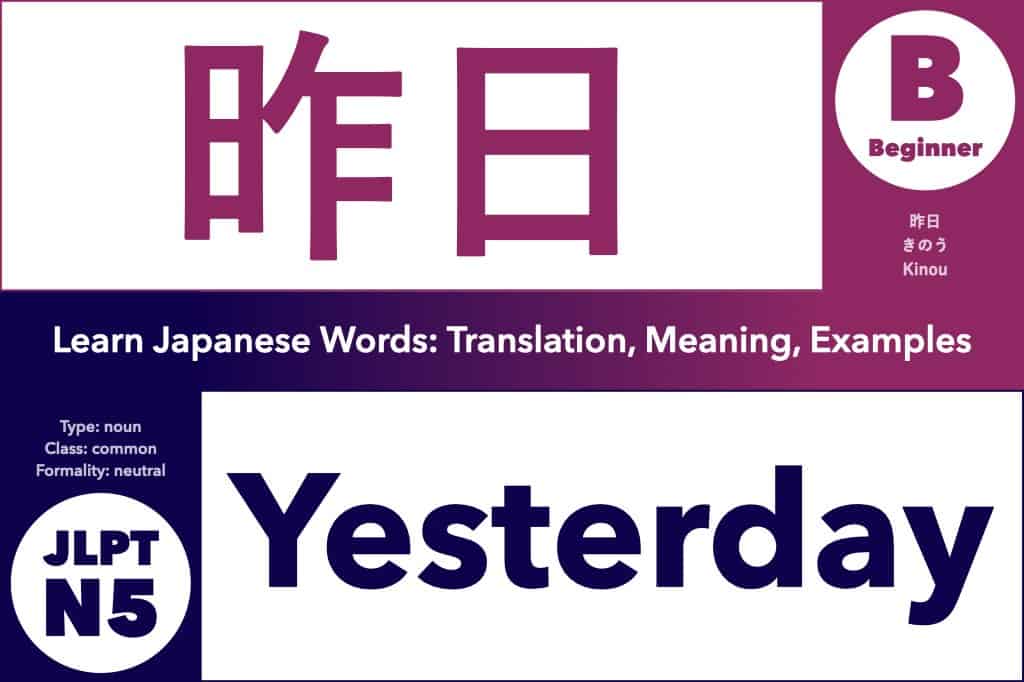
2.2 岡山 (おかやま, Okayama)
- Word: 岡山
- Reading: おかやま
- Word Type: proper noun
- Word Class: city/prefecture name
- Word Formality: neutral, general use
| 岡山 |
|---|
| [proper noun] Okayama name of a city and prefecture in western Japan |
岡山 (おかやま, Okayama) is a proper noun that refers to “Okayama“, a city and prefecture in western Japan.
Okayama is famous for Okayama Castle, Korakuen Garden, and its mild climate. Known as the “Land of Sunshine”, it is a popular spot for sightseeing, cultural experiences, and sampling local cuisine, such as kibidango (きびだんご).
The city is located about 1.5 hours from Ken’s hometown in Hyogo Prefecture.
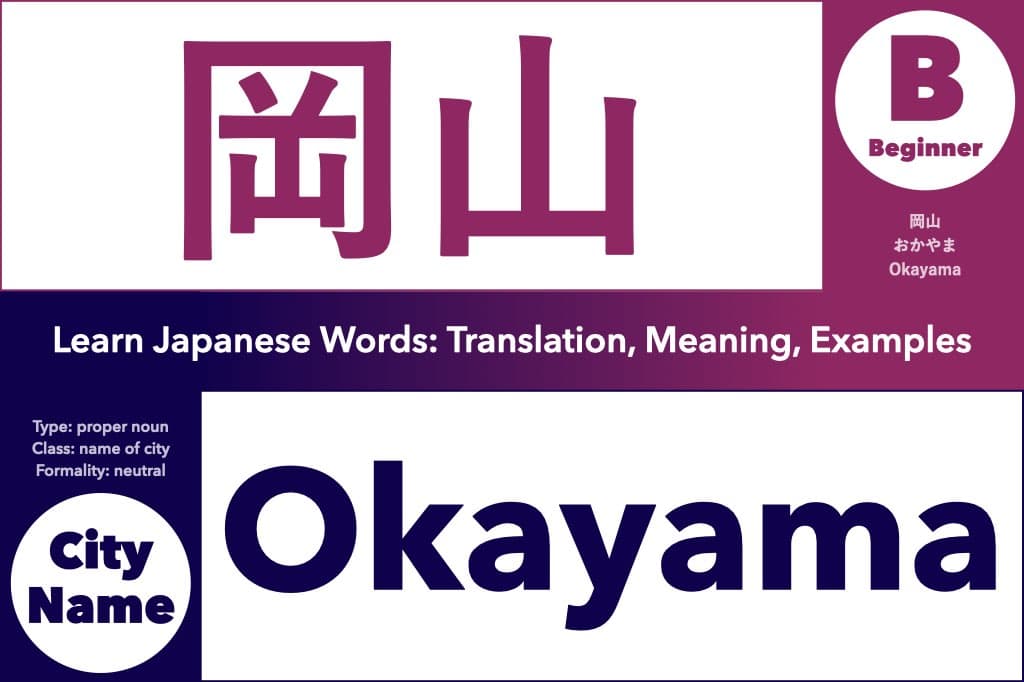
2.3 で (de)
- Word: で
- Word Type: particle
- Word Class: common, JLPT N3
- Word Formality: neutral, general use
| で |
|---|
| [particle] at, in marks the location where an action happens |
The particle で (de) marks the location where an action happens and can be translated as “at” or “in“.
It is another very essential particle with several different functions, used to describe the setting or method of an action. Most commonly, で marks the place where something occurs.
Because で has multiple functions, it does not have one fixed English translation. Instead, its meaning depends on what comes before it and the verb that follows.
In our example sentence from DXTEEN‘s Ken, the particle で clearly marks the city where the action of eating took place.
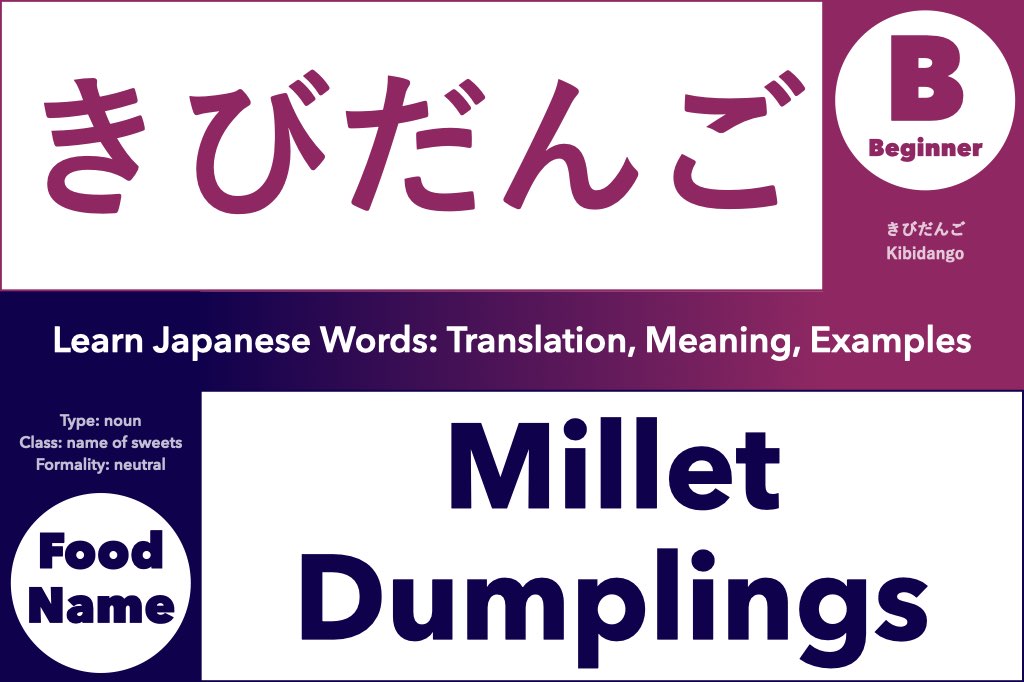
2.4 きびだんご (kibidango)
- Word: きびだんご
- Word Type: noun
- Word Class: food name
- Word Formality: neutral, general use
| きびだんご |
|---|
| [noun] kibidango name of Japanese food sweet dumpling made from millet flour and sugar (famous product of Okayama) |
きびだんご (kibidango) is a noun that refers to “kibidango“, a traditional Japanese sweet.
Kibidango are soft, small dumplings made from millet flour and sugar.
They are famous in Okayama Prefecture and are often linked to Japanese folklore, especially the story of Momotaro, the “Peach Boy”, who gives kibidango to his animal companions.
One of my coworkers is also from Okayama Prefecture, and she always brings kibidango as a souvenir (お土産, omiyage).
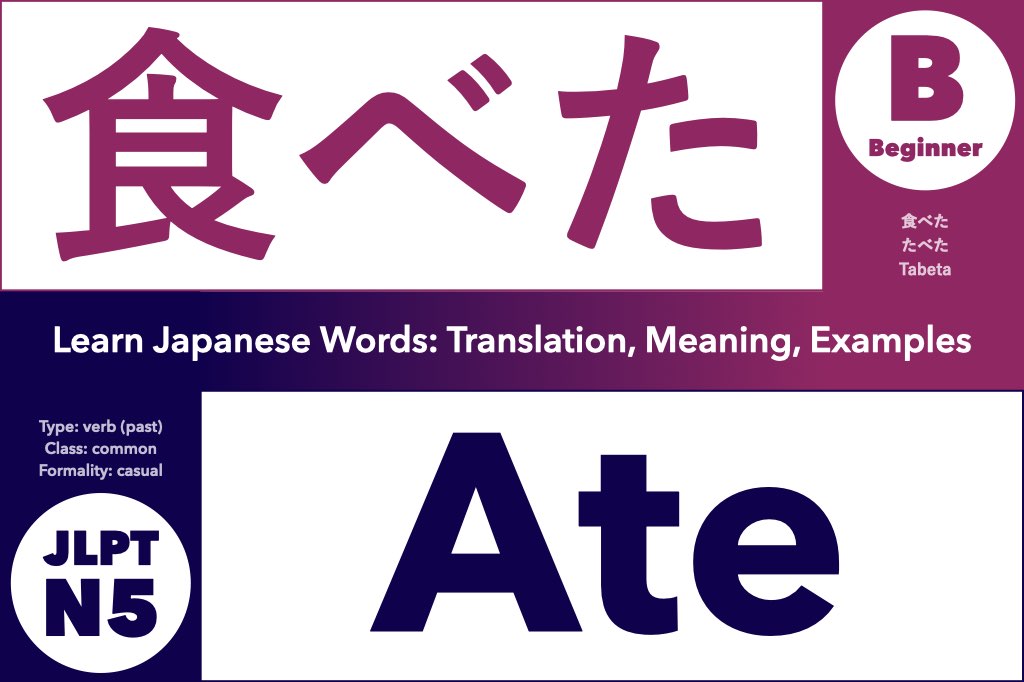
2.5 食べた (たべた, tabeta)
- Word: 食べた
- Reading: たべた
- Word Type: verb (past)
- Word Class: common, JLPT N5
- Word Formality: informal, casual form
| 食べた |
|---|
| 食べる → 食べた |
| [verb (past tense)] ate, had (food), have eaten |
食べた (たべた, tabeta) means “ate“, “had (food)“, or “have eaten“.
It is the plain past tense form of the verb 食べる (たべる, taberu, “to eat”).
- 食べる (dictionary form)
- 食べた (past tense 〜た)
- 食べます (polite present ~ます)
- 食べました (polite past ~ました)
食べた is used to describe that someone has eaten something. It is casual and often used in conversations among friends, family, or in informal writing.
昨日岡山できびだんご食べた🤓
With this sentence, Ken (DXTEEN) is just casually sharing with his fans that he ate kibidango in Okayama yesterday. His tone is friendly and relaxed, using plain past tense to make it feel like he’s speaking directly to his followers in a casual, personal way.
Step 3) Review and Improve Your Japanese
How to learn Japanese fast:
- Review sentences and words regularly
- Listen, read, speak, and write in Japanese
- Continue to the next sentence and repeat
3.1 Review & Remember Japanese With Flashcards
Create Sentence Flashcard for:
- 昨日岡山できびだんご食べた🤓
Create Word Flashcards for:
- 昨日
- 岡山
- で
- きびだんご
- 食べた
Examples
Front: Japanese sentence/word written in kanji
Back: Kana, translations, any other information
| My Sentence Flashcard |
|---|
| Front: 昨日岡山できびだんご食べた🤓 |
| Back: 昨日 (きのう) 岡山 (おかやま) できびだんご 食べた (たべた) 🤓 I ate kibidango in Okayama yesterday 🤓 I had kibidango in Okayama yesterday 🤓 Yesterday, I ate kibidango in Okayama 🤓 |
| My Word Flashcard |
|---|
| Front: 食べた |
| Back: 食べた(たべた) ate, had (food), have eaten |
3.2 Practice & Level Up Your Japanese Skills
How to improve your Japanese skills fast:
- Reading: Read Japanese for 5-10 min
- Writing: Write in Japanese for 5-10 min
- Speaking: Speak Japanese for 5-10 min
- Listening: Listen to Japanese for 5-10 min
A) Listening Practice
Listen to this song.
Can you catch the Japanese we learned today?
Source: 田村芽実 〜 無形有形
B) Reading Practice
Read the following sentences.
Can you spot the Japanese we learned today?
- 昨日、みなさんと食べた。
- みなさんはパンを食べた。
- 昨日の夏フェスに来ました。
- 岡山でアイスクリームを食べた。
- 昨日、クリスマスケーキを食べた。
- 昨日のファンミーティングは最後だった。
- 初のきびだんごをありがとうございました。
You can also try to read Ken‘s X post:
C) Speaking Practice
Say the following sentences.
Can you repeat them aloud without looking?
- ハンバーガー 食べた。
- 岡山で ラーメン を 食べた。
- 昨日、最後のきびだんご食べた。
- 美味しい (おいしい) ランチ 食べた。
- 昨日のファンミーティングで 見た (みた)。
- 岡山でDXTEENのみなさん に 会った (あった)。
- カフェ で Kenさん のお誕生日 ケーキ を 食べた。
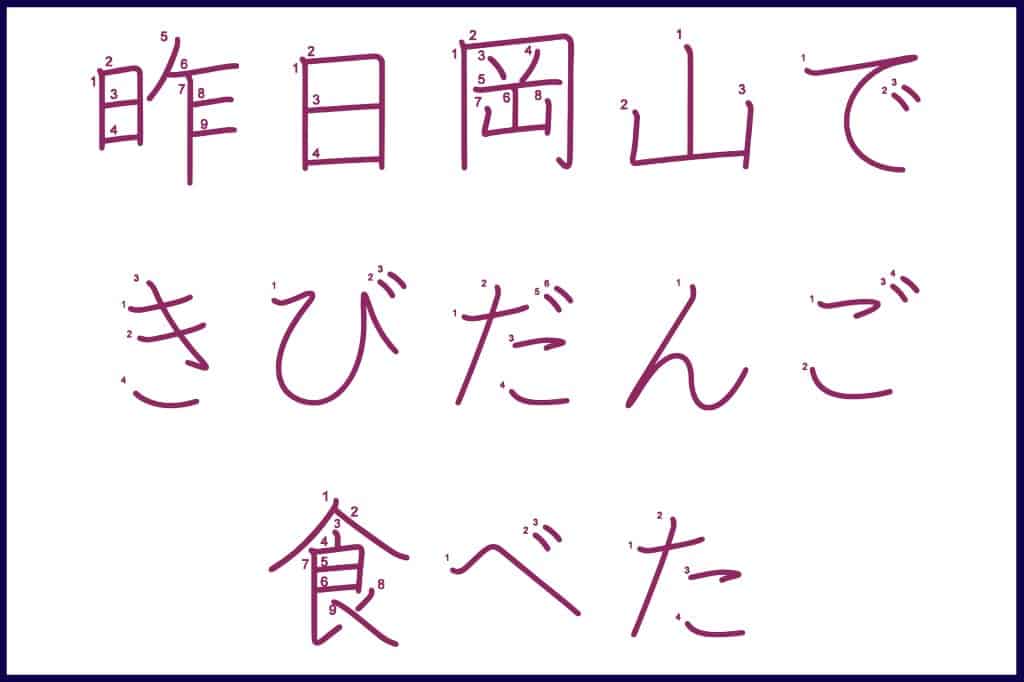
D) Writing Practice
Type (or write down) the words and sentences in Japanese.
3.3 Continue Studying Japanese
You’ve completed Learn Japanese with J-Pop Stars #7 🎉
You’re one step closer to understanding Ken and communicating with the DXTEEN members in Japanese!
- Japanese Words +5
- Japanese Sentences +1
Well done ♪٩(⌒‐⌒)۶♪
| Our Next Goal |
|---|
| Japanese Sentences 7 / 10 |
| Japanese Words 27 / 30 |
| Our Ultimate Goal |
|---|
| Japanese Sentences 7 / 10,000 |
| Japanese Words 27 / 25,000 |
To reach native fluency, our goal is to master 10,000 sentences and 25,000 words.
So let’s keep studying and continue our journey to Japanese fluency!
➡️ Next Lesson: Learn Japanese with J-Pop Stars #8 (coming soon!)
⬅️ Need a quick review? Revisit the previous lesson!
▶️ New here? Start from Lesson 1!
… or keep learning Japanese with one of my other free lessons!
- 📺 Learn Japanese with Anime
Understand anime dialogue without subtitles - 📖 Learn Japanese with Manga
Read your favourite manga written in kanji and kana - 🎵 Learn Japanese with Songs
Understand the meaning behind your favourite lyrics
🎤 Learn Japanese with J-Pop Stars
Learn real Japanese from your favourite stars and idols - 🎮 Learn Japanese with Video Games
Understand game dialogue and the characters you love
For more information about the artists, please visit DXTEEN’s Official Homepage or YouTube Channel.