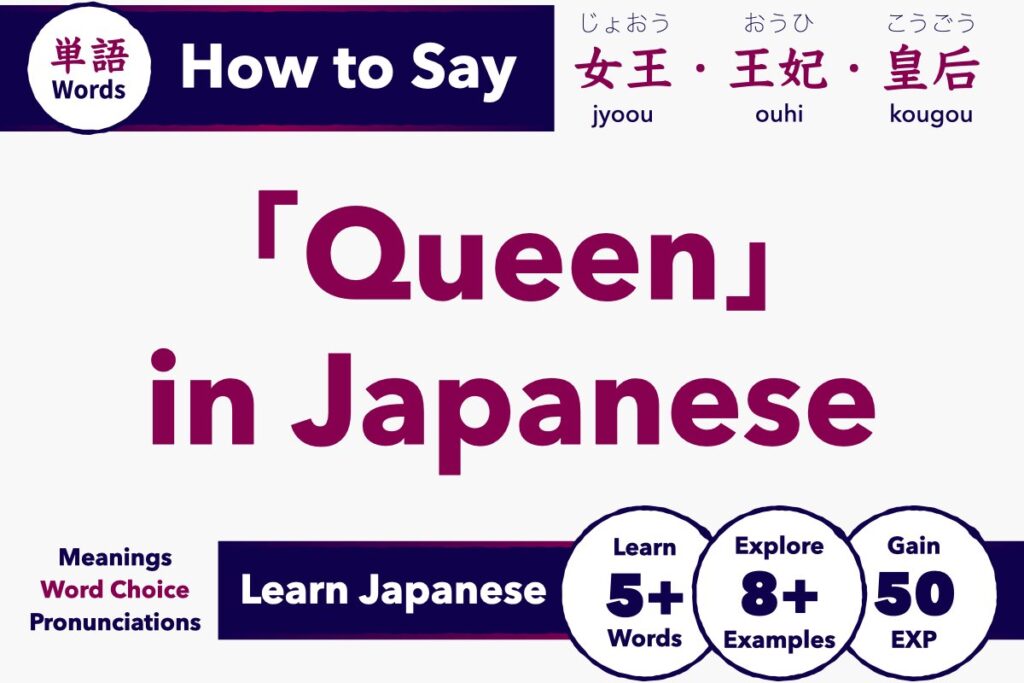
The most common way to say queen in Japanese is 女王 (じょおう, jyoou). If you mean specifically the wife of a king rather than a ruling queen, 王妃 (おうひ, ouhi) is the better choice. You’ll also run into the English loanword クイーン (kuiin) fairly often, especially in games, anime, and pop culture.
- 女王 (じょおう, jyoou)
the standard word for a queen who rules in her own right - 王妃 (おうひ, ouhi)
a queen consort, the wife of a king - クイーン (kuiin)
loanword, common in games and pop culture
Japanese has quite a few words for queen, covering everything from real monarchies to fairy tales. Below, you’ll learn each word’s meaning, pronunciation, kanji, hiragana, and usage, with examples from anime (JoJo’s Bizarre Adventure), games (Final Fantasy), and more.
Credit Attribution
- Audio file generated with VOICEVOX:四国めたん, VOICEVOX:冥鳴ひまり, VOICEVOX:ずんだもん
Common Japanese Words for Queen
| Kanji | Hiragana | Romaji | Meaning |
|---|---|---|---|
| 女王 | じょおう | jyoou | queen (reigning in her own right) |
| 王妃 | おうひ | ouhi | queen (consort, wife of a king) |
| クイーン | くいーん | kuiin | queen (loanword) |
| 皇后 | こうごう | kougou | empress (the Emperor’s wife) |
| 女王陛下 | じょおうへいか | jyoou heika | Her Majesty the Queen |
女王 (じょおう, jyoou) is the Japanese word for queen you’ll encounter and use most often. It’s the standard, everyday word for a ruling queen, and the safest choice when you’re not sure which word to use.
- 女王 (jyoou): Your default word for queen. Use it for a queen who rules in her own right, real or fictional.
- 王妃 (ouhi): Use this for the wife of a king, not a ruler in her own right.
- クイーン (kuiin): The loanword version, common in card games, brand names, and pop culture.
- 皇后 (kougou): Specifically the Japanese Emperor’s wife, the empress.
- 女王陛下 (jyoou heika): The respectful, formal way to refer to “Her Majesty the Queen”.
There are a couple more words, like 后, 皇太后, and 后妃, but you’re unlikely to encounter them in everyday Japanese. Before we get to those, let’s take a closer look at the common words.
女王 (jyoou)
- Kanji: 女王
- Romaji: jyoou
- Hiragana: じょおう
- Meaning: queen (reigning in her own right)
『女王』 is the standard, general word for queen in Japanese. It refers to a queen who rules a kingdom herself, rather than someone who became queen through marriage.
Compared to 「王妃 (ouhi)」, which specifically means the wife of a king, 『女王』 stands entirely on its own and refers to someone who holds the throne in her own right.
You’ll see 『女王』 constantly in history, news, fairy tales, anime, and games alike. It’s used for real monarchs just as much as it is for fictional queens.
Example:
エリザベス女王は長い間イギリスを治めた。
Queen Elizabeth ruled the United Kingdom for a long time.
王妃 (ouhi)
- Kanji: 王妃
- Romaji: ouhi
- Hiragana: おうひ
- Meaning: queen (consort, wife of a king)
『王妃』 specifically means a queen consort, or in other words, the wife of a king rather than a ruler in her own right.
Unlike 「女王 (jyoou)」, which stands on its own as a ruling queen, 『王妃』 always implies she holds her title through marriage.
You’ll mostly encounter the word 『王妃』 in fantasy games, historical dramas, and stories involving royalty.
Example:
私が王妃のジェーンです。
I am Jane, the queen.
— Final Fantasy 1
クイーン (kuiin)
- Kanji: (katakana loanword, no kanji)
- Romaji: kuiin
- Hiragana: くいーん
- Meaning: queen (loanword)
『クイーン』 is the English loanword for queen, and unlike some other borrowed words, it doesn’t come with a hidden double meaning to trip you up.
Compared to the more traditional-sounding 「女王 (jyoou)」, 『クイーン』 carries a modern, stylish feel, the kind of word a brand or a card game reaches for rather than a history book.
You’ll see 『クイーン』 in card games (the queen in a deck of cards), brand names, and pop culture in general. It’s often used as a title or character name rather than the everyday word for an actual ruling queen.
Example:
トランプのクイーンを引いた。
I drew the queen from the deck of cards.
皇后 (kougou)
- Kanji: 皇后
- Romaji: kougou
- Hiragana: こうごう
- Meaning: empress (the Emperor’s wife)
『皇后』 is the Japanese word for empress and refers to the wife of Japan’s Emperor. It’s a real, official title still in use today.
Unlike 「女王 (jyoou)」 or 「王妃 (ouhi)」, which apply to queens generally, 『皇后』 is reserved specifically for Japan’s own Empress, not used for foreign queens or fictional royalty.
『皇后』 is a word you’ll hear whenever Japan’s Imperial Family is mentioned.
Example:
皇后陛下が式典に出席された。
Her Majesty the Empress attended the ceremony.
女王陛下 (jyoou heika)
- Kanji: 女王陛下
- Romaji: jyoou heika
- Hiragana: じょおうへいか
- Meaning: Her Majesty the Queen
『女王陛下』 adds 「陛下 (heika, “Majesty”)」 onto 「女王 (jyoou)」. It’s the respectful, formal way to refer to a reigning queen.
If you compare it to 「女王 (jyoou)」, which works perfectly fine on its own, 『女王陛下』 specifically shows respect, similar to how English uses “Her Majesty” instead of just “the queen” in formal contexts.
When referring to a reigning queen in official speeches, ceremonies, news reports, or other formal writing, this is the expression you’ll hear.
『女王陛下』 appears more often in news coverage and official statements rather than casual conversation. You might also come across it in movies, though.
Example:
女王陛下万歳!
Long live Her Majesty the Queen!
Quick Comparison Chart
| Word | Key Difference |
|---|---|
| 女王 (jyoou) | queen regnant (ruler in her own right) |
| 王妃 (ouhi) | queen consort (married to a king) |
| 皇后 (kougou) | Japan’s empress |
| クイーン (kuiin) | queen (loanword) |
| 女王陛下 (jyoou heika) | Her Majesty |
Less Commonly Used Words for Queen in Japanese
While the words above cover almost every situation, Japanese also has several much rarer, more literary words for queen. You’re unlikely to hear them in everyday conversation, but you might come across them in poetry, novels, or classical writing.
| Kanji | Hiragana | Romaji | Meaning | Usage |
|---|---|---|---|---|
| 后 | きさき | kisaki | queen, empress consort | classical, literary, rare in modern Japanese |
| 皇妃 | こうひ | kouhi | empress consort | literary, carries a foreign or “Chinese period drama” flavor, rarely used for Japan’s own Empress |
| 皇太后 | こうたいごう | koutaigou | Empress Dowager | formal, mother of a reigning Emperor |
| 女皇 | じょこう | jyokou | empress (regnant) | extremely rare in modern Japanese, refers to a woman ruling as sovereign in her own right |
| 后妃 | こうひ | kouhi | queen consort, imperial consort | classical, formal, historical writing |
| 王后 | おうごう | ougou | queen consort | rare in Japanese, closer to Chinese-style usage |
These are all real Japanese words, but you’re very unlikely to need any of them outside classical literature, historical writing, or very specific formal contexts.
Choose the Right Japanese Word for Queen
Still not sure which word to use? The tables below will help. The first shows the best word for specific situations, while the second gives you an idea of how common each word is.
By Situation
| If you’re talking about… | Use… |
|---|---|
| a queen who rules in her own right | 女王 (jyoou) |
| someone who became queen through marriage | 王妃 (ouhi) |
| pop culture, games, or a card game queen | クイーン (kuiin) |
| Japan’s Empress or the wife of Japan’s Emperor | 皇后 (kougou) |
| a queen in a very formal setting | 女王陛下 (jyoou heika) |
By Frequency
| Word | Frequency Rank |
|---|---|
| 女王 (jyoou) | ~3500 |
| 王妃 (ouhi) | ~8000 |
| クイーン (kuiin) | ~17,000 |
| 女王陛下 (jyoou heika) | ~22,000 |
| 皇后 (kougou) | ~26,000 |
| 后 (kisaki) | ~30,000 |
| 皇妃 (kouhi) | ~39,000 |
| 皇太后 (koutaigou) | ~51,000 |
| 女皇 (jyokou) | ~88,000 |
| 后妃 (kouhi) | ~130,000 |
| 王后 (ougou) | ~160,000 |
If you only remember one word from this post, make it 『女王 (じょおう, jyoou)』. It’s by far the most common and the one you’ll use in almost every situation.
For Learning Japanese
If you want to learn Japanese, start with:
① 女王 (じょおう, jyoou)
The default word for any ruling queen, real or fictional.
② 王妃 (おうひ, ouhi)
Common in fantasy games and stories including royal families.
③ クイーン (くいーん, kuiin)
Very common in games, anime, card games, and pop culture.
The remaining words are less common and can be learned naturally as you come across them.
FAQ: My Queen, Queen Bee & Other Phrases
How do you say “my queen” in Japanese? There isn’t one standard Japanese expression. In fantasy or literary works, 我が女王 (わがじょおう, waga jyouou) can mean “my queen”. In everyday Japanese, people usually refer to a queen by her title, such as 女王 (jyoou), 女王様 (jyoou-sama), or 女王陛下 (jyoou heika), depending on the situation.
How do you say “I am the queen” in Japanese? I am the queen is 私が女王です (watashi ga jyoou desu). It uses the same が…です pattern as Queen Jane’s own introduction in Final Fantasy I.
What are king and princess in Japanese? The most common word for king is 王 (ou), while 国王 (kokuou) is the more formal word for a reigning monarch. For princess, Japanese uses 王女 (oujo) for a king’s daughter and 姫 (hime) in fairy tales, historical settings, and other more traditional contexts.
How do you say “king and queen” together in Japanese? King and queen is 王と女王 (ou to jyoou). In more formal contexts, you may also see 国王と女王陛下 (kokuou to jyoou heika).
How do you say “Queen of Hearts” from Alice in Wonderland in Japanese? The Queen of Hearts is ハートの女王 (haato no jyoou).
How do you say “Red Queen” in Japanese? The Red Queen from Through the Looking-Glass is 赤の女王 (aka no jyoou).
Is there a Japanese equivalent for “Ice Queen” or “Snow Queen”? Snow Queen and Ice Queen are usually translated as 雪の女王 (yuki no jyoou). This is also the title used for Disney’s Frozen in Japanese: アナと雪の女王.
How do you say “Queen of Darkness” in Japanese? Queen of Darkness is 暗黒の女王 (ankoku no jyoou), combining 女王 with 暗黒, the dramatic word for darkness often used in fantasy settings.
What about “Killer Queen” from JoJo’s Bizarre Adventure? Killer Queen, the Stand from JoJo’s Bizarre Adventure, is キラークイーン (Kiraa Kuiin). Like many names in anime and games, it uses the English loanword クイーン rather than 女王.
How do you say “drag queen” in Japanese? Drag queen is ドラァグクイーン (doraaggu kuiin), borrowed directly from English rather than built from 女王.
Is there a Japanese word for “drama queen”? Not as a fixed expression. Japanese doesn’t have a direct equivalent of the English idiom, so people are more likely to describe someone as 大げさな人 (oogesa na hito), literally “an exaggerated person.”
What about internet slang like “slay queen” or “yas queen”? There isn’t a direct Japanese equivalent because these are very English-specific internet expressions. Depending on the situation, a natural reaction might simply be 最高! (saikou!, “Amazing!”) or another expression of excitement.
Does 女王様 have a special meaning in casual Japanese? While 女王様 (jyoousama) literally means “queen”, it’s also used jokingly to describe someone who’s bossy, demanding, or expects special treatment, similar to calling someone “your majesty” in English.
How do you say “queen bee” in Japanese? Queen bee is 女王蜂 (jyooubachi), the standard everyday term. You may also come across 雌蜂 (mebachi), which simply means “female bee”.
How do you write “queen” in hiragana? The most common way to write queen in hiragana is じょおう (jyoou). 王妃 (ouhi) is written おうひ.
Learn Japanese with Real Examples from…
| Source | Example | Word |
|---|---|---|
| Final Fantasy I | 『私が王妃のジェーンです。』 | 王妃 (ouhi) |
| Frozen (アナと雪の女王) | アナと雪の女王 | 女王 (jyoou) |
| JoJo’s Bizarre Adventure | キラークイーン | クイーン (kuiin) |
| Alice in Wonderland | ハートの女王 | 女王 (jyoou) |
Learn More Japanese with…
Related Words
- 王 (おう, ou) — king
How to say 「King」 in Japanese - 姫 (ひめ, hime) — princess, classical/fairy tale
- 王女 (おうじょ, oujo) — princess, a king’s daughter
- 国王 (こくおう, kokuou) — king, reigning monarch
Most Common Japanese Words
- Top 25 Most Common Japanese Verbs
Learn the Top 25 Japanese Verbs with audio and examples - Top 25 Most Common Japanese Nouns
Learn the Top 25 Japanese Nouns with audio and examples - Top 25 Most Common Japanese Particles
Learn the Top 25 Japanese Particles with audio and examples - Top 25 Most Common Japanese Adjectives
Learn the Top 25 Japanese Adjectives with audio and examples
Now you know exactly why 『女王 (じょおう, jyoou)』 stands on her own as a ruling queen, why 『王妃(おうひ, ouhi)』 always means she got there through marriage, and why 『クイーン (kuiin)』 is most at home in pop culture rather than official royal titles.
The next time one of these words shows up in an anime, manga, game, or song, or even real news about an actual royal family, you’ll know exactly which kind of queen is being talked about.
Keep leveling up your Japanese, and see you soon! 👑✨
Alex