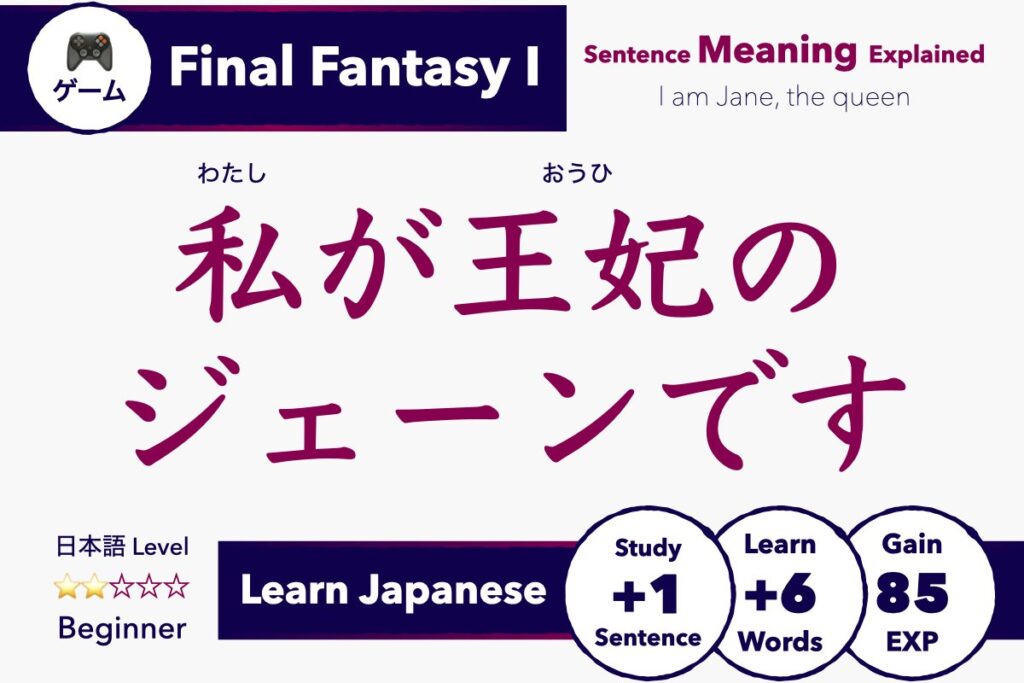
『私が王妃のジェーンです。』means 「I am Jane, the queen.」 It’s the first line in Final Fantasy 1 where a named character introduces herself, and it’s built around 「です」, one of the most useful words you’ll ever learn in Japanese.
- 私が
I am the one who - 王妃のジェーンです
is Jane, the queen
This sentence looks simple, and it mostly is, but it’s doing exactly the kind of thing you’ll do constantly in real Japanese: introducing yourself. Let’s break down exactly how it works.
✅ 1 Japanese Sentence
✅ 6 Japanese Words
✅ +85 EXP
Original Japanese Sentence (Final Fantasy I)
Credit Attribution
- Sentence from Final Fantasy I (© SQUARE ENIX)
- Audio file generated with OICEVOX:冥鳴ひまり
日本語
私が王妃のジェーンです。
カナ
わたし が おうひ の ジェーン です。
Romaji
Watashi ga ouhi no Jeen desu.
Possible English Translations
Please note: There isn’t just one correct translation. Japanese sentences can often be translated in several natural ways, and more than one translation may be correct.
Natural Translations
- I’m Queen Jane.
- I am Queen Jane.
- I am Jane, the queen.
Literal Translations
- I am the queen, Jane.
- It is I who Queen Jane is.
- As for who I am, I am Queen Jane.
My Preferred Translation
I am Jane, the queen.
I kept the full 「I am」 rather than contracting it to 「I’m」, because it sounds a little more composed and formal, which better matches the polite tone of 『です』.
I also switched the order to 「Jane, the queen」 because that’s the more natural way to introduce someone in English, even though Japanese gives us the title first.
Japanese Meaning Explained
This line comes from early in Final Fantasy I. The player enters the queen‘s own chambers, having just heard from NPCs how deeply the princess’s disappearance has shaken the royal family.
Queen Jane (王妃ジェーン) greets the party by introducing herself, then immediately asks the Warriors of Light (光の戦士) to rescue her daughter.
『私』
Meaning: 「I」
『私(わたし)』 means 「I」, the standard, neutral way to refer to yourself in Japanese.
In Queen Jane‘s line, it’s the subject the whole line is built around, the queen identifying herself before saying anything else.
You’ll see 『私』 constantly. It’s also one of the very first Japanese words most learners pick up, and one of the most common words in the entire language.
『が』
Function: Subject Marker 「が Particle」
- 「〇〇が」 means 「〇〇 (is the one who)」
- 『私が』 means 「I (am the one who)」
We’ve seen 『が』 mark a subject before, back in 「長い冒険の末 4人の若者が この地にたどり着いた」, but here it’s doing something slightly different.
Instead of just introducing who’s performing an action, it’s identifying who someone is, answering an unspoken “who’s there?” with a direct, confident “it’s me.”
In our Final Fantasy I sentence, 『が』 marks 『私』 as the answer to exactly that question. You have just met the queen for the first time, and this is her introducing herself.
You’ll see this identifying use of 『が』 constantly in Japanese whenever someone answers questions like “Who is it?” or “Which one is it?” with a direct answer.
が vs は
You might be wondering why the queen says 『私が』 instead of the much more common 「私は」. Both are grammatically correct, but they don’t feel exactly the same.
「私は」 simply introduces yourself as the topic:
私はジェーンです。
→ I’m Jane.
『私が』 puts extra focus on who the person is:
私が王妃のジェーンです。
→ I am Queen Jane.
→ I am the one who is Queen Jane.
It’s the kind of wording you’d naturally use when answering an unspoken question like “Who are you?” or “Which one is the queen?”
『`私がジェーンです。』 translates as:
- 「I’m Jane.」
- 「I’m the one who is Jane.」
『王妃』
Meaning: 「queen」
『王妃(おうひ)』 means 「queen」, specifically a queen by marriage, the wife of a king, rather than a queen who rules in her own right.
In the queen‘s sentence, it’s her title, stated right alongside her name.
You’ll mostly run into 『王妃』 in fantasy games, historical dramas, and stories involving royalty.
『の』
Function: Noun Connector 「の Particle」
- 「AのB」 means 「B of A」, 「A’s B」
- 『王妃のジェーン』 means 「Jane, the queen」
We’ve seen 『の』 connect two nouns before in 「…ひとつの予言…」, and here it’s doing that same job, just linking a title to a name.
「Title + の + name」 is a common pattern in Japanese that links a person’s role or title directly to who they are.
In our Final Fantasy I sentence, 『王妃の』 tells you exactly which Jane this is, not just any Jane, the queen.
You’ll see this same 「title + の + name」 pattern constantly whenever Japanese introduces someone by both their role and their name at once.
『`王妃のジェーン』 translates as:
- 「Queen Jane」
- 「Jane, the queen」
『ジェーン』
Character Name: 「Jane」
『ジェーン(Jane)』 is the queen of Cornelia. Like the other Final Fantasy I characters, she has her own entry in the FF1 Glossary if you’d like to learn more.
『です』
Translation: 「am」
『です』 is the polite copula, the formal version of 「am/is/are」 in Japanese. It’s one of the very first pieces of grammar every learner encounters, and also one of the most important.
Here, 『です』 closes out her self-introduction with the same calm, formal politeness a queen would be expected to use, even in a moment of real distress.
You’ll use 『です』 constantly in everyday Japanese. Whether you’re introducing yourself, asking questions, or simply describing something politely, you’ll hear it everywhere.
Build Japanese Sentences
| Building Blocks | Japanese Sentence |
|---|---|
| Subject (Who is it?) | 私が I (am the one) |
| Title + Name (Who specifically?) | 王妃のジェーン Jane, the queen |
| Copula (What’s the statement?) | です am |
私が王妃のジェーンです。
I am Jane, the queen.
Real-Life Usage Examples
Let’s look at a few natural, everyday examples using the words and patterns from today’s sentence.
- 〜です: polite sentence ending
- Title の Name: introducing someone by their title
Example 1
マイクです。
I’m Mike. (polite)
Example 2
テレビゲームです。
It’s a video game. (polite)
Example 3
女王のエリザベス
→ Elizabeth, the queen
Example 4
王子のウィリアム
→ William, the prince
Example 5
彼は国王のチャールズです。
He’s Charles, the king.
How useful is today’s Japanese in real life?
As mentioned earlier,『です』 is one of the most common words you’ll ever use in Japanese, in introductions, descriptions, questions, and everyday polite conversation.
The 「title + の + name」 pattern you saw in 『王妃のジェーン』 is useful too. You’ll see it whenever Japanese introduces someone by both their title and their name, and you can use the same pattern for jobs, roles, and positions.
Nothing in this sentence is archaic or unusual. Every single piece of it, 『が』, 『の』, and 『です』, is something you’ll use in real conversation almost immediately.
| Word | Frequency Rank |
|---|---|
| の | Top 10 |
| が | Top 10 |
| です | ~300 |
| 私 | ~3000 |
| 王妃 | ~8000 |
Beyond the Translation
Here’s what I find genuinely interesting about this line. The king from an earlier sentence sounded different because he used the old-fashioned ending 「〜ぬ」. The queen stands out for the opposite reason.
Everyone around her is overwhelmed with grief and panic, but she simply introduces herself with 『です』. There’s nothing dramatic or unusual about her Japanese at all.
And that’s one of the things I love about the Japanese used in Final Fantasy 1.
It doesn’t always tell you what a character is like directly. Sometimes it lets the way they speak do all the work.
Even though everyone around the queen is panicking, she speaks just as calmly and politely as ever. Without saying it outright, the game shows us exactly what kind of person she is.
Use the Sentence Pattern
Pattern to Remember
Identifying Who You Are
『(私が) (Title の) Name です』
「(I’m) Name, (the 〇〇) 」
- セーラです → I’m Sarah
- ルカーンです → I’m Lukahn
- 国王のレギスです → I’m Regis, the king
- 私が王のノクティスです → I am the one who is Noctis, the king
① Quick Quiz
What’s the meaning of:
『私が王妃のジェーンです。』
A) I am a queen.
B) She is a princess.
C) I am Queen Jane.
② Mini Quest
Which sentence matches the queen’s formal way of speaking?
A) 私が王妃のジェーンだ。
B) 私が王妃のジェーンです。
③ Final Challenge
Complete the sentence:
『私が王妃のジェーン _____ 。』
Answers
① C
② B
③ です
What you achieved today:
✅ Japanese Sentences +1
✅ Japanese Words +6
✅ 日本語 EXP +85
Congratulations 🎉
おめでとう🎉
Learn More Japanese with…
Final Fantasy 1
- 『偶然とは思えぬ。』
Learn another line from the King of Cornelia
Related Words
- 王妃 (おうひ) — queen (consort)
How to Say 「Queen」 in Japanese
『です』 might be the simplest word in this whole lesson, but it’s also one of the most useful. You’ll hear it constantly, and before long, you’ll probably be using it in almost every polite sentence you say.
The next time a character introduces themselves in a JRPG, or you hear someone ending a sentence with 『です』 in real life, you’ll know exactly what it’s doing.
See you for our next FF1 breakdown! 🎮✨
Alex