Are you a ME:I fan who wants to learn Japanese with J-Pop stars you love? In Lesson 4, I will translate a real Japanese sentence from Kokona and explain the words and grammar clearly and simply. By following my beginner-friendly lesson series, you will learn how to understand Japanese posts, captions, and messages from all ME:I members and other J-Pop idols in no time.
夏最後の思い出~✨❤️
Once you finish this lesson, you will be able to read and fully understand the Japanese Kokona used here. This is the perfect opportunity for international YOU:ME to boost their language skills and take one more step toward communicating with ME:I and their members in Japanese.
So let’s start learning Japanese with the ME:I members!
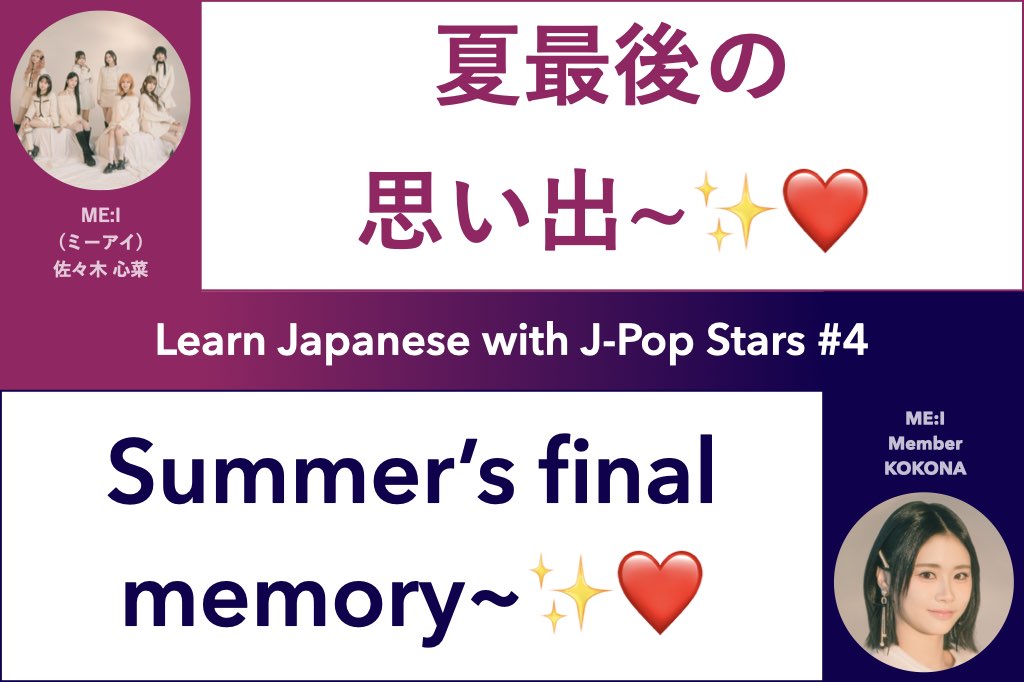
Learn Japanese with J-Pop Stars 4 (ME:I, Kokona)
⏳ Study Time: 5-10 min
How to study Japanese by yourself:
- Read a Japanese sentence aloud
- Break down its words and meanings
- Review and level up your Japanese skills
Step 1) Learn to Read Japanese Sentences and Kanji
日本語
夏最後の思い出~✨❤️
1.1 漢字 (Kanji)
夏 最後 の 思い出~✨❤️
1.2 カナ (Kana)
- 夏 (なつ)
- 最後 (さいご)
- の
- 思い出 (おもいで)
1.3 ローマ字 (Romaji)
- 夏 (natsu)
なつ - 最後 (saigo)
さいご - の (no)
- 思い出 (omoide)
おもいで
Step 2) Study Japanese Words and Their Meanings
English Translation
- Summer’s final memory~✨❤️
- A final summer memory~✨❤️
- One last summer memory~✨❤️
- My last summer memories~✨❤️
- My last memories of summer~✨❤️
- My final memories of summer~✨❤️
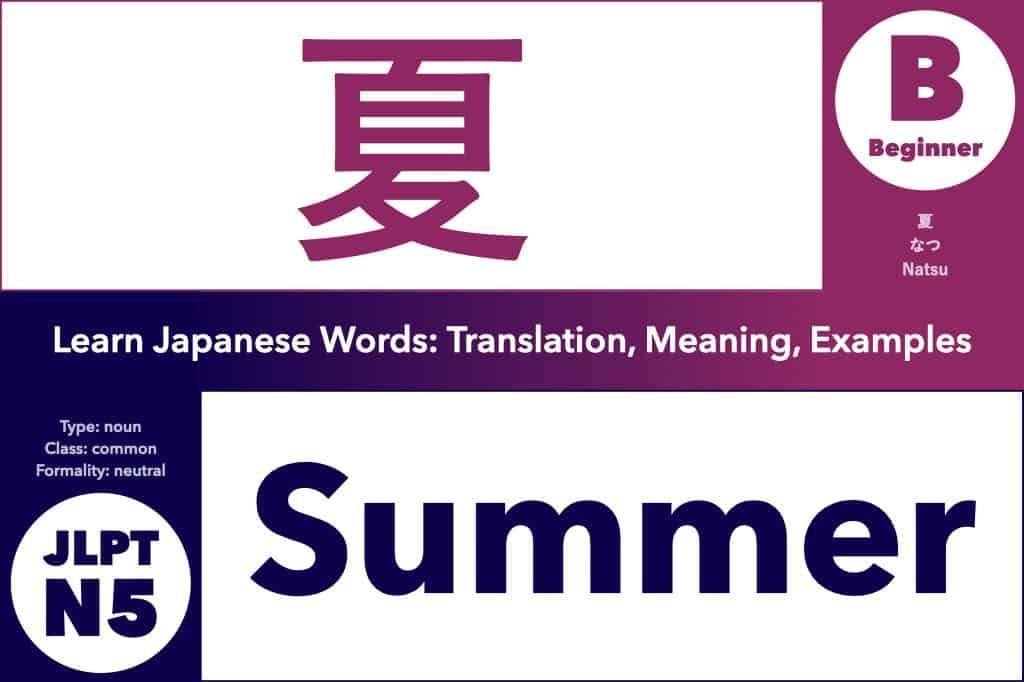
2.1 夏 (なつ, natsu)
- Word: 夏
- Reading: なつ
- Word Type: noun
- Word Class: common, JLPT N5
- Word Formality: neutral, general use
| 夏 |
|---|
| [noun] summer |
夏 (なつ, natsu) means “summer.”
It refers to the hottest season of the year, typically from the end of June or the beginning of July to September.
In Japanese culture, summer is associated with things like summer festivals (夏祭り, なつまつり, natsu matsuri), fireworks (花火, はなび, hanabi), going to the beach, cicadas, and summer vacation (夏休み, なつやすみ, natsu yasumi).
It’s a very common everyday word, and one of the first seasonal kanji learners usually encounter.
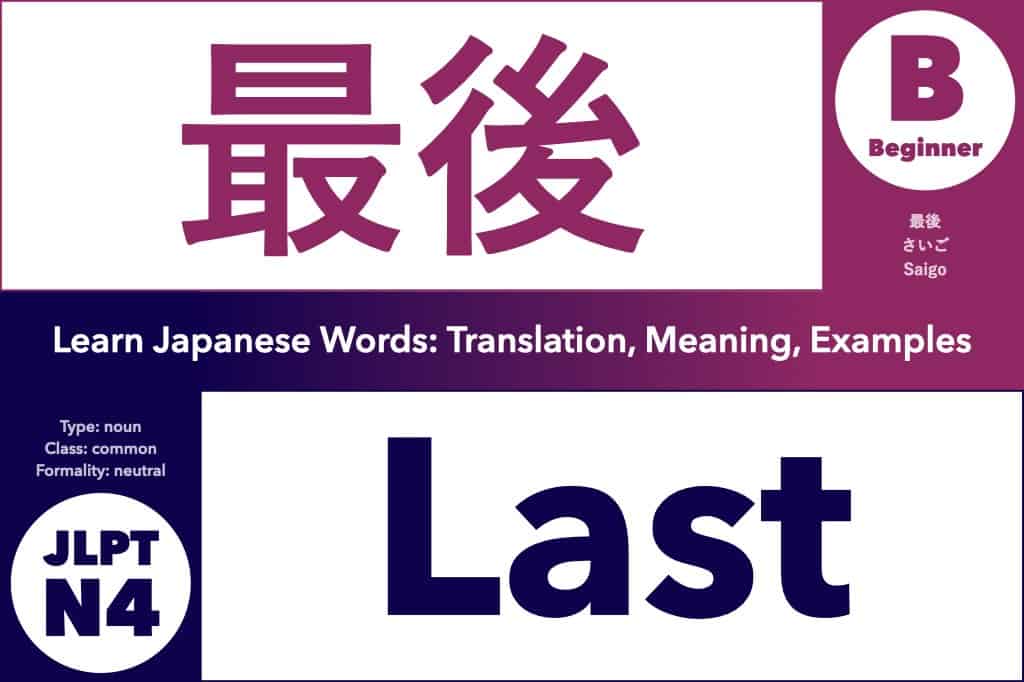
2.2 最後 (さいご, saigo)
- Word: 最後
- Reading: さいご
- Word Type: noun
- Word Class: common, JLPT N4
- Word Formality: neutral, general use
| 最後 |
|---|
| [noun] last, end, conclusion |
| [noun + の (最後の)] latest, last…, final…, most recent… |
最後 (さいご, saigo) means “last,” “end,” or “conclusion.”
As a noun, it is used when you talk about the end of a time period, the final item in a sequence, or the finishing point of something.
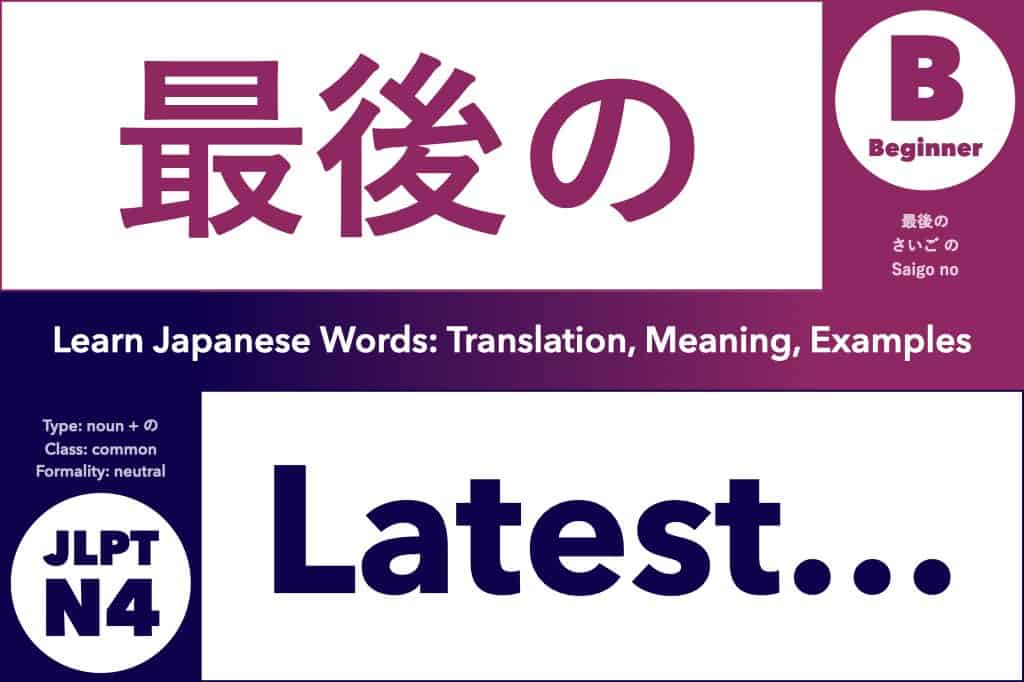
However, in Kokona’s example, we see 最後 + の (no), forming 最後の (さいご の, saigo no).
The particle の links 最後 to the noun that follows, creating phrases that mean “last…,” “final…,” or “latest…“
Here are a few examples showing how 最後の translates naturally into English:
- 最後の夏: the last summer
さいご の なつ, saigo no natsu - 最後の思い出: the last memory
さいご の おもいで, saigo no omoide - 最後のチャンス: the last chance
さいご の チャンス, saigo no chansu
2.3 の (no)
- Word: の
- Word Type: particle
- Word Class: common, JLPT N5
- Word Formality: neutral, general use
| の |
|---|
| [particle (nounのnoun)] …of…, …’s … marks a (possessive or descriptive) connection between nouns |
The particle の (no) marks a (possessive or descriptive) connection between nouns, similar to “…of…” or “…’s…” in English.
It is one of the most common and essential particles in Japanese, and it is often easiest to understand through examples.
ココナの夏 (ココナのなつ, Kokona no natsu) means “Kokona’s summer” or “summer of Kokona.” Here, AのB simply translates as “A’s B” or “B of A.”
The particle の can also connect more than two nouns.
ココナの最後の夏 (ココナのさいごのなつ, Kokona no saigo no natsu), means “Kokono’s last summer” or “last summer of Kokona.”
In both examples, the の simply links one noun to the next and shows some kind of relationship or hierarchy between them. Sometimes this includes possession.
In natural English, however, some words, like 最後 (さいご, saigo, “end”) may need to be translated differently (e.g. “last…”, “final…”) to make the sentence sound natural.
2.4 思い出 (おもいで, omoide)
- Word: 思い出
- Reading: おもいで
- Word Type: noun
- Word Class: common, JLPT N3
- Word Formality: neutral, general use
| 思い出 |
|---|
| [noun] memories, reminiscene, recollections |
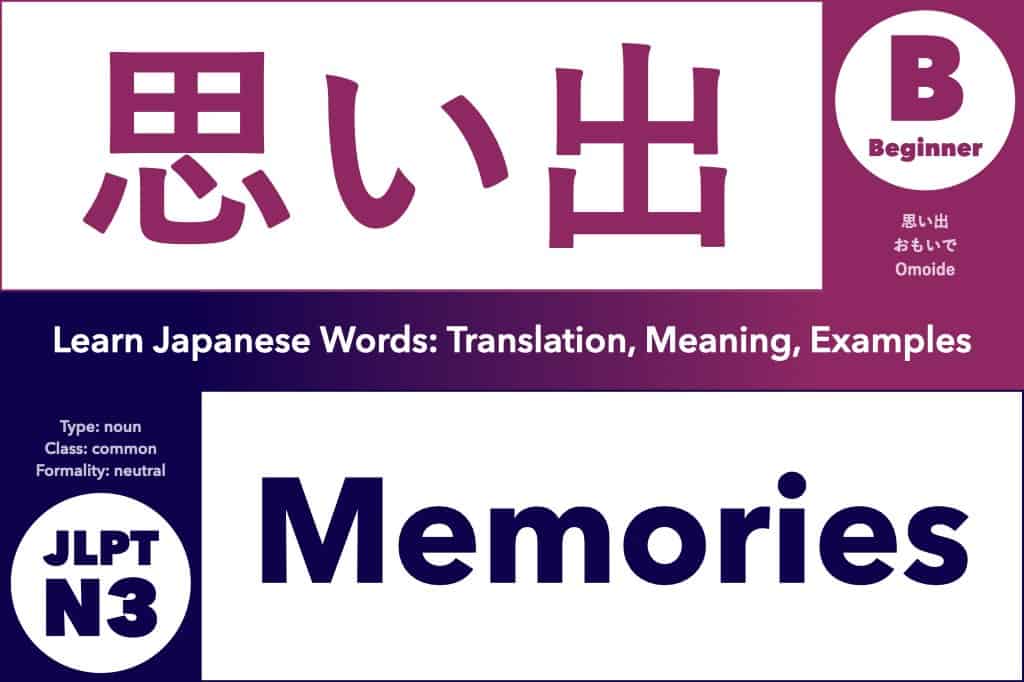
思い出 (おもいで, omoide) means “memories,” “reminiscence,” or “recollection“.
The noun refers to experiences from the past that someone remembers, often with emotion or personal significance. It is commonly used to talk about happy, nostalgic, or meaningful moments, like trips, events, or important life experiences.
The word can be about one particular memory or multiple memories, depending on context, because Japanese nouns do not change form for singular or plural.
夏最後の思い出~✨❤️
With this sentence, Kokona (ME:I) is sharing her feelings about her last memories of this year’s summer. She’s reflecting on the end of the season and highlighting the special, meaningful moments she spent with her family in Okinawa. Her words convey a sense of nostalgia, warmth, and sentimentality.
Step 3) Review and Improve Your Japanese
How to learn Japanese fast:
- Review sentences and words regularly
- Listen, read, speak, and write in Japanese
- Continue to the next sentence and repeat
3.1 Review & Remember Japanese With Flashcards
Create Sentence Flashcard for:
- 夏最後の思い出~✨❤️
Create Word Flashcards for:
- 夏
- 最後
- 最後の
- の
- 思い出
Examples
Front: Japanese sentence/word written in kanji
Back: Kana, translations, any other information
| My Sentence Flashcard |
|---|
| Front: 夏最後の思い出~✨❤️ |
| Back: 夏最後の思い出~✨❤️ Summer’s final memory~✨❤️ My final memories of summer~✨❤️ |
| My Word Flashcard |
|---|
| Front: の |
| Back: の …of…, …’s … marks a (possessive or descriptive) connection between nouns ココナの夏 ココナの最後の夏 ココナの最後の夏の思い出 |
3.2 Practice & Level Up Your Japanese Skills
How to improve your Japanese skills fast:
- Reading: Read Japanese for 5-10 min
- Writing: Write in Japanese for 5-10 min
- Speaking: Speak Japanese for 5-10 min
- Listening: Listen to Japanese for 5-10 min
A) Listening Practice
Listen to this song.
Can you catch the Japanese we learned today?
Source: ZONE 〜 君がくれたもの
B) Reading Practice
Read the following sentences.
Can you spot the Japanese we learned today?
- 最後のライブに来ました。
- これは夏の最後の思い出です。
- 君 (きみ) と夏の終わり (おわり)
- 夏の思い出がたくさんあります。
- 夏の思い出をありがとうございました!
- 最後の最後まで幸せ (しあわせ) だった😭😭
- さあさあ、夏最後のイベントが始まる (はじまる)
You can also try to read Kokona‘s IG post.
C) Speaking Practice
Say the following sentences.
Can you repeat them aloud without looking?
- 夏 が 来ました。
- これ が 最後 です。
- 夏 が 好き (すき) です。
- 夏の最後の日 (ひ) です。
- 夏 最後の思い出 に なりました。
- 最後のファンミーティング です。
- 最後 の ライブ に 行きました (いきました)。
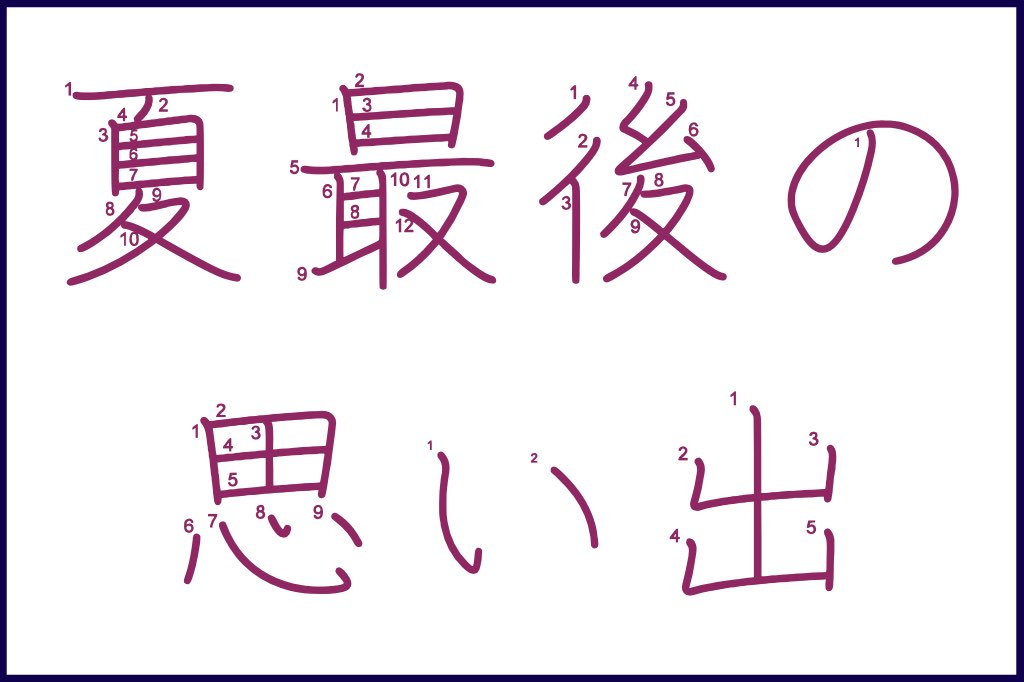
D) Writing Practice
Type (or write down) the words and sentences in Japanese.
3.3 Continue Studying Japanese
You’ve completed Learn Japanese with J-Pop Stars #4 🎉
You’re one step closer to understanding Kokona and communicating with the ME:I members in Japanese!
- Japanese Words +5
- Japanese Sentences +1
Well done ♪٩(⌒‐⌒)۶♪
| Our First Goal |
|---|
| Japanese Sentences 4 / 10 |
| Japanese Words 12 / 10 |
| 🎊おめでとう🎊 You reached your first vocab goal! 🎉٩(⌒ω⌒)੭⁾⁾🎉 |
| Our Ultimate Goal |
|---|
| Japanese Sentences 4 / 10,000 |
| Japanese Words 12 / 25,000 |
To reach native fluency, our goal is to master 10,000 sentences and 25,000 words.
So let’s keep studying and continue our journey to Japanese fluency!
➡️ Next Lesson: Learn Japanese with J-Pop Stars #5
⬅️ Need a quick review? Revisit the previous lesson!
▶️ New here? Start from Lesson 1!
… or keep learning Japanese with one of my other free lessons!
- 📺 Learn Japanese with Anime
Understand anime dialogue without subtitles - 📖 Learn Japanese with Manga
Read your favourite manga written in kanji and kana - 🎵 Learn Japanese with Songs
Understand the meaning behind your favourite lyrics
🎤 Learn Japanese with J-Pop Stars
Learn real Japanese from your favourite stars and idols - 🎮 Learn Japanese with Video Games
Understand game dialogue and the characters you love
For more information about the artists, please visit ME:I’s Official Homepage or YouTube Channel.