
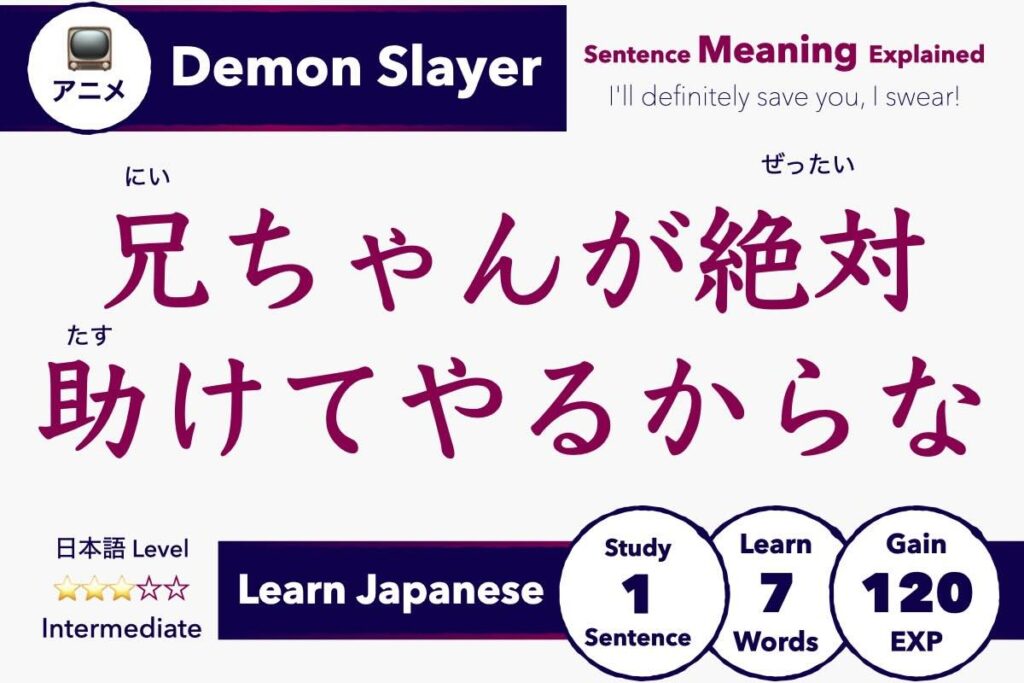
Moments after he found his sister Nezuko critically injured, Tanjiro Kamado desperately says: 『兄ちゃんが絶対助けてやるからな』. But what exactly does this emotional Demon Slayer (Kimetsu no Yaiba) line mean? In this sentence breakdown, I’ll explain the meaning and help you understand every word.
Demon Slayer
兄ちゃんが絶対助けてやるからな
Meaning: I'll definitely save you, I swear!
Romaji: Nii-chan ga zettai tasukete yaru kara na
On the surface, this Japanese sentence sounds like a simple cry of desperation, but Tanjiro’s word choice makes his line fiercely protective. By pairing 『~てやる (~te yaru)』 with 『から (kara)』 and 『な (na)』, he transforms this exclamation into an unwavering oath to save Nezuko.
Meaning | Vocab | Translation | Usage
Demon Slayer: Sentence Meaning & Scene Context
兄ちゃんが絶対助けてやるからな
にいちゃん が ぜったい たすけて やる から な
Nii-chan ga zettai tasukete yaru kara na
Credit Attribution
- Sentence from Demon Slayer: Kimetsu no Yaiba (© Koyoharu Gotouge / Shueisha)
- Audio file generated with VOICEVOX:剣崎雌雄
Meaning: Tanjiro promises to save Nezuko, no matter what. Reassuring not only her but himself, his words carry fierce determination, desperate urgency, and deep brotherly warmth. He makes it clear that he will do everything in his power to get her through this.
Scene: Stumbling through deep snow with Nezuko on his back, Tanjiro is living his worst nightmare. His family was just murdered, and his sister is critically injured. Desperate to find help, he utters these words as he runs through the freezing mountain air.
Vocabulary & Grammar
| Word | Reading | Meaning | Notes |
|---|---|---|---|
| 兄ちゃん | にいちゃん nii-chan | big brother (casual) | Tanjiro refers to himself by his family role |
| が | ga | subject marker | Marks 『兄ちゃん (nii-chan)』 as the subject |
| 絶対 | ぜったい zettai | absolutely, definitely | Adds strong emphasis |
| 助ける | たすける tasukeru | to save, to help | Appears here in the te-form 『助けて (tasukete)』 |
| やる | yaru | to do, to give (casual) | Helper verb 『〜てやる』, when doing something for someone close |
| から | kara | because, so | Explains the cause or reason for something |
| な | na | right?, okay?, you know | Expresses emotion, self-reflection, or soft emphasis |
Kanji:
兄(あに)
絶(ゼツ)
対(タイ)
助(たす.ける)
1. 兄ちゃん (nii-chan)
- Type: Noun
- Reading: にいちゃん
- Meaning: big brother (casual)
Tanjiro refers to himself by his family role rather than a standard word for 「I」. In Japanese, older siblings often call themselves 「big brother」 when talking to younger family members to emphasize closeness and responsibility. By calling himself 『兄ちゃん (nii-chan)』, Tanjiro immediately establishes his bond with Nezuko and asserts his duty as her personal protector.
2. が (ga)
Tanjiro’s Sentence: 兄ちゃんが (nii-chan + ga)
Subject Particle: が
- Pattern: [subject] + が
- Translates as: (no direct translation)
- Function: marks the subject of a sentence
This particle marks 『兄ちゃん (nii-chan)』 as the explicit subject doing the action. Tanjiro could easily drop 『が (ga)』 and leave the subject unstated, which is common in casual spoken Japanese. Including 『が (ga)』 makes his statement active and deliberate, signaling that he personally steps forward to take responsibility for her life.
3. 絶対 (zettai)
- Type: Adverb
- Reading: ぜったい
- Meaning: absolutely, definitely
Placing this adverb right before his statement to save Nezuko, 『絶対 (zettai)』 transforms a hopeful statement into a powerful commitment. Tanjiro uses it to eliminate any lingering doubt, reinforcing his total resolve to save his sister no matter what.
4. 助けて|助ける (tasukeru)
- Type: Verb
- Reading: たすける
- Meaning: to help, to save
Tanjiro’s Sentence: 助ける → 助けて (tasukeru → tasukete)
Te-Form: Vて
- Pattern: [verb]て
- Translates as: …and…, …and then…
- Function: connects an action verb to a subsequent verb
Appears in its te-form 『助けて (tasukete)』 so it can connect directly to the helper verb 『やる (yaru)』. On its own, the te-form simply links actions together, carrying no standalone sentence-ending power. Unlike the grand, heroic verb 「救う (sukuu)」, Tanjiro chooses 『助ける (tasukeru)』 to keep his promise immediate, grounded, and deeply personal.
5. やる (yaru)
- Type: Verb
- Reading: やる
- Meaning: to do, to give (very casual)
Tanjiro’s Sentence: 助けてやる (tasukete + yaru)
Te-Yaru Form: Vてやる
- Pattern: Vて + やる
- Translates as: do [action] for you
- Function: used toward someone younger, lower in status, or someone the speaker feels protective of or responsible for (a younger sibling, a pet, a subordinate)
Combined with 『助けて (tasukete)』, 『やる (yaru)』 forms 『助けてやる (tasukete yaru)』. This helper verb pattern adds grit and intense determination to his words. Instead of a gentle “I’ll help you”, it communicates a fiery, active commitment to step in and save Nezuko at all costs.
6. から (kara)
Tanjiro’s Sentence: 助けてやるから (tasukete yaru + kara)
Sentence-Final Particle: から
- Pattern: [sentence] + から
- Translates as: because, since, so
- Function: explains the cause or reason for something
Ends the clause with 「because」, leaving the concluding reassurance unspoken. Spoken at the end of a sentence, it implies an unsaid clause like “so trust me” or “so don’t worry”. Tanjiro uses 『から (kara)』 to give his vow an assertive edge, turning a basic statement into an active guarantee designed to soothe his sister.
7. な (na)
Tanjiro’s Sentence: 助けてやるからな (tasukete yaru kara + na)
Sentence-End Particle な
- Pattern: [sentence] + な
- Translates as: right?, okay?, you know!
- Function: adds emotional emphasis and resolve
Attaches to the very end of the sentence to add emotional weight. It softens the rough edge of 『やる (yaru)』 while seeking agreement and shared understanding. Tanjiro ends the line with 『な (na)』 to sound more reassuring for Nezuko and probably himself too.
Now Try Building Your Own Sentences
Pattern
絶対 [verb in て-form] やるからな
Romaji: Zettai _____ yaru kara na
Meaning: I’ll definitely [do action for] you, I swear!
| Word Swap | New Sentence | Meaning |
|---|---|---|
| 買う kau to buy | 絶対買ってやるからな Zettai katte yaru kara na | I’ll definitely buy it for you, I swear. |
| 直す naosu to fix | 絶対直してやるからな Zettai naoshite yaru kara na | I’ll definitely fix it for you, I swear. |
| 作る tsukuru to make | 絶対作ってやるからな Zettai tsukutte yaru kara na | I’ll definitely make it for you, I swear. |
| 守る mamoru to protect | 絶対守ってやるからな Zettai mamotte yaru kara na | I’ll definitely protect you, I swear. |
| 見つける mitsukeru to find | 絶対見つけてやるからな Zettai mitsukete yaru kara na | I’ll definitely find it for you, I swear. |
Grammar:
が
て-form
〜てやる
から
な
English Translations
| English | Translation Notes & Cultural Nuance |
|---|---|
| LITERAL TRANSLATIONS | |
| Because Big Brother will absolutely save [you]! | Keeps Tanjiro referring to himself in the third person and translates 『から (kara)』 directly as 「because」. |
| Big Brother will definitely save [you], okay? | Preserves his family title while turning 『な (na)』 into a gentle tag question at the end. |
| NATURAL TRANSLATIONS | |
| I swear I’ll save you! | Swaps 「Big Brother」 for 「I」 to sound more natural in English, translating the sentence into a strong pledge. |
| I’ll definitely save you, okay? | Softens the line just enough to highlight the quiet, comforting touch of the sentence-ending particle 『な (na)』. |
| I’ll definitely save you, I swear! | Blends the unshakeable weight of 『絶対 (zettai)』 with the fiery resolve of 『〜てやる (~te yaru)』. |
| I’ll save you, I promise you that. | Highlights the active, protective nuance of the helper verb 『やる (yaru)』. |
| I promise I’ll save you, no matter what. | Combines 『絶対 (zettai)』 and 『からな (kara na)』 into 「no matter what」. |
My Preferred Translation: Out of the natural options, “I’ll definitely save you, I swear!” and “I swear I’ll save you!” feel the closest to Tanjiro’s original words in the anime. It keeps the intense weight of 『絶対 (zettai)』 and the masculine resolve of 『〜てやる (~te yaru)』.
If you want to preserve more of the protective, comforting quality behind 『からな (kara na)』, 「I promise I’ll save you, no matter what.」 is an equally strong pick.
Usage & Nuance
兄ちゃんが絶対助けてやるからな
Rough
○●○○○
Polite
Masculine
●○○○○
Feminine
Composed
○○○○●
Emotional
Soft-Spoken
○○○●○
Determined
Can You Say This in Everyday Life? Tanjiro’s line carries a rough, masculine, and determined energy. Using 『助けてやるからな (tasukete yaru kara na)』 with people you aren’t close with or outside of high-stakes situations will make you sound overly aggressive or like you are talking down to them.
To express the same type of promise in everyday Japanese without sounding like an anime protagonist, use these natural alternatives:
1. Casual Everyday Use
絶対助けてあげるからね
- Romaji: Zettai tasukete ageru kara ne
- Meaning: I’ll definitely help you out, okay?
Swaps the rough helper verb 『やる (yaru)』 for the politer 「あげる (ageru)」, and softens the ending particle to 「ね (ne)」. This creates a caring, gentle tone that is perfect for close friends, younger siblings, or a romantic partner.
2. Polite Everyday Use
必ず助けますからね
- Romaji: Kanarazu tasukemasu kara ne
- Meaning: I will definitely help you.
Swaps 『絶対 (zettai)』 for 「必ず (kanarazu)」 to express a firm, reliable promise, while using standard polite Japanese 「〜ます (~masu)」. This phrasing sounds clear, dependable, and respectful when speaking to acquaintances, coworkers, or customers.
Learn More Japanese
And that is 『兄ちゃんが絶対助けてやるからな』! Every word, from his family title to that final particle, turns a simple offer of help into a determined vow. The next time you hear 『〜てやるからな』 in Kimetsu no Yaiba (Demon Slayer) or an anime, you’ll know a hero is making a serious promise.
Catch you in the next anime breakdown!
また来てね〜
Alex