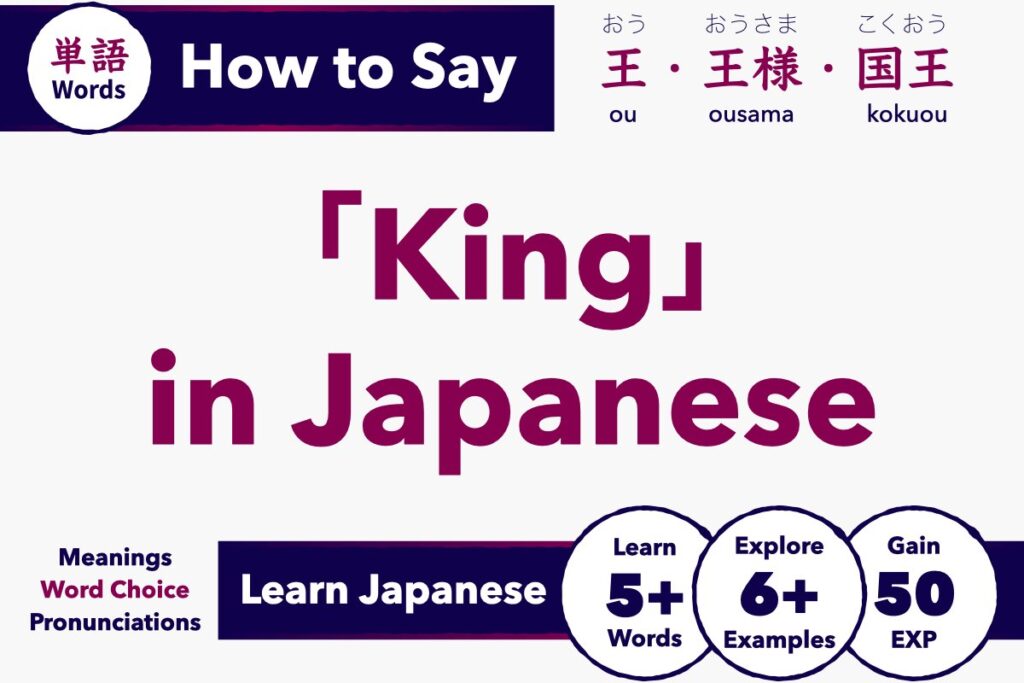
The most common way to say king in Japanese is 王 (おう, ou). If you mean the actual, official title of a country’s monarch, 国王 (こくおう, kokuou) is the more precise choice. For the everyday, affectionate way to say it, especially the one kids use, 王様 (おうさま, ousama) is what you want.
- 王 (おう, ou)
the default, all-purpose word for king - 王様 (おうさま, ousama)
the everyday, affectionate way to say king - 国王 (こくおう, kokuou)
the formal, official title for a country’s monarch
Japanese has several words for king, plus a loanword, and they split along register and formality rather than meaning. Below, you’ll learn each word’s meaning, pronunciation, kanji, hiragana, and usage, with examples from anime, manga, games, and everyday Japanese.
Credit Attribution
- Audio file generated with VOICEVOX:四国めたん, VOICEVOX:冥鳴ひまり, VOICEVOX:ずんだもん
Common Japanese Words for King
| Kanji | Hiragana | Romaji | Meaning |
|---|---|---|---|
| 王 | おう | ou | king, ruler, sovereign, monarch |
| 王様 | おうさま | ousama | king (everyday, polite) |
| 国王 | こくおう | kokuou | king, monarch (formal, official title) |
| 王者 | おうじゃ | oujya | king, champion, ruler (figurative) |
| キング | きんぐ | kingu | king (loandword) |
王 (おう, ou) is the Japanese word for king you’ll encounter and use most often. It’s the standard, all-purpose word and the safest choice when you’re not sure which one to reach for.
- 王 (ou): Your go-to word for king. It works in almost any context, from history books to fantasy anime.
- 王様 (ousama): The word you’d use with kids, in fairy tales, or in everyday conversation when you see someone as “the king” in an admiring, affectionate, or sometimes joking way.
- 国王 (kokuou): Use this when you’re talking about an actual, official monarch, the kind you’d read about on the news or in a history class.
- 王者 (ouja): Less about a throne and more about being the best. You’ll see this for champions, top competitors, or a “king” in a figurative sense.
- キング (kingu): Borrowed from English, mostly used in branding, titles, and modern or Western contexts rather than plain conversation.
There are a couple more words, like 国主, 王物, and 王将, but unless you’re into old Japanese literarture or Japanese chess you’re unlikely to encounter them in everyday Japanese. So, before we explore those, let’s take a closer look at the common words.
王 (ou)
- Kanji: 王
- Romaji: ou
- Hiragana: おう
- Meaning: king, ruler, sovereign, monarch
『王』 is the most common, most neutral Japanese word for king. You can use it for both real monarchs and fantasy rulers in anime, manga, games, and novels.
You’ll also see 『王』 attached to other words to create titles like 「海賊王 (Pirate King)」 , 「魔王 (Demon King)」 or 「真の王 (True King)」.
Compared to 「国王 (kokuou)」, 『王』 feels more general and less official. The word 「国王 (kokuou)」 specifically refers to the reigning monarch of a country, whereas 『王』 can refer to almost any king, whether real or fictional.
When you’re not sure which word to use, 『王』 is almost always the safest choice. If you’re only going to remember one Japanese word for king make it this one. It’s short, common, and you’ll encounter it everywhere.
Example:
ぜひ王にお会いください!
Please meet with the king!
— Final Fantasy 1
王様 (ousama)
- Kanji: 王様
- Romaji: ousama
- Hiragana: おうさま
- Meaning: king (everyday, polite)
『王様』 adds the honorific 「様 (sama)」 to 「王 (ou)」, making it sound warmer, friendlier, and more familiar.
It’s the word you’ll hear in fairy tales, children’s stories, anime, games, and everyday conversation whenever someone casually talks about “the king“.
It’s also used figuratively for someone who’s treated like a king, spoiled, pampered, or jokingly seen as “the king” of something. For example, fans might jokingly call their favourite idol 「〇〇王様 (… ousama)」 or describe someone as living like a king.
You’ll also come across 『王様』 in expressions like:
- 王様気分 (ousama kibun)
— feeling like a king - 王様扱い (ousama atsukai)
— treating someone like royalty
Compared to 「国王 (kokuou)」, which sounds formal and almost bureaucratic, 『王様』 feels much more personal and approachable. It’s the version most learners will actually hear used out loud.
Example:
王様はとても優しい人だった。
The king was a very kind person.
国王 (kokuou)
- Kanji: 国王
- Romaji: kokuou
- Hiragana: こくおう
- Meaning: king (official monarch)
『国王』 is the formal, official word for king and is used for an actual monarch who rules a country. It literally combines 「国 (country)」 and 「王 (king)」.
You’ll mostly see this word in the news, history books, official writing, and discussions about real royal families, like the 「タイ国王 (King of Thailand) 」 for example.
Unlike 「王 (ou)」, which works just as well for fantasy kings, 『国王』 almost always refers to a real or historical ruler. It’s much less common in everyday conversation unless you’re specifically talking about a country’s monarch.
Example:
国王は国民に演説した。
The king gave a speech to the people.
王者 (oujya)
- Kanji: 王者
- Romaji: oujya
- Hiragana: おうじゃ
- Meaning: champion, king (of a field)
『王者』 isn’t really about ruling a kingdom. It’s used for someone who stands at the very top of their field, like a champion, title holder, or undisputed number one.
You’ll hear this word all the time in sports, esports, martial arts, and competitive games in phrases like 「王者に輝く (to be crowned champion)」 or a team being called the 『王者』 of their league.
Unlike 「王 (ou)」 or 「国王 (kokuou)」, nobody expects a 『王者』 to actually wear a crown. It’s almost always used figuratively to describe someone who’s the best. If someone is called 『王者』, they’re being praised as the undisputed champion.
Example:
彼はボクシング界の王者だ。
He is the king of the boxing world.
キング (kingu)
- Kanji: (katakana loandword, no kanji)
- Romaji: kingu
- Hiragana: きんぐ
- Meaning: king (loandword)
『キング』 is borrowed directly from English. Rather than replacing 「王」, it gives things a more modern, stylish, or Western feel.
You’ll often see it in:
- brand names
- movie titles
- playing cards
- nicknames
- product names
Examples include Burger King, King Kong, The Lion King, or nicknames like 「ラーメンキング (Ramen King)」.
Unlike 「王 (ou)」, which feels native and traditional, 『キング』 usually sounds more modern or playful. It’s rarely the word you’d use for an actual historical monarch.
Example:
彼はラーメン業界のキングと呼ばれている。
He’s known as the king of the ramen industry.
Quick Comparison Chart
| Word | Key Difference |
|---|---|
| 王 (ou) | king (general, the default word) |
| 国王 (kokuou) | king (formal, official title) |
| 王様 (ousama) | king (everyday, warmer) |
| 王者 (oujya) | champion (figurative “king”) |
| キング (kingu) | king (modern, branding) |
Less Commonly Used Words for King in Japanese
Japanese also has a few much rarer words for king. You’re unlikely to use them yourself, but you might come across them in shogi, history, or old writing.
| Kanji | Hiragana | Romaji | Meaning | Usage |
|---|---|---|---|---|
| 王将 | おうしょう | oushou | shogi king | shogi (Japanese chess), the senior player’s king piece |
| 国主 | こくしゅ | kokushu | king, sovereign | historical or literary, also an Edo-period term for a feudal lord |
| 王物 | おうもの | oumono | king, royalty | extremely rare, moslty found in old or literary text |
These are all real Japanese words, but you’re very unlikely to need any of them outside classical literature, historical writing, or very specific formal contexts.
『王将 (oushou)』 is worth a special mention if you’ve ever played shogi. In a game between two players, the senior or higher-ranked player uses the 『王将』 piece, while the other player uses a nearly identical piece called 「玉将 (gyokushou)」. Both are 「the king」 of the board, just with different names depending on seniority.
How to Say “King of X” or “X King” in Japanese
Most of the dramatic 「King of X」 titles you see in anime or games, like 「King of the Pirates」 or 「Demon King」, are built by attaching 『王 (ou)』 directly onto the thing being ruled.
- 魔王(まおう, maou)
King of Demons or Demon King - 竜王(りゅうおう, ryuuou)
King of Dragons or Dragon King - 海賊王(かいぞくおう, kaizokuou)
King of the Pirates or Pirate King
So it’s essentially the other way around: the word being ruled comes first, then the word for king 『王 (ou)』 gets added to the end. Sometimes you will also see the particle 「の (no)」 in between the words.
- 真の王(しん の おう, shin no ou)
True King or King of Kings - 夜の王(よる の おう, yoru no ou)
Night King or King of Night - 鹿の王(しか の おう, shika no ou)
Deer King or King of Deer
Once you notice this pattern, you’ll start spotting it everywhere.
Choose the Right Japanese Word for King
Still not sure which word to use? The tables below will help. The first shows the best word for specific situations, while the second gives you an idea of how common each word is.
By Situation
| If you’re talking about… | Use… |
|---|---|
| kings in general | 王 (ou) |
| an actual, official monarch | 国王 (kokuou) |
| a king in a story or fairy tale | 王様 (ousama) |
| a champion or “king” of a field | 王者 (oujya) |
| modern names, brands, titles, and nicknames | キング (kingu) |
By Frequency
| Word | Frequency Rank |
|---|---|
| 王 (ou) | ~1500 |
| 国王 (kokuou) | ~8100 |
| 王様 (ousama) | ~8200 |
| キング (kingu) | ~12,000 |
| 王者 (oujya) | ~15,000 |
| 国主 (kokushu) | ~40,000 |
| 王将 (oushou) | ~60,000 |
| 王物 (oumono) | ~140,000 |
If you only remember one word from this post, make it 『王 (おう, ou)』. It’s by far the most common and the one you’ll use in almost every situation.
For Learning Japanese
If you want to learn Japanese, start with:
① 王 (おう, ou)
You’ll use this constantly, on its own and as a suffix.
② 王様 (おうさま, ousama)
Useful for your fave and when watching or reading fantasy.
③ 国王 (こくおう, kokuou)
Learn this for real kings, history, and news.
The remaining words are less common and can be learned naturally as you come across them.
FAQ: Demon Kings, Pirate Kings & Other King Phrases
How do you write “king” in hiragana? The most common way to write king in hiragana is おう (ou). 国王 is written こくおう, and 王様 is written おうさま.
How do you say “King of the Pirates” in Japanese? King of the Pirates is 海賊王 (かいぞくおう, kaizoku ou). Thanks to One Piece, this is probably the single most searched-for “king” phrase in Japanese.
How do you say “Demon King” in Japanese? Demon King is 魔王 (まおう, maou), a hugely common word in fantasy games and anime, most famously as the final boss title in the Dragon Quest series.
How do you say “Dragon King” in Japanese? Dragon King is 竜王 (りゅうおう, ryuuou). It’s a common fantasy and game title, and it also happens to be the name of one of the eight major titles in professional shogi, held by whoever wins that particular tournament.
How do you say “King of Beasts” in Japanese? King of Beasts is 百獣の王 (ひゃくじゅうのおう, hyakujuu no ou), a set phrase traditionally used for lions, similar to how English uses “king of the jungle”.
How do you say “great king” in Japanese? Great king is 大王 (だいおう, daiou), a word with a grand, historical feel, often used for legendary or especially powerful rulers rather than everyday monarchs.
How do you say “my king” in Japanese? There isn’t one fixed Japanese equivalent of “my king”. In dramatic or fantasy settings, you might see 我が王 (わがおう, waga ou), meaning “my king” or “our king”. In everyday Japanese, however, people usually refer to a king by his title, such as 王 (ou), 王様 (ousama), 国王 (kokuou), or respectfully as 王陛下 (ou heika, “His Majesty the King”), depending on the context.
How do you say “black king” in Japanese? A fantasy ruler might be translated as 黒い王 (kuroi ou) or 黒王 (kuro ou), while some stories or games may choose a completely different title. There isn’t one fixed Japanese equivalent.
How do you say “shadow king” in Japanese? Depending on the story, it might be translated as 影の王 (kage no ou , “King of Shadows”), 影王 (kage ou, “Shadow King”), or something completely different. There isn’t one fixed expression. The natural choice depends on the setting and the translator.
What about Burger King, King Kong, or The Lion King? These are brand names and titles, so Japanese keeps them close to the English rather than translating “king” on its own. You’ll see them as バーガーキング (Burger King), キングコング (King Kong), and ライオン・キング (Lion King).
What about “king of spades”? King of Spades is スペードのキング (Supeedo no Kingu) in Japanese.
Is 王 or キング more common? 王 (ou) is far more common. キング (kingu) shows up mostly in branding, card games, and titles, while 王 (ou) is the word you’ll actually see in books, anime, and everyday Japanese.
How do you say “king and queen” together in Japanese? King and queen is 王と女王 (ou to jyoou). In more formal contexts, you may also see 国王と女王陛下 (kokuou to jyoou heika).
Learn Japanese with Real Examples from…
| Source | Example | Word |
|---|---|---|
| Final Fantasy I | 『ぜひ王にお会いください!』 | 王 (ou) |
| One Piece | 『海賊王に 俺は なる』 | 王 (ou) |
| Dragon Quest | 魔王 (final boss) | 王 (ou) |
Learn More Japanese with…
Related Words
- 王子 (おうじ, ouji) — prince
- 女王 (じょおう, joou) — queen
How to Say 「Queen」 in Japanese - 王女 (おうじょ, oujo) — princess
- 王国 (おうこく, oukoku) — kingdom
- 陛下 (へいか, heika) — Your Majesty
Most Common Japanese Words
- Top 25 Most Common Japanese Verbs
Learn the Top 25 Japanese Verbs with audio and examples - Top 25 Most Common Japanese Nouns
Learn the Top 25 Japanese Nouns with audio and examples - Top 25 Most Common Japanese Particles
Learn the Top 25 Japanese Particles with audio and examples - Top 25 Most Common Japanese Adjectives
Learn the Top 25 Japanese Adjectives with audio and examples
Now you know exactly why 『王 (おう, ou)』 works almost everywhere, why 『国王 (こくおう, kokuou)』 is reserved for actual reigning monarchs, and why 『王様 (おうさま, ousama)』 is the one that shows up in fairy tales and casual conversation.
The next time one of these words shows up in an anime, manga, game, or song, especially one with 『王』 tacked onto the end of something, you’ll know exactly why that particular word was chosen.
Keep leveling up your Japanese, and see you soon! 👑✨
Alex