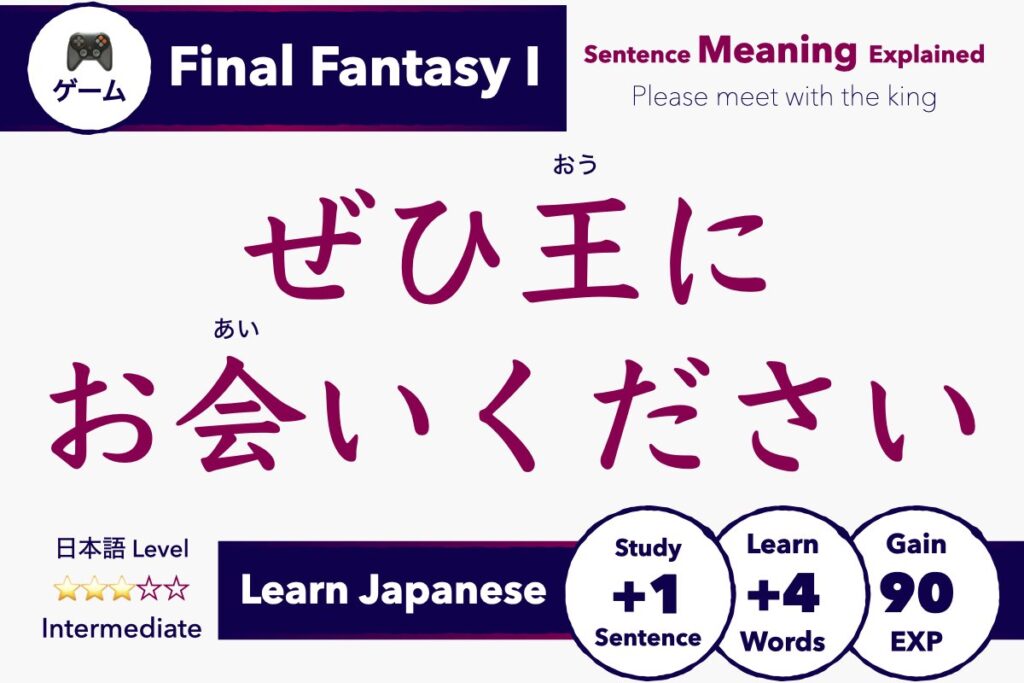
『ぜひ王にお会いください!』means 「Please meet with the king!」 It’s a Final Fantasy 1 line spoken by a guard inside Castle Cornelia. Its second half, 「お会いください」, uses a polite request pattern you’ll hear all over Japan, not just in castles.
- ぜひ
by all means - 王に
with the king - お会いください
please meet
Before you see the king, one of the Castle Cornelia guards spots the crystal in your hand, and suddenly he’s speaking to you very differently. Let’s see exactly what’s happening in his one line.
✅ 1 Japanese Sentence
✅ 4 Japanese Words
✅ +90 EXP
Original Japanese Sentence (Final Fantasy I)
Credit Attribution
- Sentence from Final Fantasy I (© SQUARE ENIX)
- Audio file generated with VOICEVOX:剣崎雌雄
日本語
ぜひ王にお会いください!
カナ
ぜひ おう に おあいください!
Romaji
Zehi ou ni oai kudasai!
Possible English Translations
Please note: There isn’t just one correct translation. Japanese sentences can often be translated in several natural ways, and more than one translation may be correct.
Natural Translations
- Please meet with the king!
- Please go and see the king!
- You should definitely meet the king!
Literal Translations
- Please meet the king!
- Please do meet the king!
- Please, by all means, meet the king!
My Preferred Translation
Please meet with the king!
Among all the translations, this is the one I’d pick. It keeps the polite tone of 『お会いください』 without overstating what 『ぜひ』 is doing.
「You should definitely meet the king」 makes 『ぜひ』 sound like an instruction, but 『ぜひ』 is closer to sincere encouragement than a command.
「Please meet with the king」 stays polite and natural without losing that softer, encouraging feel.
Japanese Meaning Explained
This line is spoken by a guard inside Castle Cornelia (コーネリアの城), right as the player is making their way toward the throne room. Moments earlier, another guard mentioned that the king is searching for the legendary Warriors of Light, then noticed the crystals the party is carrying.
So, with 『ぜひ王にお会いください!』, he encourages the party and the player to go meet the king themselves.
『ぜひ』
Meaning: 「by all means」
『ぜひ』 means 「by all means」 or 「definitely」. It’s used to encourage someone to do something or to strongly recommend something.
In our Final Fantasy I sentence, the guard isn’t just informing the party that meeting the king is possible. He’s actively and sincerely encouraging them to go do it.
You’ll see and hear 『ぜひ』 constantly. It’s commonly used by YouTubers, teachers, shop staff, tourist information centers, and friends when recommending something they genuinely think you’ll like.
『王』
Meaning: 「king」
『王(おう)』 simply means 「king」. The word refers to the ruler or monarch of a kingdom.
The same kanji is used in 「王妃 (おうひ)」, one of the common words for queen, which we encountered in an earlier FFI sentence when the Queen of Cornelia introduced herself with 「私が王妃のジェーンです。」.
You won’t hear 『王』 as much in everyday modern conversation, since there aren’t that many kings to talk about anymore, but it’s a word that constantly comes up in fantasy games, historical fiction, and stories involving royalty.
『に』
Function: Target Marker 「に Particle」
- 「〇〇に会う」 means 「to meet 〇〇」
- 『王に会う』 means 「to meet the king」
The particle 『に』 is commonly used to mark the destination, target, or endpoint of an action.
In Japanese, the word 「会う(あう, “to meet”」 almost always takes the particle 『に』, not 「を」, even though English speakers often expect an object marker here since “meet someone” feels like a direct action.
In this line, the particle 『に』 marks 『王(おう)』 as the person being met, since 「会う(あう)」 is not an action performed on him.
You’ll come across this exact pattern constantly: 「友達に会う (meet a friend)」, 「先生に会う (meet a teacher)」, 「王に会う (meet the king)」. It’s always 『に』, never 「を」.
『お会いください』
Translation: 「please meet」
- 「お」 is a polite prefix
- 「会う(あう)」 means 「to meet」
- 「ください」 means 「please (give or do for me)」
- 『お会いください』 = 「お」+ 「会う (stem form)」 + 「ください」
『お会いください』 means 「please meet」. It’s a polite and respectful way to ask someone to do something.
This expression combines the honorific prefix 「お」, the stem form of 「会う」, and 「ください」.
Most learners meet the plain request form 「会ってください(あってください)」 long before they ever see 『お会いください』.
However, in this Final Fantasy I scene, the guard believes he may be speaking to the legendary Warriors of Light from Lukahn’s prophecy, so the more respectful expression feels natural.
Since「お〜ください」 is a common, respectful pattern, you’ll hear it everywhere from shops and hotels to train stations and museums.
Build Japanese Sentences
| Building Blocks | Japanese Sentence |
|---|---|
| Adverb (How strongly?) | ぜひ by all means |
| Target (Meet with who?) | 王に with the king |
| Polite Request (What’s being asked?) | お会いください please meet |
ぜひ王にお会いください!
By all means, please meet with the king!
Real-Life Usage Examples
Let’s look at a few natural, everyday examples using the words and patterns from today’s sentence.
- 〜に会う: meeting someone
- お〜ください: polite requests
- ぜひ〜ください: sincere encouragement
Example 1
友達に会いに行く。
I’m going to meet a friend.
Example 2
お待ちください。
Please wait.
Example 3
お入りください。
Please come in.
Example 4
ぜひ来てください。
Please come.
Example 5
ぜひ遊びに来てください。
Please come visit.
How useful is today’s Japanese in real life?
『お〜ください』 is genuine, modern, everyday polite Japanese. You’ll hear it constantly in shops, hotels, offices, and anywhere someone’s speaking respectfully to a guest or customer.
『ぜひ』 is just as practical. It’s one of those words that comes up when someone is genuinely recommending something to you, and you can use it yourself, too!
The pattern「〇〇に会う」 is also frequently used with friends or other people you meet. Just keep in mind to always use 『に』, not 「を」.
| Word | Frequency |
|---|---|
| に | Top 10 |
| お | ~60 |
| 会う | ~200 |
| ください | ~500 |
| 王 | ~1400 |
| ぜひ | ~2500 |
Beyond the Translation
At first glance, 『お会いください』 might just look like a polite way of saying 「please meet the king」, but there’s actually more going on than that.
Instead of using the plain verb 「会う」, the game uses the respectful pattern 『お〜ください』. This is a common way to make requests more polite, especially when the action involves someone important or someone you want to show respect toward.
In this scene, the guard doesn’t simply say 「王に会ってください」. Since he’s inviting the Warriors of Light to meet the king, 『お会いください』 is the much more natural choice.
Use the Sentence Pattern
Pattern to Remember
Respectful Requests
『(ぜひ) お + V(stem) + ください』
「Please (be sure to) (verb)」
- お書きください → Please write
- お申し込みください → Please apply
- ぜひお楽しみください → Please enjoy it
- ぜひお越しください → Please be sure to come
① Quick Quiz
What’s the meaning of:
『ぜひ王にお会いください!』
A) You can visit the king.
B) Please meet with the king!
C) You must meet the king immediately!
② Mini Quest
Which sentence is correct?
A) 友達を会う。
B) 友達に会う。
③ Final Challenge
Complete the sentence:
『_____ 王にお会いください。』
Answers
① B
② B
③ ぜひ
What you achieved today:
✅ Japanese Sentences +1
✅ Japanese Words +4
✅ 日本語 EXP +90
Congratulations 🎉
おめでとう🎉
Learn More Japanese with…
Final Fantasy 1
- 『偶然とは思えぬ。』
Learn how the King of Cornelia speaks - 『私が王妃のジェーンです。』
Learn how the Queen of Cornelia speaks
Related Words
- 王 (おう) — king
How to Say 「King」 in Japanese
Now you know why 『お会いください』 sounds so much more polite than plain 「会ってください」, and how 『ぜひ』 turns a simple request into sincere encouragement.
The next time you hear 「ぜひ〜ください」 in a game, anime, or while travelling in Japan, you’ll instantly recognize both the polite request and the warm encouragement packed into those few words.
See you soon! またね 🎮✨
Alex