
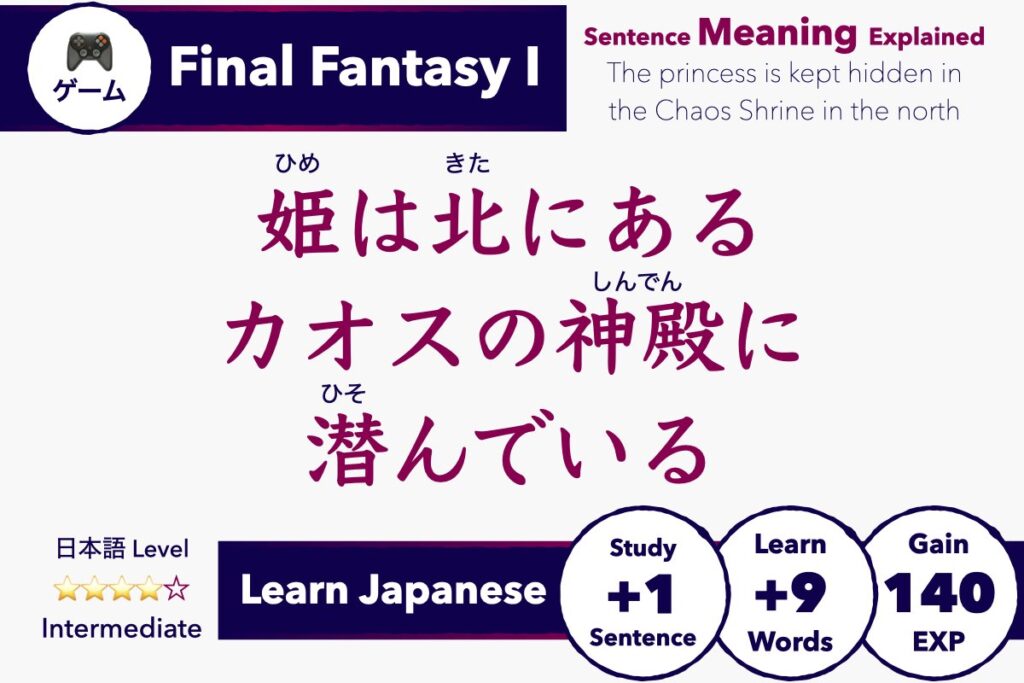
『姫は北にあるカオスの神殿に潜んでいる。』 means 「The princess is kept hidden in the Chaos Shrine in the north.」 It’s a line from Final Fantasy 1, spoken by Cornelia’s minister right after explaining that Garland kidnapped Princess Sarah.
- 姫は
as for the princess - 北にあるカオスの神殿に
in the Chaos Shrine that is to the north - 潜んでいる
is hidden
This is the moment the story finally points you toward your next destination, while quietly teaching you one of Japanese‘s most useful sentence patterns.
✅ 1 Japanese Sentence
✅ 9 Japanese Words
✅ +140 EXP
Original Japanese Sentence (Final Fantasy I)
Credit Attribution
- Sentence from Final Fantasy I (© SQUARE ENIX)
- Audio file generated with VOICEVOX:四国めたん
日本語
姫は北にあるカオスの神殿に潜んでいる。
カナ
ひめ は きた に ある カオス の しんでん に ひそんでいる。
Romaji
Hime wa kita ni aru Kaosu no Shinden ni hisonde iru.
Possible English Translations
Please note: There isn’t just one correct translation. Japanese sentences can often be translated in several natural ways, and more than one translation may be correct.
Natural Translations
- The princess is being held in the Chaos Shrine to the north.
- The princess is kept hidden in the Chaos Shrine in the north.
- The princess remains hidden in the Chaos Shrine located in the north.
Literal Translations
- The princess is hidden in the Chaos Shrine in the north.
- The princess is hidden in the Chaos Shrine, which is in the north.
- As for the princess, she is hidden in the Chaos Shrine in the north.
My Preferred Translation
The princess is kept hidden in the Chaos Shrine in the north.
『潜んでいる』 literally means 「is hidden」 or 「is lurking」, but that phrasing makes it sound like the princess chose to hide herself.
Just moments earlier in this same scene, the minister explains that the knight Garland kidnapped her, so she isn’t hiding by choice. Knowing that context, 「is kept hidden」 or 「is being held」 just sounds most natural in English.
It’s still an interesting word choice, though. Instead of saying 「kidnapped」 or 「held captive」, the game simply describes her as being hidden away in the shrine. We’ll come back to why in Beyond the Translation.
Japanese Meaning Explained
Today’s sentence 『姫は北にあるカオスの神殿に潜んでいる。』 is spoken by the minister of Cornelia. Right after he tells the party that the knight Garland kidnapped Princess Sarah and is now demanding the throne of Cornelia for himself.
Rather than dwelling on Garland‘s betrayal, the minister tells the Warriors of Light the exact location in the north where the princess is held captive and asks them to go to Chaos Shrine to rescue her.
『姫』
Meaning: 「princess」
『姫(ひめ)』 means 「princess」. It’s used respectfully to refer to a young lady of noble birth.
Here, it refers to Princess Sarah (セーラ姫), the daughter of Queen Jane and the King of Cornelia, who was kidnapped by Garland.
『姫』 appears in the upper half of the Top 10,000 most common Japanese words. It’s especially common in fantasy games, fairy tales, historical dramas, and other stories that involve royalty.
『は』
Function: Topic Marker 「は Particle」
The particle 『は』 marks the word 「姫」as the topic of the sentence. It tells us that everything that follows is about the princess, which in this specific sentence is where she currently is.
The particle does the same job it did in these earlier FF1 sentences:
- 「この世は暗黒に包まれている」
『は』 introduces 「この世」 as the topic - 「偶然とは思えぬ。」
『は』 marks the quoted word 「偶然」 as the topic
『は』 is one of the Top 10 most common Japanese words.
『姫は潜んでいる』 translates as:
- 「The princess is hidden」
- 「As for the princess, (she) is hidden」
『北』
Meaning: 「north」
『北(きた)』 simply means 「north」. It’s one of the four cardinal directions, alongside 「南 (south)」、「東 (east)」、and 「西 (west)」.
『北』 ranks in the top quarter of the Top 10,000 most common Japanese words. You’ll come across it whenever someone gives directions, checks a map, or talks about where somewhere is.
『に』
Function: Location Marker 「に Particle」
The particle 『に』 marks 「北」 as the location where the Chaos Shrine is, and ultimately as the place where the princess is held captive.
You’ll encounter 『に』 one more time later in this sentence.
『北にある』 translates as:
- 「to the north」
- 「is in the north」
- 「located in the north」
『ある』
Meaning: 「to be, to exist」
Translation: 「is」
『ある』 is the plain form (dictionary form) of the existence verb and means 「to be」 or 「to exist」. It’s commonly used to express that something exists, is there, or is available.
In this Final Fantasy 1 sentence, it’s used before the noun phrase「カオスの神殿(カオス の しんでん)」 to describe where the shrine is located.
In Japanese, you don’t need a word like 「that」 or 「which」 to build a relative clause. The plain, dictionary form of a verb can sit directly in front of a noun and describe it, no extra word needed.
- 「北にある神殿」
「the shrine, that is in the north」
「the shrine located in the north」 - 『北にあるカオスの神殿』
「the Chaos shrine that is in the north」
「the Chaos shrine located in the north」
So 『北にある』 describes not just the noun right next to it, but reaches all the way to 「神殿(しんでん)」. This can be confusing at first glance, but once you are aware that Japanese sentences untangle themselves.
『ある』 sits in the first quarter of the Top 100 most common Japanese words, so you will see, hear, and use it a lot!
『カオス』
Character Name: 「Chaos」
Meaning: 「chaos」
The Japanese word『カオス』 means 「chaos」, but here it’s actually used as the name 「Chaos」 for one of the Final Fantasy 1 characters. You can find him and the Japanese names of other characters on the FF1 Glossary page.
『の』
Function: Noun Connector 「の Particle」
The particle 『の』 connects the two nouns 「カオス」 and 「神殿(しんでん)」. It tells us that this is not just any shrine, but the 「shrine of Chaos」 or 「Chaos’s Shrine」.
We’ve already seen this function of 「の」 in earlier FF1 sentences:
- 「人々は ひとつの予言を信じ…」
『の』 connects 「ひとつ」 and 「予言」 - 「私が王妃のジェーンです。」
『の』connects 「王妃」 and 「ジェーン」
『の』 is one of the Top 10 most common Japanese words. You’ll encounter it constantly in Japanese, including many other functions besides simply connecting nouns.
『カオスの神殿』 translates as:
- 「Chaos Shrine」
- 「Chaos’s shrine」
- 「the shrine of Chaos」
『神殿』
Meaning: 「shrine」
『神殿(しんでん)』 means 「shrine」 or 「temple」. It refers to a sacred building dedicated to a god or spirit.
『神殿』 falls within the latter half of the Top 10,000 most common Japanese words. It’s less common than 「神社(じんじゃ)」, but you’ll come across it in fantasy games, historical dramas, and anywhere Shinto shrines or ancient temples come up.
『北にあるカオスの神殿』 translates as:
- 「the Chaos shrine in the north」
- 「the Chaos shrine that is in the north」
- 「the Chaos shrine located in the north」
『に』
Function: Location Marker 「に Particle」
The particle 『に』 marks 「神殿」 as the location where the princess is held captive.
『に』 is one of the Top 10 most common Japanese words. It’s a particle you’ll encounter constantly marking locations, destinations, or the passive agent.
『神殿に潜んでいる』 translates as:
- 「is hidden in the shrine」
『潜んでいる』
Translation: 「is hidden」
Dictionary: 「潜む(ひそむ)」
- to lurk
- to be hidden
- to be concealed
『潜んでいる(ひそんでいる)』 is the 「〜ている form」 of 「潜む(ひそむ)」.
It describes an ongoing state of being hidden rather than a single moment of hiding and translates as 「is hidden」.
The word usually implies staying out of sight on purpose, which is exactly why some of the translations make it sound like the princess chose to hide. There’s more to that below, in Beyond the Translation.
The word 「潜む」 is among the first half of the Top 10,000 most common Japanese words. It’s used in mystery novels, nature documentaries, and news reports just as often as in games, whenever something is hidden, or someone is staying deliberately hidden.
How to Form the Present Continuous
| Step | Word | Form |
|---|---|---|
| ① | 潜む | dictionary form |
| ② | 潜んで | te-form |
| ③ | 潜んでいる | te-form + iru |
Build Japanese Sentences
| Building Blocks | Japanese Sentence |
|---|---|
| Topic (What about?) | 姫は the princess |
| Relative Clause (Which shrine?) | 北にある that’s in the north |
| Location (Where?) | カオスの神殿に in the Chaos Shrine |
| Verb (What action?) | 潜んでいる is hidden |
姫は北にあるカオスの神殿に潜んでいる。
The princess is hidden in the Chaos Shrine to the north.
Real-Life Usage Examples
Let’s look at a few natural, everyday examples using today’s vocabulary and sentence patterns.
- 〜にある: describing where something is located
- 〜に潜む: something is hidden or lying low somewhere
- 〜ている: describing a current or ongoing state
Example 1
東京にある店
→ the shop that’s in Tokyo
Example 2
駅の中にある店
→ the shop inside the station
Example 3
闇に潜む
→ to lurk in the darkness
Example 4
近くに潜む犯人
→ a culprit that hides nearby
Example 5
猫は机の下に潜んでいる。
The cat is hiding under the desk.
How useful is today’s Japanese in real life?
『にある』 is something you’ll use constantly. It’s used any time you describe where a shop, building, or place is located.
「潜む」 is a little more situational. You won’t use it to talk about your own house, but it comes up regularly in the news, mystery stories, and everyday conversations about animals or people staying out of sight.
Between the two, you’re walking away with one grammar pattern you’ll use every day, and one vocabulary word that’s genuinely useful the moment the right situation comes up.
| Word | Frequency |
|---|---|
| の | Top 10 |
| は | Top 10 |
| に | Top 10 |
| ある | ~20 |
| 北 | ~2000 |
| 姫 | ~3000 |
| 潜む | ~4000 |
| 神殿 | ~8000 |
| カオス | ~19,000 |
Beyond the Translation
One thing I found interesting when reading this FF1 sentence is the word 『潜んでいる』.
You might have heard this word before, since it’s used in the title of one of Final Fantasy 7‘s songs: 「闇に潜む (Lurking in the Darkness)」.
I kept wondering why they are using a word that specifically describes someone or something remaining out of sight on purpose. I mean, after all, it’s the same word you’d use for an animal hiding from view or a criminal lying low.
Earlier, we learned that Garland kidnapped the princess, so she isn’t hiding there by choice. Yet the game still uses 『潜んでいる』 and I only have one explanation for that.
The game isn’t focused on re-explaining Garland‘s actions or framing him as evil. It’s just describing the situation as it exists right now, not explaining how she actually got there.
Just like 「包まれている」 in 「この世は暗黒に包まれている」 paints a picture of the world’s current state, 『潜んでいる』 simply paints a picture of where the princess is right now.
Use the Sentence Pattern
Pattern to Remember
Located Somewhere
『〇〇にある + N』
「the (noun) that’s (located) in/at 〇〇」
- そこにある犬 → the dog that’s over there
- ここにあるもの → the things that are here
- 駅の近くにある公園 → the park near the station
- 山の上にある神殿は有名だ → The shrine on top of the mountain is famous
① Quick Quiz
What’s the meaning of:
『姫は北にあるカオスの神殿に潜んでいる。』
A) The princess is hiding in the south.
B) The princess went to the Chaos Shrine.
C) The princess remains hidden in the Chaos Shrine.
② Mini Quest
Which sentence is correct?
A) 南にある神殿
B) 東をある神殿
③ Final Challenge
Complete the sentence:
『姫は北にあるカオスの _____ に潜んでいる。』
Answers
① C
② A
③ 神殿
What you achieved today:
✅ Japanese Sentences +1
✅ Japanese Words +9
✅ 日本語 EXP +140
Congratulations 🎉
おめでとう🎉
Learn More Japanese with…
Final Fantasy 1
Topic Marker 『は』
- 『偶然とは思えぬ。』
See how 『は』 marks a quoted topic - 『この世は暗黒に包まれている』
See how 『は』 introduces the topic
Noun Connector 『の』
- 『私が王妃のジェーンです。』
See another way 『の』 connects nouns - 『人々は ひとつの予言を信じ…』
See how 『の』 connects two nouns
Target Particle 『に』
- 『ぜひ王にお会いください!』
See how 『に』 marks the person you meet - 『長い冒険の末 4人の若者が この地にたどり着いた』
See how 『に』 marks a destination
Now you know how 『にある』 quietly builds a relative clause in front of a noun, and why 『潜んでいる』 paints a picture of hiding even when the story is really about someone being held captive.
The next time a JRPG needs to point you toward your next destination, keep an ear out for 『にある』 doing exactly this job.
Have fun playing FF1 and see you soon! 🎮✨
Alex