
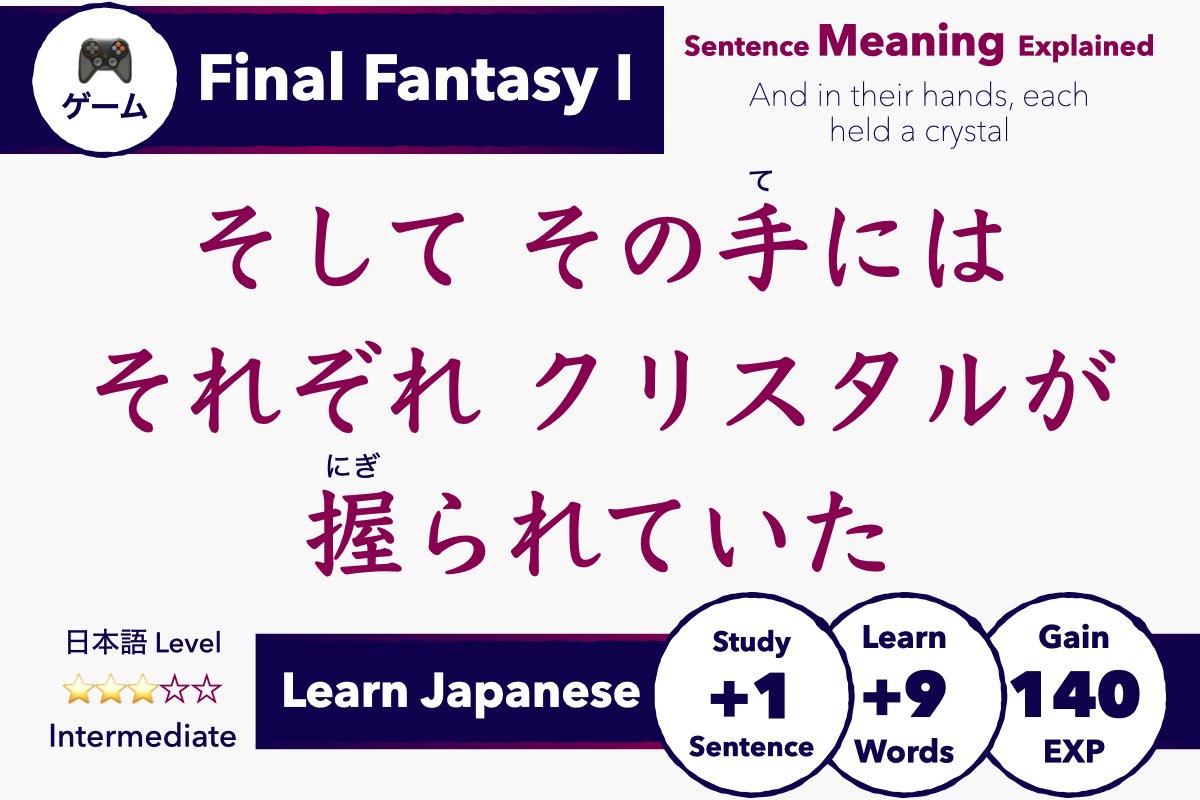
Learn Japanese with Final Fantasy 1! Today, we’ll study the meaning and English translations of 『そして その手には それぞれ クリスタルが握られていた』 from the game’s opening narration.
The Japanese sentence from FF1:
『そして その手には それぞれ クリスタルが握られていた』
Its meaning & English translation:
「And in their hands, each held a crystal」
Want to understand what this Japanese sentence really means? Scroll down, and I’ll bring you one step closer to playing Final Fantasy I in Japanese.
✅ 1 Japanese Sentence
✅ 9 Japanese Words
✅ +140 EXP
Original Japanese Sentence (Final Fantasy I)
日本語
そして その手には それぞれ
クリスタルが握られていた
カナ
そして その て に は それぞれ
クリスタル が にぎられていた
Romaji
Soshite sono te ni wa sorezore
kurisutaru ga nigirarete ita
Possible English Translations
Please note: There isn’t just one correct translation. Japanese sentences can often be translated in several natural ways, and more than one translation may be correct.
Natural Translations
- And in their hands, each held a crystal.
- And each of them held a crystal in their hands.
- And in their hands, each was holding a crystal.
Literal Translations
- And as for those hands, each held a crystal.
- And in their hands, a crystal was being held.
- And in each of those hands, a crystal was being held.
My Preferred Translation
And in their hands, each held a crystal.
This is the translation I would choose because it stays very close to the original Japanese while still sounding natural in English.
I especially like keeping the sentence focused on their hands first, because Japanese uses 『その手には』 before it even mentions the crystals.
That word order creates a small moment of suspense: we look at their hands first, and only then discover that each one holds a crystal.
To me, that better preserves the slow reveal of the original Japanese, where our attention is first drawn to their hands before the crystals are revealed.
Japanese Meaning Explained
『そして その手には それぞれ クリスタルが握られていた』 appears near the end of the opening narration of Final Fantasy I, immediately after the four young people finally arrive in this land.
This Japanese sentence doesn’t simply tell us that the heroes possess crystals. It shows us. It describes how all four young people are carrying crystals with them, emphasizing that each one is holding a crystal in their hands.
『そして』
Meaning: 「and then」
『そして』 means「and then」. It connects one event or scene to the next and helps the story flow naturally, and can also be translated as 「and」 or 「then」.
Here, in our Final Fantasy I sentence, 『そして』 introduces the next important image after the four young people arrive in this mysterious land.
You’ll encounter 『そして』 frequently in everyday Japanese conversations, books, games, anime, and narration whenever one event naturally leads into another.
『その』
Meaning: 「that…」
- 「その〇〇」 means 「that 〇〇」
- 『その手』 means 「that hand」 or 「those hands」
『その』 means 「that…」. It is usually used before a noun to refer to something that has already been mentioned or is already understood from the context.
In our Final Fantasy 1 sentence, 『その』 refers back to the four young people mentioned in the previous sentence, making 『その手』 naturally understood as their hands.
You’ll encounter 『その』 constantly in everyday Japanese when referring back to people, places, objects, or ideas that have already been introduced.
『手』
Meaning: 「hand」
『手(て)』 means「hand」. Besides referring to the physical hand, it also appears in countless everyday expressions related to help, skill, effort, or ways of doing something.
You’ll hear 『手』 constantly in everyday Japanese, making it one of the most useful vocabulary words you’ll ever learn.
『に』
Function: Location Marker 「に Particle」
- 「〇〇に」 means 「in/at 〇〇」
- 『その手に』 means 「in their hands」
The particle 『に』 commonly marks a location, destination, point in time, or target.
In our Final Fantasy I sentence, it marks 『その手』 as the location where each crystal is being held.
You’ll encounter 『に』 constantly in Japanese whenever someone talks about where something exists, where someone goes, when something happens, or who receives an action.
『は』
Function: Topic Marker 「は Particle」
- 「〇〇は」 means 「As for 〇〇」
- 『その手には』 means 「As for in those hands」
The particle 『は』 marks the topic of the sentence. Think of it as saying, “Let’s talk about…”
In our Final Fantasy I sentence, it introduces 『その手に』 as the topic, bringing our attention to the four young people’s hands before revealing what is in them.
It may look unusual to see 『は』 right after 『に』, but this is simply two particles working together.
『に』 marks the location 「in their hands」, and 『は』 turns that location into the topic of the sentence.
So 『その手には』 is not just talking about 「hands」. It’s talking about their hands as the location we’re focusing on.
You’ll encounter 『は』 in almost every Japanese conversation, making it one of the most important particles to learn.
『それぞれ』
Meaning: 「each」
『それぞれ』 means 「each」, 「each one」, or 「respectively」. It emphasizes that every person or thing in a group has its own individual item, role, or characteristic.
In today’s Final Fantasy I sentence, 『それぞれ』 tells us that each of the four young people has their own crystal rather than sharing a single one.
You’ll encounter 『それぞれ』 frequently in everyday Japanese, instructions, conversations, documentaries, and stories whenever something applies individually to every member of a group.
『クリスタル』
Meaning: 「crystal」
『クリスタル』 means 「crystal」. It usually refers to a crystal made of glass or quartz, but in fantasy games it often describes magical crystals with mysterious powers.
In today’s Final Fantasy I sentence, 『クリスタル』 refers to the legendary crystals that play a central role in all FF stories.
You’ll encounter 『クリスタル』 frequently in the Final Fantasy game series, other JRPGs, fantasy anime, and novels, whenever magical crystals, artifacts, or gemstones appear.
『が』
Function: Subject Marker 「が Particle」
- 「〇〇が」 means 「〇〇 (does something)」
- 『クリスタルが』 means 「the crystal」
The particle 『が』 marks the subject of a sentence. In other words, it tells us what performs the action or what is being described.
In our Final Fantasy I sentence, 『が』 marks 『クリスタル』 as the thing that is being held.
Even though the four young people are holding the crystals, the 「Passive Form」 shifts the focus away from the people and onto the crystals themselves.
That’s why 『クリスタル』 becomes the subject of the sentence.
One helpful way to think about the 「Passive Form」 is to temporarily translate it as 「getting held」. What is getting held? → the crystal (not the four people).
This isn’t always the best English translation, but it can be a very helpful way to see why 『クリスタル』 is marked with 『が』.
You’ll encounter 『が』 constantly in Japanese whenever a sentence introduces who performs an action or identifies what is being described.
『握られていた』
Translation: 「was being held」
- 「握る(にぎる)」 means 「to hold」, 「to grip」, 「to grasp」
- 『握られている』 = 「握られる (passive)」+ 「〜ている (past tense)」
『握られていた(にぎられていた)』 translates naturally as 「was being held」. It describes an ongoing state in the past rather than the moment someone grabbed the crystal.
So our FF1 sentence isn’t describing the action of taking hold of the crystal. Instead, the focus is on the image that, at that moment in the story, each crystal was already resting firmly in its owner’s hand.
You’ll hear 『握る』 frequently in everyday Japanese whenever someone holds a hand, grips a steering wheel, grabs a handle, or firmly holds an object.
Build Japanese Sentences
そして → その手には → それぞれ → クリスタルが → 握られていた
| Building Blocks | Japanese Sentence |
|---|---|
| Connector | そして and then |
| Location (Where?) | その手に in their hands |
| Topic (What about?) | は as for (location) |
| Adverb | それぞれ each |
| Subject (What’s getting held?) | クリスタルが a crystal |
| Verb (What happens?) | 握られていた was being held |
そして その手には それぞれ
クリスタルが握られていた。
And in their hands, each
held a crystal.
Real-Life Usage Examples
Here are some natural examples using 「握る」 and 『握られている』.
Example 1
手を握る
→ to hold someone’s hand
Example 2
ハンドルを握る
→ grip the steering wheel
Example 3
鍵を握る
→ to hold the key (to something)
Example 4
彼の手には花が握られていた。
A flower was being held in his hand.
Example 5
その手には一枚の紙が握られていた。
A single sheet of paper was held in that hand.
So, can I actually use today’s Japanese in everyday life?
『握る』 is a common everyday verb used whenever someone firmly holds or grips something, whether it’s a person’s hand, a steering wheel, a microphone, or another object.
Today’s sentence also introduces the 「Passive」 expression 『握られていた』, a pattern you’ll encounter regularly in novels, games, movies, and narration whenever the writer focuses on the state of a scene rather than the person performing the action.
| Word | Frequency |
|---|---|
| 1. 『は』 | Top 10 |
| 2. 『に』 | Top 10 |
| 3. 『が』 | Top 10 |
| 4. 『その』 | Top 30 |
| 5. 『そして』 | Top 90 |
| 6. 『手』 | Top 100 |
| 7. 『握る』 | Top 800 |
| 8. 『それぞれ』 | Top 900 |
| 9. 『クリスタル』 | Top 20,000 |
Beyond the Translation
One thing I really want to highlight is that Japanese often uses the passive form in situations where English naturally prefers the active voice.
In English, we’d usually say 「Each of them held a crystal」.
Japanese sentences often chooses a different viewpoint.
Instead of focusing on who is holding the crystals, it focuses on the crystals themselves and the image of them being held.
That shift in perspective is very common in Japanese narration. Writers often describe what is seen or what exists in the scene rather than immediately emphasizing the person performing the action.
It’s almost like a camera slowly reveals the scene.
First, we see the four young people.
Then, our eyes move to their hands.
Finally, we discover the crystals they carry.
Rather than just describing the heroes’ action, the narration lets the image unfold piece by piece, making the reveal feel more dramatic and cinematic.
Use the Sentence Pattern
Pattern to Remember
N が 握られていた
(noun) was being held
- ペンが握られていた → a pen was being held
- 手紙が握られていた → a letter was being held
- チケットが握られていた → a ticket was being held
- スマホが握られていた → a smartphone was being held
① Quick Check
What’s the meaning of:
『そして その手には それぞれ クリスタルが握られていた』
A) Everyone was looking for four crystals.
B) They took the four crystals with their hands.
C) Each of the four young people had a crystal in their hand.
② Mini Challenge
Which sentence means:
「A flower was being held in his hand.」
A) 彼の手には花を握っていた。
B) 彼の手には花が握られていた。
③ Try it Yourself
Use the pattern to say:
- a key was being held
- a letter was being held
- In those hands a sword was being held.
Answers
① C
② B
③ There are many correct answers.
This is just one way to translate them:
- 鍵が握られていた
- 手紙が握られていた
- その手には剣が握られていた。
What you achieved today:
✅ Japanese Sentences +1
✅ Japanese Words +9
✅ 日本語 EXP +140
Congratulations 🎉
おめでとう🎉
Learn More Japanese with…
Final Fantasy
Video Games
Words
- 手
- その
- 握る
- そして
- それぞれ
- クリスタル
Particles
- は
- に
- が
Grammar
- 〜ていた
- Passive Form
Related & Similar Sentences
Final Fantasy 1
- 『この世は暗黒に包まれている』
See another example of the「Passive Form」 - 『人々は ひとつの予言を信じ それを待っていた』
See another example of the 「〜ていた」 grammar pattern
Don’t worry if you can’t remember everything immediately. The goal isn’t to memorize every word the first time you see it.
If the next time you play Final Fantasy or another game, you suddenly recognize 『それぞれ』, 『握る』, or even the passive form in a sentence, then today’s study session was a success.
Just keep gaining Japanese EXP and leveling up your Japanese skills by collecting Japanese sentences and Japanese words, one by one.
See you soon! 🎮✨
Alex