
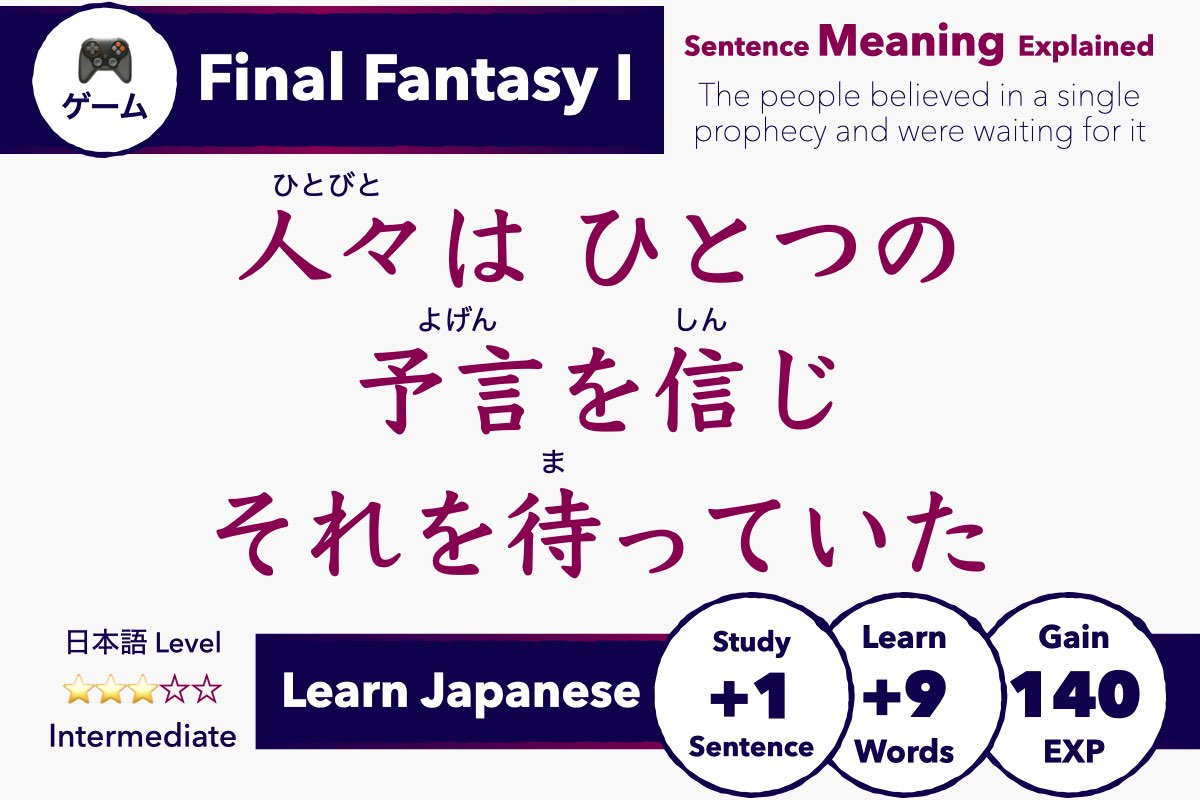
Learn Japanese with Final Fantasy 1! Today, we’ll study the meaning and English translations of the opening line 『人々は ひとつの予言を信じ それを待っていた』.
The Japanese sentence from FF1:
『人々は ひとつの予言を信じ それを待っていた』
Its meaning & English translation:
「The people believed in a single prophecy and were waiting for it」
Want to understand what this Japanese sentence really means? Scroll down, and I’ll bring you one step closer to enjoying Final Fantasy I in Japanese.
✅ 1 Japanese Sentence
✅ 9 Japanese Words
✅ +140 EXP
Original Japanese Sentence (Final Fantasy I)
日本語
人々は
ひとつの予言を信じ
それを待っていた
カナ
ひとびと は
ひとつ の よげん を しんじ
それ を まっていた
Romaji
Hitobito wa
hitotsu no yogen o shinji
sore o matte ita
Possible English Translations
Please note: There isn’t just one correct translation. Japanese sentences can often be translated in several natural ways, and more than one translation may be correct.
Natural Translations
- People placed their faith in one prophecy and waited for it.
- Everyone believed in one prophecy and awaited its fulfillment.
- The people believed in a single prophecy and were waiting for it.
Literal Translations
- The people believed in one prophecy and waited for it.
- The people believed in a prophecy and were waiting for it.
- As for the people, they believed in one prophecy and waited.
My Preferred Translation
The people believed in a single prophecy and were waiting for it.
This is my favorite translation because it sounds natural in English while preserving the hopeful feeling of the original Japanese. I especially like using 「a single prophecy」, since 『ひとつの』 emphasizes that everyone is placing their hopes in one particular prophecy rather than many different ones.
Japanese Meaning Explained
Today’s sentence 『人々はひとつの予言を信じ それを待っていた』 is part of the opening narration of Final Fantasy I after the narrator describes how the world has fallen into darkness.
For the first time, there’s a glimmer of hope. Instead of giving up, the people continue to believe that an ancient prophecy will one day come true, giving them hope that the world could still be saved.
『人々』
Meaning: 「people」
『人々(ひとびと)』 means 「people」, referring to people as a group rather than one specific person.
The 「々」 symbol tells you that the previous kanji is repeated, so 『人々』 literally means 「person person」, giving it the meaning of 「people」.
You’ll encounter 『人々』 frequently whenever someone talks about society, villagers, citizens, or humanity as a whole.
『は』
Function: Topic Marker
- 「〇〇は」 means 「As for 〇〇」
- 『人々は』 means 「As for the people」
『は』 introduces the topic of the sentence. Think of it as saying, “Now let’s talk about …”
In our Final Fantasy I sentence, it marks 『人々』 as the topic of the sentence.
Like we’ve seen before, 『は』 appears constantly in Japanese, making it one of the most useful particles you’ll ever learn.
『ひとつ』
Meaning: 「one」
『ひとつ(一つ)』 means 「one」 and is one of the native Japanese ways to count things.
In today’s sentence, 『ひとつ』 combines with 『の』 to become 『ひとつの』, meaning 「one…」 or 「a single…」 before a noun.
You’ll hear 『ひとつ』 all the time in everyday Japanese whenever people count objects, order something, or emphasize that there is only one of something.
『の』
Function: Noun Connector (Possessive Marker)
- 「AのB」 means 「B of A」, 「A’s B」
- 『ひとつの予言』 means 「one prophecy」
『の』 connects two or more nouns. Sometimes it shows possession, while other times it simply allows one noun to describe another.
In our Final Fantasy 1 sentence, 『の』 connects 『ひとつ』 and 『予言』 to express the idea of one single prophecy.
You’ll encounter 『の』 in almost every Japanese conversation, making it one of the most useful and versatile particles to learn.
『予言』
Meaning: 「prophecy」
『予言(よげん)』 means 「prophecy」, referring to a prediction of the future that foretells events long before they happen and is believed to come true.
Unlike a normal prediction, 『予言』 usually suggests something mystical, legendary, or destined to happen.
You’ll come across 『予言』 frequently in fantasy games, anime, manga, and novels involving chosen heroes, ancient legends, or the fate of the world.
『を』
Function: Object Marker
- 「〇〇をV」 means 「to (verb) 〇〇」
- 「予言を信じる」 = 「to believe in a prophecy」
『を』 marks the direct object of a verb. In other words, it marks the thing the action is performed on.
In our FFI sentence, it marks 『予言』 as the thing that people believe in.
You’ll encounter 『を』 in almost every Japanese conversation whenever someone eats something, watches something, studies something, believes something, or performs almost any action involving an object.
『信じ』
Meaning: 「believe and…」
- 「信じる(しんじる)」 means 「to believe」, 「to have faith in」, 「to trust」
- 『信じ』 is the stem form of 「信じる」
『信じ(しんじ)』 means 「believe and…」. Because the verb is in its stem form, it connects to the next verb and shows that another action follows.
In our Final Fantasy I sentence, 『信じ』 connects to 『待っていた』 to express two actions in sequence: 「believed (in the prophecy) and waited (for it)」.
You’ll hear 『信じる』 frequently in both everyday conversations and stories whenever people talk about trusting someone, believing in something, or having faith in themselves.
『それ』
Meaning: 「that」
『それ』 means 「that」, and refers to something that has already been mentioned. When it refers back to something you’ve already mentioned, it’s often translated as 「it」.
In our FF1 sentence, 『それ』 refers back to 『ひとつの予言』 instead of repeating the word 「prophecy」 again.
You’ll hear 『それ』 constantly in everyday conversations whenever speakers refer back to something they already talked about.
『を』
- 『それを待っていた』 = 「were waiting for it」
『待っていた』
Meaning: 「were waiting」
- 「待つ(まつ)」 means 「to wait」, 「to await」
- 『待っていた』 = 「待つ」 + 「〜ている (past tense)」
『待っていた(まっていた)』 means 「were waiting」 or 「had been waiting」. It describes an ongoing state in the past rather than a single moment.
The people weren’t waiting for just a few minutes. They had been waiting for the prophecy for a long time.
『待つ』 is one of the most common everyday verbs in Japanese. You’ll hear it everywhere, whether you’re waiting for a friend, a train, or your favorite game to be released.
Build Japanese Sentences
人々は → ひとつの予言を → 信じ → それを → 待っていた
| Building Blocks | Japanese Sentence |
|---|---|
| Topic (What about?) | 人々は the people |
| Object 1 (Believe what?) | ひとつの予言を one prophecy |
| Verb 1 (What happens?) | 信じ believed and… |
| Object 2 (Wait for what?) | それを it |
| Verb 2 (What happens?) | 待っていた were waiting |
人々はひとつの予言を信じ、
それを待っていた。
The people believed in a single prophecy and
were waiting for it.
Real-Life Usage Examples
Here are some natural examples using 「信じていた」 and 『待っていた』.
Example 1
友達を信じていた。
I believed in my friend.
Example 2
先生の言葉を信じていた。
I believed my teacher’s words.
Example 3
友達を待っていた。
I was waiting for my friend.
Example 4
バスを待っていた。
I was waiting for the bus.
Example 5
みんなが結果を待っていた。
Everyone was waiting for the results.
So, can I use today’s Japanese in everyday life?
Both 「信じる」 and 「待つ」 are extremely common everyday verbs.
Whether you’re trusting a friend, believing in yourself, waiting for a train, or waiting for someone to arrive, you’ll hear and use these words all the time.
You’ll also encounter 『それ』 constantly, making today’s sentence surprisingly practical despite its fantasy setting.
The 「stem form」 is especially common in written Japanese, such as novels, game dialogue, narrations, newspapers, and formal speeches. In everyday conversation, Japanese speakers prefer the 「〜て」 form instead.
Beyond the Translation
One little detail I love about this sentence is the use of 『信じ』 instead of 「信じて」.
Japanese often uses the stem form of a verb to connect two closely related actions.
Here, 『信じ』 smoothly links 「believed」 to 「waited」, almost like saying 「They believed (in …) and waited」.
You could also say 『信じて待っていた』, but that places slightly more emphasis on the sequence of the actions.
Using the stem form makes the narration feel smoother, more literary, and more like something you’d read in a novel or hear in a game’s opening narration.
Use the Sentence Pattern
Pattern to Remember
V(stem) + V
often used in written Japanese to connect two actions in sequence
- 座り、本を読む → sit down and read a book
- ドアを開け、入る → open the door and enter
- 音楽を聞き、勉強する → listen to music and study
- 朝ご飯を食べ、学校へ行く → eat breakfast and go to school
① Quick Check
What’s the meaning of:
『人々は ひとつの予言を信じ それを待っていた』
A) The people wrote a new prophecy.
B) The people believed the prophecy and waited for it.
C) The people kept waiting for the prophecies to come true.
② Mini Challenge
Which sentence means:
「I believed in my friend.」
A) 友達を待っていた。
B) 友達を信じていた。
③ Try it Yourself
Use the pattern to describe:
- eat and drink
- wake up and wash my face
- meet my friend and eat dinner
Answers
① B
② B
③ There are many correct answers.
Here are just a few examples:
- 食べ、飲む
- 起き、顔を洗う
- 友達に会い、晩ご飯を食べる
What you achieved today:
✅ Japanese Sentences +1
✅ Japanese Words +9
✅ 日本語 EXP +140
Congratulations 🎉
おめでとう🎉
Learn More Japanese with…
Video Games
Learn Japanese with Video Games
Final Fantasy
Learn Japanese with Final Fantasy
Words
- それ
- 待つ
- 人々
- 予言
- ひとつ
- 信じる
Particles
- は
- を
- の
Grammar
- ~ていた
- Stem Form
Today’s Final Fantasy I sentence introduced quite a few new words and grammar points, so don’t worry if you can’t remember everything immediately. That’s completely normal.
If one day you’re playing Final Fantasy or another video game and suddenly think, “Wait… I know what that means!” then this study session was a success.
Just keep gaining Japanese EXP and leveling up your Japanese skills by collecting sentences and words, one by one.
See you again next time! 🎮✨
Alex