

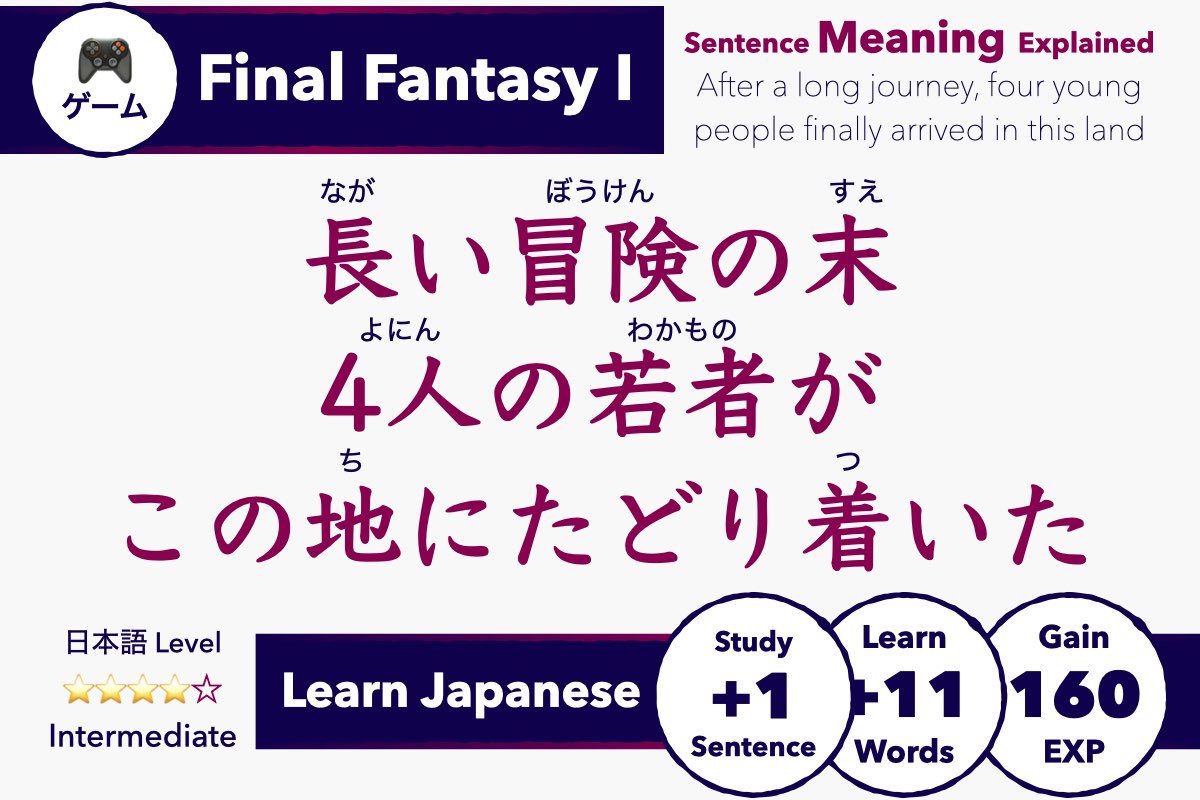
Learn Japanese with Final Fantasy 1! Today, we’ll study the meaning and English translations of the line 『長い冒険の末 4人の若者が この地にたどり着いた』.
The Japanese sentence from FF1:
『長い冒険の末 4人の若者が この地にたどり着いた』
Its meaning & English translation:
「After a long journey, four young people finally arrived in this land」
Want to understand this Japanese sentence from start to finish? Scroll down, and I’ll bring you one step closer to playing Final Fantasy I in Japanese.
✅ 1 Japanese Sentence
✅ 11 Japanese Words
✅ +160 EXP
Original Japanese Sentence (Final Fantasy I)
日本語
長い冒険の末
4人の若者が
この地にたどり着いた
カナ
ながい ぼうけん の すえ
よにん の わかもの が
この ち に たどりついた
Romaji
Nagai bouken no sue
yonin no wakamono ga
kono chi ni tadoritsuita
Possible English Translations
Please note: There isn’t just one correct translation. Japanese sentences can often be translated in several natural ways, and more than one translation may be correct.
Natural Translations
- After a long journey, four young people finally arrived in this land.
- At the end of a long adventure, four young people reached this land.
- Following a long adventure, four young people finally reached this place.
Literal Translations
- Following a long adventure, four young people arrived at this land.
- At the end of a long adventure, four young people arrived in this place.
- After the conclusion of a long adventure, four young people reached this land.
My Preferred Translation
After a long journey, four young people finally arrived in this land.
This is my favorite translation because 「journey」 sounds a little more natural in English than 「adventure」 in this type of narration.
I also like the addition of 「finally」 because it captures the sense of both 「〜の末」 and 『たどり着いた』.
Together, they preserve not only the literal meaning, but also the feeling that our heroes reached this place only after a long and difficult journey.
Japanese Meaning Explained
Today’s sentence 『長い冒険の末 4人の若者が この地にたどり着いた』 appears near the end of the opening narration of Final Fantasy I.
Rather than simply saying that the heroes arrived somewhere, the narrator emphasizes that they reached this place only after a long adventure, making their arrival feel significant—as if fate itself has finally brought them here.
『長い』
Meaning: 「long」
『長い(ながい)』 means「long」 and describes length or duration.
In our Final Fantasy I sentence, 『長い』 refers to the duration of the adventure rather than the physical distance traveled.
You’ll encounter 『長い』 a lot in everyday Japanese when talking about things such as long roads, long hair, long meetings, or other long periods of time.
『冒険』
Meaning: 「adventure」
『冒険(ぼうけん)』 means 「adventure」.
It usually refers to an exciting journey into the unknown that involves danger, exploration, or overcoming challenges.
You’ll hear 『冒険』 everywhere in JRPGs, anime, manga, fantasy novels, and even everyday conversations when talking about trying something new.
『の』
Function: Noun Connector 「の Particle」
- 「AのB」 means 「B of A」, 「A’s B」
- 『冒険の末』 means 「the end of the adventure」
The particle 『の』 connects two or more nouns together. It can indicate possession or simply allow one noun to describe another.
In our Final Fantasy 1 sentence, 『の』 links 『冒険』 to 『末』 to express that something happens only after a long adventure.
Like we’ve already seen in previous lessons,『の』 is one of the most common particles in Japanese.
『末』
Meaning: 「end」
- 「〇〇の末」 means 「(finally) after 〇〇」, 「(at last) after 〇〇」, 「at the end of 〇〇」
『末(すえ)』 literally means 「end」.
However, in our Final Fantasy I sentence, it is used in the expression 「〜の末」 and emphasizes that something finally happened only after considerable time, effort, or difficulty.
You’ll encounter 「末」 and 「〜の末」 fairly often in novels, news articles, biographies, documentaries, and dramatic narration.
『4人』
Meaning: 「four people」
『4人(よにん)』 simply means 「four people」.
The Japanese language uses different counters depending on what you’re counting. For people, the counter is 「〜人」.
You’ll see the kanji 「人」 , the counter 「〜人」, and the word 「人(ひと)」 constantly in everyday Japanese.
『若者』
Meaning: 「young people」
『若者(わかもの)』 means 「young people」 or 「young person」.
Rather than referring to children, it usually describes teenagers or young adults.
You’ll often encounter 『若者』 in news, documentaries, novels, games, and conversations about younger generations.
『が』
Function: Subject Marker 「が Particle」
- 「〇〇が」 means 「〇〇 (does something)」
- 『4人の若者が』 means 「four young people」
The particle 『が』 marks the subject of a sentence. In other words, it tells us who or what performs the action.
In our Final Fantasy 1 sentence, 『が』 shows us that the four young people are the ones who 「finally arrive」 in this land.
You’ll encounter 『が』 constantly in Japanese whenever a sentence introduces who performs an action or identifies who or what something is.
『この』
Meaning: 「this…」
- 「この〇〇」 means 「this 〇〇」
- 『この地』 means 「this land」
『この』 means 「this…」. It is used before nouns to indicate something close to the speaker or the current situation.
In today’s FF1 sentence, it refers to the land where our heroes are about to begin their adventure.
You’ll encounter 『この』 constantly in everyday Japanese when talking about people, places, objects, or ideas nearby.
『地』
Meaning: 「land」
『地(ち)』 means 「land」 and refers to the ground, a place, or a territory.
Unlike 「土地(とち)」, which often refers to property or a specific piece of land, 『地』 has a broader and more literary feeling.
You’ll encounter 『地』 in games, novels, documentaries, and expressions referring to places, regions, or the earth itself.
『に』
Function: Destination Marker 「に Particle」
- 「〇〇にmotion verb」 means 「to (motion verb) in/at 〇〇」
- 『この地にたどり着いた』 means 「arrived in this land」
The particle 『に』 is commonly used to mark the destination, target, or endpoint of an action.
In our FF1 sentence, it marks 『この地』 as the destination where our four heroes arrive after their long adventure.
『に』 has many different uses in Japanese, but you’ll most commonly encounter it when talking about destinations, locations, points in time, or the agent in passive sentences.
『たどり着いた』
Meaning: 「(finally) arrived」
- 「たどり着く(たどりつく)」 means 「to (finally) arrive at」, 「to reach (at last)」, 「to find one’s way to」, 「to manage to get to」
- 『たどり着いた』 is the 「Past Tense Form」 of 「たどり着く」
『たどり着いた(たどりついた)』 translates as「(finally) arrived」 and suggests that reaching the destination wasn’t something easy to do.
The journey was long, difficult, and only after great effort did the four young people finally make it here.
You’ll encounter 『たどり着く』 often in fantasy stories, documentaries, travel writing, and emotional scenes where someone finally reaches a long-awaited goal.
Build Japanese Sentences
長い冒険の末 → 4人の若者が → この地に → たどり着いた
| Building Blocks | Japanese Sentence |
|---|---|
| Time (When?) | 長い冒険の末 after a long adventure |
| Subject (Who?) | 4人の若者が four young people |
| Location (Where?) | この地に in this land |
| Verb (What happens?) | たどり着いた finally arrived |
長い冒険の末4人の若者がこの地にたどり着いた。
After a long adventure, four young people finally arrived in this land.
Real-Life Usage Examples
Here are some natural examples using 「〜の末」 and 『たどり着いた』.
Example 1
長い旅の末、家に帰った。
After a long journey, I returned home.
Example 2
長い話し合いの末、決まった。
After much discussion, it was decided.
Example 3
山頂にたどり着いた。
We finally reached the summit.
Example 4
ようやく駅にたどり着いた。
I finally made it to the station.
Example 5
ようやく答えにたどり着いた。
I finally arrived at the answer.
So, can I actually use today’s Japanese in everyday life?
Absolutely!『冒険』 may be more common in games and stories, but 「〜の末」 and 「たどり着く」 are both used in real life.
「〜の末」 is used when talking about decisions, hard work, or long processes, while 「たどり着く」 is often used both literally and figuratively whenever someone finally reaches a destination, solution, or goal.
Beyond the Translation
One thing I really love about today’s sentence is the verb 『たどり着いた』.
Instead of using the simple 「着いた」 meaning 「arrived」, the game makers went with 『たどり着いた』, which tells a much richer story.
It implies that the destination wasn’t easy to reach.
There were obstacles, hardships, and uncertainty along the way.
By choosing this single verb, the narration makes the heroes’ arrival feel earned before the adventure has even truly begun.
Use the Sentence Pattern
Pattern to Remember
Nの末
after… / after much effort… / after a long process…
- 努力の末 → after much effort
- 苦労の末 → after many hardships
- 長い旅の末 → after a long journey
- 長い話し合いの末 → after a long discussion
① Quick Check
What’s the meaning of:
『長い冒険の末 4人の若者が この地にたどり着いた』
A) Four heroes set out on a long journey.
B) Four young people finally arrived after a long adventure.
C) After a long journey, five people finally reached their destination.
② Mini Challenge
Which sentence means:
「After a long talk, the adventure started.」
A) 長い話の末、冒険が始まった。
B) 長い話の前、冒険が始まった。
③ Try it Yourself
Use the pattern to describe:
- after years of practice
- After a long trip, I arrived in Tokyo.
- After much effort, I achieved my dreams.
Answers
① B
② A
③ There are many correct answers.
This is just one way to translate them:
- 練習の末
- 長い旅の末、東京にたどり着いた。
- 努力の末、夢をかなえた。
What you achieved today:
✅ Japanese Sentences +1
✅ Japanese Words +11
✅ 日本語 EXP +160
Congratulations 🎉
おめでとう🎉
Learn More Japanese with…
Final Fantasy
Video Games
Words
- 末
- 地
- この
- 4人
- 長い
- 若者
- 冒険
- たどり着く
Particles
- が
- に
- の
Grammar
- 〜の末
- Past Tense
Always remember that the goal is not to memorize and use everything you have learned at once. Learning Japanese is a long adventure, too!
If the next time you play Final Fantasy or another game, you recognize one more word or expression, then this Japanese study guide was worth it.
Just keep gaining Japanese EXP and leveling up your Japanese skills by collecting Japanese sentences and Japanese words, one by one.
See you soon! 🎮✨
Alex