

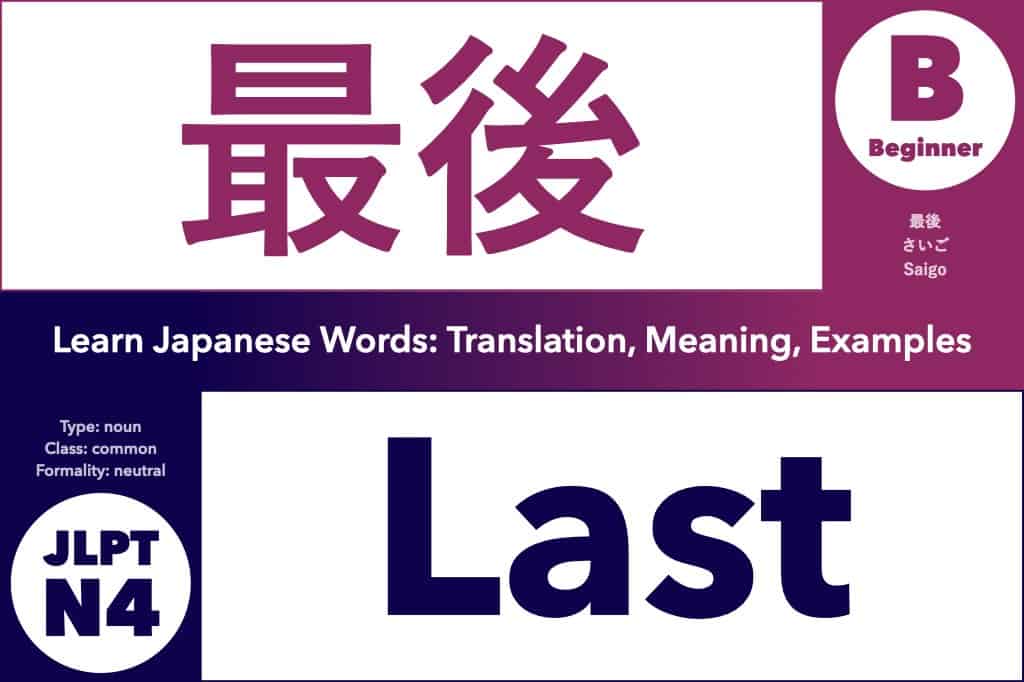
最後 (さいご, saigo) means “last,” “end,” or “final.” It refers to a conclusion of a time period, sequence, or event. As a noun, it can stand on its own, but when used before another noun as 最後の (さいご の, saigo no), it becomes a modifier meaning “last…” or “latest.” It’s a common JLPT N4 word.
最後
さいご
saigo
last, end
In this post, you can explore the meanings, translations, and natural usages of 最後 (さいご, saigo). I will share plenty of example sentences to help you understand and use this noun naturally in everyday Japanese, whenever you want to talk about the “end,” “last,” or “final” part of something.
最後 Means “Last” in Japanese
Word: 最後
Kana: さいご
Romaji: saigo
Meaning: last, end
Type: noun
Class: common, JLPT N4
Formality: neutral, general use
1. English Translations of 最後
| 最後 |
|---|
| [noun] last, end, conclusion |
| [noun + の (最後の)] latest…, last…, final…, most recent… |
2. Japanese Meaning of 最後
最後 (さいご, saigo) means “last,” “end,” or “conclusion.”
It refers to the final point, part, or item of something, such as the end of a day, the final stage of an event, or the last item in a sequence.
As a noun, 最後 stands alone to talk about the end or final moment of something. It behaves like other nouns and can appear with particles such as に (time marker), まで (until), or は (topic marker).
When 最後 is followed by the particle の (no), it becomes 最後の (さいごの, saigo no), which works as a noun modifier meaning “latest,” “last…” or “final…” In this form, 最後 connects directly to the noun that follows and indicates its position as the last or final in order.
最後 can also express emotional nuance, often carrying the idea of something being definitive, final, or unchangeable, depending on context.
Like with other nouns, 最後 can take either the polite copula です (desu) or the casual copula だ (da). Using です makes your sentence sound more formal, polite, or respectful. Using だ sounds more casual, direct, and natural in everyday conversation with close friends and family.
- Formal situations: 最後です
- Casual situations: 最後だ
3. How to Use 最後 in a Sentence
- 最後に (sentence)。
- 最後まで (sentence)。
- 最後は (sentence)。
- (sentence) 最後だ。
- (sentence) 最後です。
- 最後の…
Example Sentences
| 最後かもしれないだろ? |
|---|
| さいご かもしれない だろ? |
| This might be the end, right? This might be the last (time), right? |
| Saigo kamoshirenai daro? |
| Final Fantasy X (Tidus) |
| 最後ぐらい言うことを聞いてよ! |
|---|
| さいご ぐらい いう こと を きいて よ! |
| Just listen to me this one last time! |
| Attack on Titan (Carla Jaeger) |
More examples will be added in the future…
Specific Example Sentences for 最後の
| 夏最後の思い出~✨❤️ |
|---|
| なつ さいご の おもいで ~✨❤️ |
| Summer’s final memory~✨❤️ My final memories of summer~✨❤️ |
| Natsu saigo no omoide ~✨❤️ |
| Free Lesson: J-Pop Stars #4 (ME:I, Kokona) |
⏩ Need more examples? Go to 最後の (さいご の, saigo no)!