
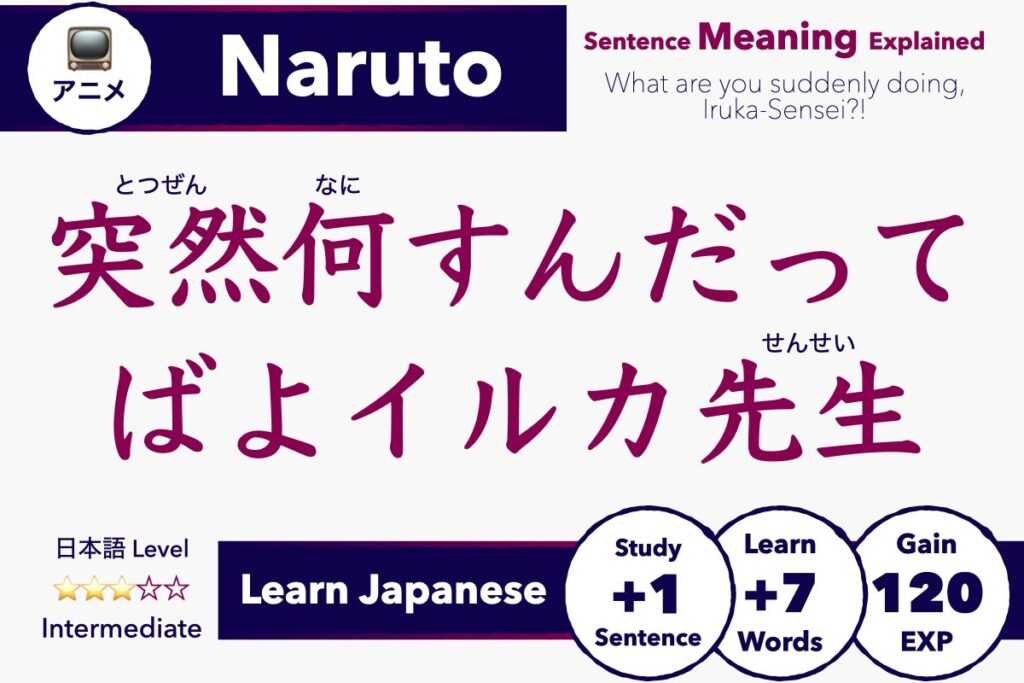
『Totsuzen nani sunda tteba yo Iruka-Sensei(突然何すんだってばよイルカ先生)』means「What are you suddenly doing, Iruka-Sensei?!」. Naruto Uzumaki says this the moment Iruka-Sensei catches him, right as he thought he’d gotten away clean.
| Japanese: | 突然何すんだってばよイルカ先生 |
| Reading: | Totsuzen nani sunda tteba yo Iruka-Sensei |
| Meaning: | What are you suddenly doing, Iruka-Sensei?! |
You’ll learn what each word means, why 『する (suru)』 shrinks down to 『すんだ (sunda)』 in fast, casual speech, and more about Naruto‘s famous 『だってばよ (dattebayo)』. We’ll also look at why 『先生 (sensei)』 attaches directly onto 『イルカ (Iruka)』 instead of standing alone.
Meaning: Totsuzen nani sunda tteba yo Iruka-Sensei (Naruto)
Credit Attribution
- Sentence from Naruto (Anime)
© Masashi Kishimoto / Shueisha - Audio file generated with VOICEVOX:剣崎雌雄
Jump to: Words · Sentence · Grammar · Tone
Japanese
- Kanji: 突然何すんだってばよイルカ先生
- Kana: とつぜん なに すんだ ってば よ いるか せんせい
- Romaji: Totsuzen nani sunda tteba yo Iruka-Sensei
English Meaning
- What are you suddenly doing, Iruka-Sensei?!
- Why’d you do that all of a sudden, Iruka-Sensei?!
- Come on, Iruka-Sensei! Why’d you do that all of a sudden?!
Literal Translations
- Suddenly, what are you doing, Iruka-Sensei?!
- All of a sudden, what are you doing, Iruka-Sensei?!
- What are you doing so suddenly, come on, Iruka-Sensei!
My Preferred English Translation
What are you suddenly doing, Iruka-Sensei?!
I kept 「suddenly」 near the beginning because 『突然 (totsuzen)』 is Naruto‘s immediate reaction. He genuinely didn’t see Iruka coming, so the first thing he expresses is surprise.
Furthermore, I decided to translate 『何すんだ (nani sunda)』 as 「What are you doing?」 to stay closer to the original Japanese, even though 「Why’d you do that?」 would sound just as natural in English in this situation.
Word Walkthrough: Learn Japanese Words & Phrases
Let’s look at the meaning of each word in this sentence and see how Naruto‘s word choice creates such a surprised, emotional reaction.
Word | Hiragana | Romaji | Meaning |
|---|---|---|---|
突然 | とつぜん | totsuzen | suddenly, all of a sudden |
何 | なに | nani | what |
すんだ | すんだ | sunda | what are you doing (casual) |
ってば | ってば | tteba | I’m telling you, come on |
よ | よ | yo | (assertive particle) |
イルカ | いるか | Iruka | Iruka (name) |
先生 | せんせい | sensei | teacher |
1. 『突然 (totsuzen)』
- Adverb
- Reading: とつぜん (totsuzen)
- Meaning: suddenly, all of a sudden, out of nowhere
『突然』 means 「suddenly」 or 「all of a sudden」. It’s used when something happens without warning. Here, it shows that Naruto was completely caught off guard by Iruka‘s sudden action.
2. 『何 (nani)』
- Top 100 Word
- Reading: なに (nani)
- Meaning: what
『何』 simply means 「what」. Here, Naruto uses it to question Iruka‘s sudden action, asking what he thinks he’s doing.
3. 『すんだ (sunda)』
- Dictionary: する (suru)
- Reading: すんだ (sunda)
- Meaning: doing, what’s going on (casual, rushed)
『すんだ』 combined with 『何 (nani)』 is a very casual way of asking 「What are you doing?」. I’ll break down exactly how it’s formed below in Sentence Grammar.
4. 『ってば (tteba)』
- Expression
- Reading: ってば (tteba)
- Meaning: I’m telling you, come on, seriously
『ってば』 adds extra insistence to Naruto‘s question. He’s not just asking what Iruka just did, but also complaining about it.
5. 『よ (yo)』
- Top 25 Particle
- Reading: よ (yo)
- Meaning: I tell you, you know
『よ』 works essentially like an exclamation mark and adds more force. Paired with 『ってば (tteba)』 right before it, this is what forms Naruto’s signature 『ってばよ (ttebayo)』 verbal tic.
6. 『イルカ (Iruka)』
- Proper Noun
- Reading: いるか (Iruka)
- Meaning: Iruka (name)
『イルカ』 is Iruka‘s name. Naruto says it at the end of the sentence to make it clear he’s directing his outburst at his teacher.
7. 『先生 (sensei)』
- Honorific
- Reading: せんせい (sensei)
- Meaning: teacher
『先生』 attaches right onto 『イルカ (Iruka)』, marking him out as Naruto’s teacher and the target of this whole outburst.
Sentence Building: Learn Japanese Sentence Structure
Starting from 『突然 (totsuzen)』, let’s add one word at a time until we reach the full line, 『突然何すんだってばよイルカ先生 (Totsuzen nani sunda tteba yo Iruka-Sensei)』.
| Step 1 |
|---|
| 突然 |
| suddenly |
Romaji: totsuzen
| Step 2 |
|---|
| 突然何 |
| suddenly, what |
Romaji: totsuzen nani
| Step 3 |
|---|
| 突然何すんだ |
| what are you suddenly doing |
Romaji: totsuzen nani sunda
| Step 4 |
|---|
| 突然何すんだってば |
| what are you suddenly doing, come on |
Romaji: totsuzen nani sunda tteba
| Step 5 |
|---|
| 突然何すんだってばよ |
| what are you suddenly doing, come on! |
Romaji: totsuzen nani sunda tteba yo
| Step 6 (Final) |
|---|
| 突然何すんだってばよイルカ先生 |
| What are you suddenly doing, come on, Iruka-Sensei! |
Romaji: Totsuzen nani sunda tteba yo Iruka-Sensei
Sentence Grammar: Learn Japanese Grammar Patterns
Here’s how 「する (suru)」 shrinks down into 『すんだ (sunda)』 in casual speech, and how the two particles at the end stack on top of each other.
Particles
Particle よ (yo)
『よ』 attaches to the end of a sentence to add emphasis. It’s often used when the speaker wants to make sure the listener pays attention or feels like he’s telling them something new.
Pattern: [statement] + よ = “[statement]!”
Particle ってば (tteba)
『ってば』 attaches after a verb or clause to add insistence or mild exasperation, like the speaker is repeating themselves or venting frustration that something needs saying at all.
Pattern: [verb/clause] + ってば = “I’m telling you, [verb/clause]”
Casual Contractions
How 『すんだ』 is formed: in fast, casual speech, 「するんだ (suru n da)」 is commonly contracted to 『すんだ (sunda)』
Step | Japanese | How to Form | Label |
|---|---|---|---|
① | する suru | dictionary form | plain form |
② | するんだ suru n da | add んだ (n da) | explanatory form |
③ | すんだ sunda | remove る (ru) | casual explanatory form |
I cover 『んだ (n da)』 and 『だってばよ (dattebayo)』 in full detail in my 『俺はすごいんだってばよ』 post if you want to go deeper on either one.
Sentence Tone: Nuance, Style & Cultural Notes
Naruto‘s just pulled off his prank and thinks he’s escaped when Iruka-Sensei suddenly shouts at him from behind. Rather than backing down, Naruto fires back with a confident complaint of his own, showing his stubborn, defiant personality.
Word Choice
Why 『すんだ』 and not 「するんだ (suru n da)」? 「するんだ」 is the fuller, slower version of the same question. 『すんだ』 is what comes out when you’re surprised and talking fast, which fits Naruto getting caught completely off guard.
Beyond the Translation
『先生 (sensei)』 attached directly to a name, like 『イルカ先生 (Iruka-Sensei)』, is how you address a teacher in Japanese. It works differently from English, where you would usually say “Teacher Iruka” only in very specific situations.
In Japanese, teachers are normally called by their name plus 『先生』 rather than just their name alone. It takes the place of honorifics like 「さん (san)」 and is used both when speaking directly to them and when talking about them. Calling Iruka-Sensei simply 『イルカ (Iruka)』 would sound unusually blunt.
What makes this line interesting is the contrast. Naruto is frustrated and fires back at his teacher, but 『先生』 never disappears. Even in the middle of a complaint, he still addresses Iruka with respect.
Level Up Your Japanese: Recap & Quiz
Test what you just learned with this quick quiz on the sentence.
① Quick Quiz
『突然何すんだってばよイルカ先生』
What’s the meaning of this sentence?
A) Naruto is complaining that Iruka-Sensei startled him
B) Naruto is asking what Iruka-Sensei is going to do later
C) Naruto is complaining that Iruka-Sensei didn’t do something
② Mini Quest
Which sentence sounds more casual?
A) 何すんだよ?
B) 何をしますか?
③ Final Challenge
『_____ 何すんだってばよイルカ先生』
Fill in the missing word to complete the sentence.
Answers
① A
② A
③ 突然 (totsuzen)
You leveled up your Japanese today:
✅ Japanese Sentences +1
✅ Japanese Words +7
✅ 日本語 EXP +120
Congratulations 🎉
おめでとう🎉
Learn More Japanese with…
Naruto
- 『俺はすごいんだってばよ (Ore wa sugoi n dattebayo)』
Learn more about 『んだ (n da)』 and 『だってばよ (dattebayo)』
That’s the whole story behind 『突然何すんだってばよイルカ先生』. You now know why 『する (suru)』 shrinks to 『すんだ (sunda)』 when Naruto‘s caught off guard, how stacking 『ってば』 and 『よ』 builds up his frustration, and why 『先生』 stays glued to Iruka’s name even mid-outburst.
Contractions like すんだ are everywhere in real, fast-spoken Japanese, and once you can spot them, a whole layer of casual anime and manga dialogue stops sounding like a blur and starts sounding like actual words.
See you for our next sentence!
また来てね〜
Alex 🥷✨