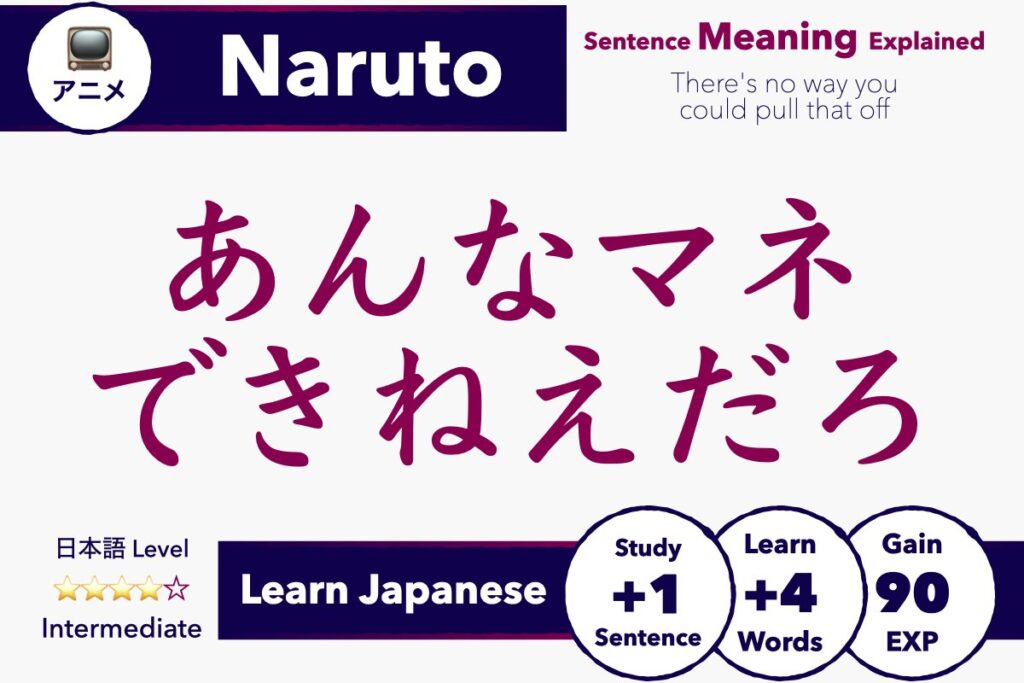
『Anna mane dekinee daro(あんなマネできねえだろ)』means「There’s no way you could pull that off」. Naruto Uzumaki says this in Episode 1 after a prank, confidently teasing those who underestimate his ninja abilities.
| Japanese: | あんなマネできねえだろ |
| Reading: | Anna mane dekinee daro |
| Meaning: | There’s no way you could pull that off. |
In this sentence walkthrough, you’ll learn what each word means, how the sentence is built, why Naruto says 『できねえ (dekinee)』 instead of 「できない (dekinai)」, and how 『だろ (daro)』 adds a confident, taunting tone to the sentence.
Meaning: Anna mane dekinee daro (Naruto Japanese Explained)
Credit Attribution
- Sentence from Naruto (Anime)
© Masashi Kishimoto / Shueisha - Audio file generated with VOICEVOX:剣崎雌雄
Jump to: Words · Sentence · Grammar · Tone
Japanese
- Kanji: あんなマネできねえだろ
- Kana: あんな マネ できねえ だろ
- Romaji: Anna mane dekinee daro
- Series: Naruto
- Speaker: Naruto Uzumaki
- Source: Anime (Season 1, Episode 1)
English Meaning
- No way you could do that.
- There’s no way you could pull that off.
- There’s no way you’d be able to pull off something like that.
Literal Translations
- You can’t do that kind of thing.
- You probably can’t do that kind of thing.
- You probably couldn’t pull off that kind of thing, could you?
My Preferred English Translation
There's no way you could pull that off.
I went with this one because it captures the natural meaning of 『あんなマネ (anna mane)』 without translating it too literally as 「that imitation」. It also keeps the challenging edge of 『だろ (daro)』, so it sounds like something a native English speaker would actually taunt someone with, not a stiff textbook line.
Word Walkthrough: Learn Japanese Words & Phrases
Let’s break down what each word means here and how Naruto’s vocabulary choices shape the feeling of the line. We’ll look at the meaning of each word, its role in this sentence, and why the natural English translation differs from the literal one.
Word | Hiragana | Romaji | Meaning |
|---|---|---|---|
あんな | あんな | anna | that kind of |
マネ | まね | mane | stunt, behavior |
できねえ | できねえ | dekinee | can’t do (rough) |
だろ | だろ | daro | I bet, right? |
1. 『あんな (anna)』
- Modifier
- Reading: あんな (anna)
- Meaning: that kind of, like that, that sort of
『あんな』points to something already known in the conversation. Here, Naruto is referring to the prank he just pulled off, so it means 「that kind of stunt」 or 「something like that」.
2. 『マネ (mane)』
- Noun
- Reading: まね (mane)
- Meaning: stunt, action, behavior
『マネ』 usually means copying or imitating someone, but here Naruto is talking about the prank itself. So 「stunt」, 「action」, or 「behavior」are more natural translations for this specific sentence.
3. 『できねえ (dekinee)』
- Dictionary: できる (dekiru)
- Reading: できねえ (dekinee)
- Meaning: can’t do, not able to, cannot do
『できねえ』 is Naruto’s rough, masculine way of saying 「can’t do」. It’s a conjugated form of the verb「できる (dekiru)」, which means “can do” or “able to do“.
できねえ vs できない is covered in Sentence Grammar down below.
4. 『だろ (daro)』
- Expression
- Reading: だろ (daro)
- Meaning: right?, I bet, probably
『だろ』 adds a challenging tone, almost like 「right?」 or 「I bet you can’t」. Here, it makes Naruto‘s statement sound more taunting.
Sentence Building: Learn Japanese Sentence Structure
See how this sentence comes together step by step. Starting from 『あんな (anna)』, we’ll add each piece to understand how Japanese builds the full meaning of 『あんなマネできねえだろ (Anna mane dekinee daro)』.
| Step 1 |
|---|
| あんな |
| That kind of … |
Romaji: Anna
| Step 2 |
|---|
| あんなマネ |
| A stunt like that |
Romaji: Anna mane
| Step 3 |
|---|
| あんなマネできねえ |
| (You) can’t do a stunt like that |
Romaji: Anna mane dekinee
| Step 4 (Final) |
|---|
| あんなマネできねえだろ |
| I bet (you) can’t do a stunt like that! |
Romaji: Anna mane dekinee daro
Sentence Grammar: Learn Japanese Grammar Patterns
Find out why this sentence is written this way. We’ll look at the missing particles, the rough negative form of 『できねえ (dekinee)』, and the grammar choices that make this sound like natural spoken Japanese.
Conjugations
How 『できねえ』 is formed: replace 「〜ない (nai)」 with 「〜ねえ (nee)」
Step | Japanese | How to Form | Label |
|---|---|---|---|
① | できる dekiru | plain form ending in る (ru) | dictionary form |
② | できない dekinai | drop る (ru) add ない (nai) | negative form |
③ | できねえ dekinee | replace ない (nai) with ねえ (nee) | negative form (rough, masculine) |
More Examples
The same rough speech pattern appears across other verbs too:
Verb | Standard | Rough/Casual | Meaning |
|---|---|---|---|
食べる taberu | 食べない tabenai | 食べねえ tabenee | don’t eat |
知る shiru | 知らない shiranai | 知らねえ shiranee | don’t know |
分かる wakaru | 分からない wakaranai | 分からねえ wakaranee | don’t understand |
The same 「ない → ねえ」 change also appears with い-adjectives in rough speech.
Sentence Tone: Nuance, Style & Cultural Notes
Naruto says this right after smearing paint across the faces of the Hokage Monument. He’s deliberately showing off and challenging the ninja of Konoha, so every word is chosen to sound confident, rough, and a little provocative.
Word Choice
Why 『できねえ (dekinee)』 and not 「できない (dekinai)」? 「できない (dekinai)」 is the normal, neutral way to say 「can’t do」. 『できねえ (dekinee)』 is a much rougher, more masculine version, which fits Naruto’s loud, rebellious personality perfectly.
Why 『だろ (daro)』 and not 「だろう (darou)」 or 「か (ka)」? 「だろう (darou)」 sounds a little more complete and thoughtful, while 「か (ka)」 makes it a straightforward question. 『だろ (daro)』 feels more like a challenge, as if Naruto is saying, 「There’s no way you could do that, right?」.
Why 『あんな (anna)』 and not 「こんな (konna)」 or 「そんな (sonna)」? 「こんな (konna)」 means 「this kind of」, while 「そんな (sonna)」 is usually used for something connected to the listener or something that was just mentioned. Since Naruto is pointing back to his own completed prank as something impressive,『あんな (anna, “that kind of”)』fits better.
Particle Choice
Why is 『が (ga)』 dropped after 『マネ (mane)』? The intransitive verb 「できる (dekiru)」is usually marked with 「が (ga)」, but in spoken Japanese and fast, casual speech, particles like this are often dropped altogether.
Beyond the Translation
『できねえ (dekinee)』 isn’t just rough. It’s also a masculine way of speaking. Swapping 「〜ない (~nai)」 for 「〜ねえ (~nee)」 is common among guys talking casually with friends, but it would sound out of place coming from most female speakers, and it’s not something you’d use with someone you don’t know well.
Naruto‘s choice of 『できねえ』 isn’t random. It’s exactly the kind of language you’d expect from a loud, cocky teenage boy. The fact that he talks this way even to adults and authority figures only reinforces his rebellious personality. A neutral form like 「できない (dekinai)」 simply wouldn’t have the same impact.
Level Up Your Japanese: Recap & Quiz
Confirm your newly gained Japanese knowledge and understanding of this Naruto sentence with a quick quiz.
① Quick Quiz
『あんなマネできねえだろ』
What’s the meaning of this sentence?
A) Anyone could do a stunt like this
B) Naruto couldn’t do a stunt like this himself
C) The other ninjas couldn’t do a stunt like this
② Mini Quest
Which sentence sounds more casual?
A) そんなこと知らねえ。
B) そんなことは知らない。
③ Final Challenge
「I bet you couldn’t do this」
『これできねえ_____』
Fill in the missing word to complete the sentence.
Answers
① C
② A
③ だろ
You leveled up your Japanese today:
✅ Japanese Sentences +1
✅ Japanese Words +4
✅ 日本語 EXP +90
Congratulations 🎉
おめでとう🎉
Learn More Japanese with…
Naruto
- 『俺はすごいんだってばよ (Ore wa sugoi n dattebayo)』
Another rough, confident Naruto line, this time built around his signature 『だってばよ (dattebayo)』 verbal tic instead of 『だろ (daro)』.
That’s all there is to 『あんなマネできねえだろ (Anna mane dekinee daro)』. You now know what each word means, how the sentence is put together, why Naruto says 『できねえ (dekinee)』 instead of 「できない (dekinai)」, and how 『だろ (daro)』 turns it into a confident taunt.
Every rough verb ending and every taunting だろ you pick up like this is one more piece of real, spoken Japanese you’ll actually recognize, the kind no textbook hands you. Keep collecting them, and entire scenes will start opening up to you.
See you for our next Naruto sentence!
またねAlex 🥷✨