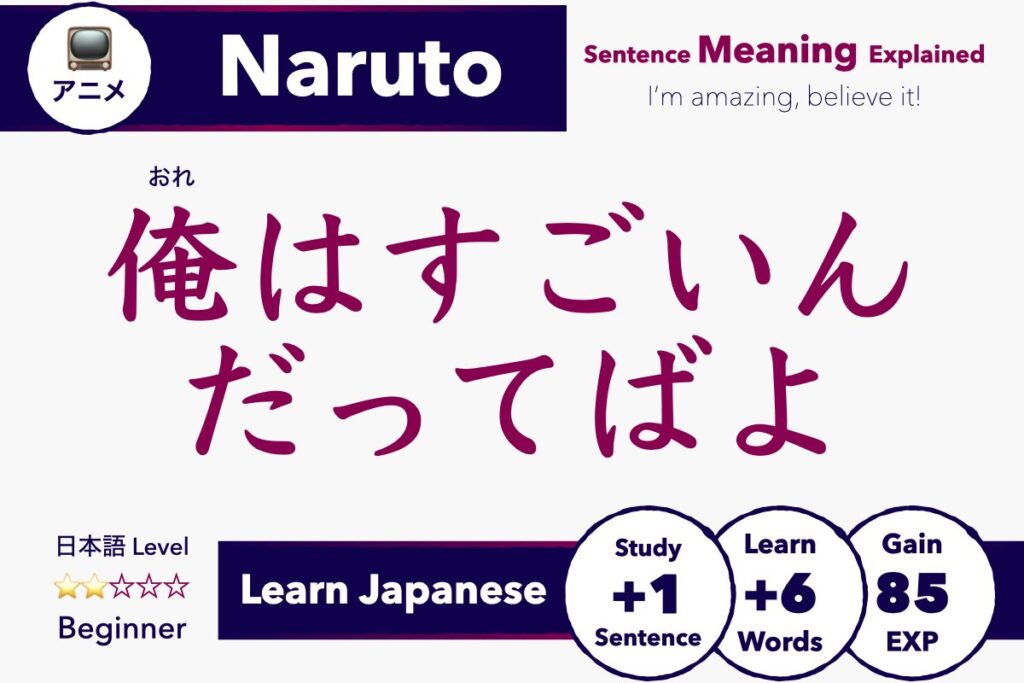
『俺はすごいんだってばよ』 means 「I’m amazing, believe it!」. Naruto says this line in Episode 1 of the anime, after boasting that nobody else could have pulled off his Hokage Rock stunt. It’s also one of the first times we hear his famous catchphrase, 『だってばよ (dattebayo)』.
| Source: | Naruto |
|---|---|
| Japanese: | 俺はすごいんだってばよ |
| Romaji: | Ore wa sugoi n dattebayo |
| Meaning: | I’m amazing, believe it! |
Let’s break down this short but brash sentence word by word and see how Naruto adds tons of overconfident-sounding emphasis by ending sentences with his well-known 「だってばよ (dattebayo)」.
Ore wa Sugoi n Dattebayo: Meaning in Japanese & English
Credit Attribution
- Sentence from Naruto (Anime)
© Masashi Kishimoto / Shueisha - Audio file generated with VOICEVOX:剣崎雌雄
日本語
俺はすごいんだってばよ
- Kanji: 俺はすごいんだってばよ
- Kana: おれ は すごい んだ ってば よ
- Romaji: Ore wa sugoi n dattebayo
Natural English
- I’m amazing, believe it!
- I’m awesome, believe it!
- I’m seriously amazing, I’m telling you!
Literal Translations
- I’m amazing, I tell you.
- I’m amazing, I keep telling you, okay?
- As for me, I’m amazing, I’m telling you.
My Preferred Translation
I'm amazing, believe it!
This keeps Naruto‘s confidence front and centre while giving 『だってばよ (dattebayo)』 a natural English home. 「Believe it!」 isn’t a literal translation, but it’s become so tied to Naruto‘s voice in English that it captures the same insistent energy as the original.
A fully literal version like 「I’m amazing, I tell you」 is accurate, but it loses the punch. Naruto isn’t just informing you. He’s practically daring you to disagree.
Sentence Walkthrough: Learn Japanese Words & Phrases
This line comes right after some ninjas catch Naruto in the act of spray-painting graffiti across the stone faces of the Hokage monument. Instead of apologizing, Naruto laughs it off, brags that none of them could have pulled off what he did, and proceeds to proclaim to everyone how amazing he is.
1. 『俺 (ore)』
Meaning: 「I, me」
『俺(おれ)』 is a casual, masculine way to say 「I」. Compared with the more neutral 「私 (watashi)」, it sounds rougher, more confident, and more assertive, making it a perfect fit for a loud, cocky kid like Naruto.
You’ll hear 『俺』 constantly from boys and men in anime, especially characters who want to sound tough, casual, or a little rebellious. It’s one of the first pronouns most learners pick up from watching Japanese anime.
Example:
俺がやる。
Ore ga yaru.
I'll do it.
2. 『は (wa)』
Function: Topic Marker 「は Particle」
The particle 『は』 marks 『俺』 as the topic of the sentence, telling us that everything after it is a statement about Naruto himself.
『は』 is one of the Top 25 Most Common Japanese Particles, and you’ll see it in almost every sentence you come across.
俺は[すごい]
- I (am) [amazing]
- As for me, (I’m) [amazing]
- Speaking of myself, (I’m) [amazing]
3. 『すごい (sugoi)』
Meaning: 「amazing, incredible, great」
『すごい』 describes something impressive or amazing. It’s usually used to admire or praise someone or something else, but in today’s sentence, Naruto uses it to boast about himself.
You’ll see the i-adjective『すごい』 constantly. It’s one of the most useful words for reacting to almost anything in everyday conversation.
Example:
このゲームはすごい。
Kono geemu wa sugoi.
This game is amazing.
4. 『んだ (n da)』
Function: Explanatory Tone「〜んだ」
『んだ』 attaches to the plain form of a verb or adjective to add emphasis and explanation, turning a plain statement into something more explanatory or empathic. It’s similar to the English 「you know」, 「you see」, or even 「really」.
Rather than simply stating 『すごい』, Naruto says 『すごいんだ』, making the statement sound stronger, more personal, and more convincing.
『んだ』 is extremely common in spoken Japanese and ranks high in the Top 100 Most Common Japanese Words. You’ll hear it constantly in anime, drama, and everyday conversation whenever someone wants to sound emphatic or explanatory.
For the full breakdown of how it works, check the dedicated Explanatory Tone 「〜んだ」 grammar post that’ll be out there soon.
How to Form: 〜んだ (Explanatory Tone)
Step | Word | Form |
|---|---|---|
① | すごい | dictionary form (plain form, non-past) |
② | すごいんだ | plain form + んだ |
Note: for i-adjectives like すごい, the dictionary form and the plain non-past form are the same word. They only differ once you conjugate further, e.g. すごくない (plain negative).
5. 『ってば (tteba)』
Function: Emphatic Expression 「ってば Particle」
『ってば』 is a casual sentence-ending particle used to strongly emphasize, repeat, or insist upon a point you’ve already said. It often carries a sense of impatience, frustration, or annoyance because the listener isn’t listening, understanding, or responding.
It’s often translated as 「I’m telling you…」, 「I told you (already)…」, 「Come on…」, or just「Seriously!」.
In this sentence, Naruto combines 『ってば』 with 『んだ』 to double down and insist on the fact that he is amazing because he feels like the others either doubt, ignore, or don’t get it.
『ってば』 is common in casual speech, especially among kids and close friends, and it turns up often in anime dialogue whenever a character wants to sound insistent or a little annoyed.
すごいんだってば
- Seriously, (I’m) amazing
- I’m telling you that (I’m) amazing
- Come on, I told you (I’m) amazing
6. 『よ (yo)』
Function: Exclamation Marker 「よ Particle」
『よ』 is added to the end of a sentence to add emphasis or assert new information to the listener, similar to adding 「you know」 or an exclamation mark「!」 in English.
『よ』 is one of the Top 25 Most Common Japanese Particles, and it appears constantly at the end of casual sentences of all kinds.
ってばよ
- …believe it!
- …I mean it!
- I’m telling you…!
Naruto’s Catchphrase『だってばよ (Dattebayo)』
『だってばよ (dattebayo)』 combines 「だ (da)」, 『ってば (tteba)』, and 『よ (yo)』 into Naruto’s own personal catchphrase.
Don’t think of 『だってばよ』 as grammar you should copy. It’s Naruto‘s personal anime speaking style or verbal tic. Recognizing it is much more useful than trying to use it yourself.
Today’s Sentence Vocabulary
Word | Japanese | English | Frequency Rank |
|---|---|---|---|
俺 | おれ ore | I | ~450 |
は | は wa | (topic particle) | ~10 |
すごい | 凄い sugoi | amazing | ~500 |
んだ | nda | (adds explanatory tone) | ~30 |
ってば | tteba | I’m telling you | ~3000 |
よ | yo | ! (adds emphasis) | ~20 |
Building Blocks: Learn Japanese Sentence Structure
| Core Sentence | A is B (Topic) |
|---|---|
| 俺はすごい。 I’m amazing. | (Topic)は (adjective) (だ)。 |
| Building Blocks | Japanese Sentence |
|---|---|
| Topic (What about?) | 俺は I (as for me) |
| Adjective (What am I?) | すごい amazing |
| Emphatic Insistence | んだってばよ believe it! |
俺はすごいんだってばよ。
As for me, (I’m) amazing, believe it!
Sentence Pattern: The Emphatic Insistence 〜ってば
# | Formula | Example |
|---|---|---|
① | verb/i-adjective (plain) + ってば | すごいってば。 Sugoi tteba. I told you, it’s amazing! |
② | noun/na-adjective + だ + ってば | 嘘だってば。 Uso datteba. I’m telling you, it’s a lie! |
『〜ってば』 attaches directly to the end of any casual plain-form sentence to add urgent emphasis and sound more insistent.
Example 1
本当だってば。
Hontou datteba.
I told you, it’s the truth!
Example 2
知らないってば。
Shiranai tteba.
I already told you, I don’t know!
Example 3
もう寝るってば。
Mou neru tteba.
I said I’m going to sleep already!
Example 4
大丈夫だってば、心配しないで。
Daijoubu datteba, shinpai shinaide.
I’m telling you, I’m fine, don’t worry.
Beyond the Translation: Tone, Nuance & Cultural Notes
Naruto could have simply said 『俺はすごい (I’m amazing)』 and stopped here.
But he doesn’t.
First comes 『んだ』, making the statement sound more personal and emphatic.
Then comes 『ってばよ』 to add even more emphasis and insist on the fact that he is great.
That choice tells us something about Naruto himself.
At this point in the story, almost nobody believes in him. The adults see him as nothing more than a troublemaker.
So this isn’t just a kid bragging.
It’s the first glimpse of someone who desperately wants to be acknowledged.
Level Up: Check Your Understanding
① Quick Quiz
What’s the meaning of this sentence?
『俺はすごいんだってばよ』
A) It’s great, believe it!
B) I’m incredible, believe it!
C) I told you that he is amazing!
② Mini Quest
Which sentence is correct?
A) すごいってば。
B) すごいだってば。
③ Final Challenge
Complete the sentence:
『俺はすごい _____ ってばよ』
Answers
① B
② A
③ んだ
You leveled up your Japanese today:
✅ Japanese Sentences +1
✅ Japanese Words +6
✅ 日本語 EXP +85
Congratulations 🎉
おめでとう🎉
Learn More Japanese with…
Naruto
- 『だけど俺にはできる』
See 俺 paired with には instead of just は
Now you know that 『俺はすごいんだってばよ』 isn’t just Naruto bragging. It’s 『んだ』 turning a plain claim into a firm one, and 『ってばよ』 stamping it with his own unmistakable voice.
Listen for 『〜ってば』 the next time you watch anime. Whenever a character sounds like they’re insisting on something or trying to convince someone, there’s a good chance you’ll hear it.
See you in the next lesson,
だってばよ!🍥✨
Alex