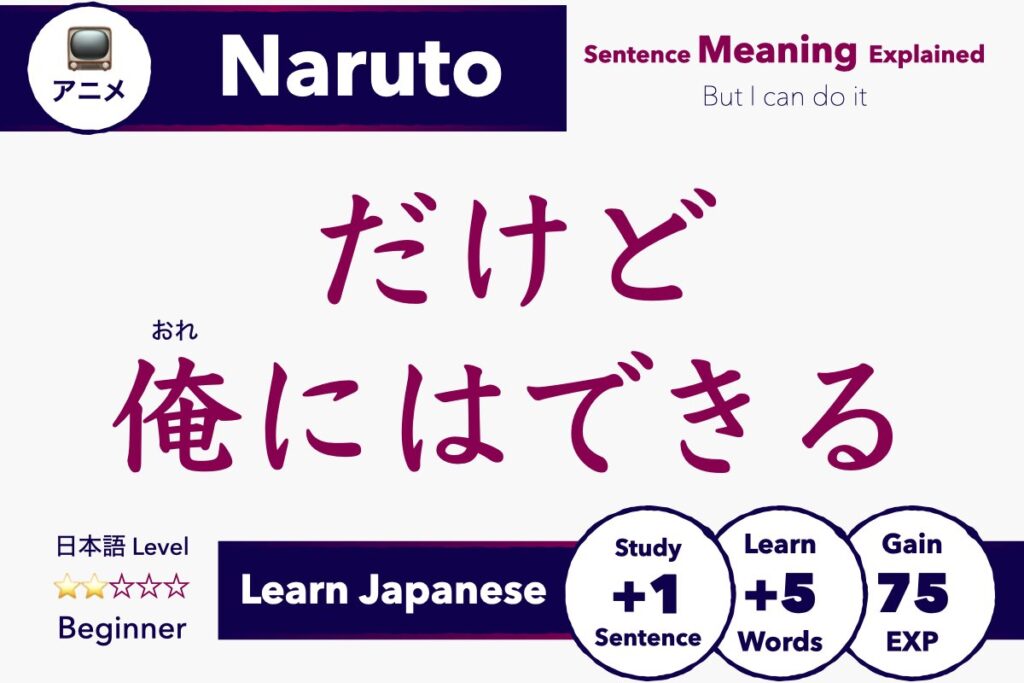
『だけど俺にはできる』 means 「But I can do it」. It’s a line Naruto shouts in Episode 1 after painting graffiti across the Hokage Monument and trying to escape the pursuing ninja. Here you’ll learn why he says 『俺には (ore ni wa)』 instead of simply 『俺は (ore wa)』.
| Source: | Naruto |
|---|---|
| Japanese: | だけど俺にはできる |
| Romaji: | Dakedo ore ni wa dekiru |
| Meaning: | But I can do it |
At first glance, this looks like a simple beginner sentence. But the tiny particle combination 『には (ni wa)』 completely changes the nuance. Once you understand what it’s doing, you’ll start noticing it everywhere in everyday Japanese.
『だけど 俺にはできる』 (Kanji, Kana, Romaji, English)
Credit Attribution
- Sentence from Naruto (Anime)
© Masashi Kishimoto / Shueisha - Audio file generated with VOICEVOX:剣崎雌雄
Original Anime Sentence
だけど俺にはできる
- Kanji: だけど俺にはできる
- Kana: だけど おれ に は できる
- Romaji: Dakedo ore ni wa dekiru
Natural English
- But I can do it.
- But I’m the one who can do it.
- But unlike the others, I can do it.
Literal Translations
- But as for me, I can.
- But as for me, I can do it.
- But as for me, it is something I can do.
My Preferred Translation
But I can do it.
I kept this one short and punchy because that’s exactly how Naruto says it. No extra explanation, just a flat, bold statement.
It doesn’t fully capture the contrast baked into 『には (ni wa)』, but English doesn’t really have a natural way to cram 「unlike everyone else」 into four words without it sounding clunky.
If you want the fuller nuance, 「But I’m the one who can do it」 gets closer, since it hints that Naruto is setting himself apart from the other kids who supposedly couldn’t do it either.
Sentence Walkthrough: Learn Japanese Words & Phrases
This is Naruto’s very first scene in the series. He’s just finished spray-painting graffiti across the faces of the Hokage monument, and two chasing ninjas try to hold him responsible for it. But a full-of-himself Naruto isn’t the least bit sorry. He’s busy bragging about his own handiwork.
Right before this line, Naruto taunts the ninjas chasing him with 「あんなマネできねえだろ (You guys couldn’t pull that off)」 Then he follows it up with 『だけど俺にはできる (Dakedo ore ni wa dekiru)』, proudly drawing the line between himself and everyone else in the village.
He’s not just stating a fact, but boasting that he’s the one who could actually do it.
1. 『だけど (dakedo)』
Meaning: 「however, but」
『だけど』 is a casual version of 「でも (demo)」 or 「しかし (shikashi)」, used to introduce a contrast with what was just said or implied. It usually starts a sentence, picking up where the previous statement left off and flipping the direction.
Right before this line, Naruto says the ninjas couldn’t have pulled off his prank, and he uses 『だけど』 to pivot straight into the contrast: it’s different for him.
『だけど』 is extremely common in everyday spoken Japanese, so you’ll hear it constantly in casual conversation, anime, and manga, especially at the start of a sentence when someone is about to disagree or add an exception.
Example:
疲れた。だけど頑張る。
Tsukareta. Dakedo ganbaru.
I'm tired. But I'll keep trying.
『だけど』 vs 『でも』 vs 『しかし』
All three of these mean 「but」, but they don’t all sound the same. 『だけど』 is casual and conversational, 『でも』 is casual too but slightly softer and more common in polite small talk, and 『しかし』 is formal and shows up more in writing, news, and speeches.
Naruto reaching for 『だけど』 instead of 『しかし』 fits his character perfectly. A formal 「しかし、俺にはできる (shikashi, ore ni wa dekiru)」 would sound oddly stiff coming out of a loud, cocky kid. We’ll break down the full differences between these three in a dedicated だけど vs でも vs しかし post in the future.
2. 『俺 (ore)』
Meaning: 「I, me」
『俺(おれ)』 is a casual, masculine way to say 「I」. It’s used mostly by boys and men among friends or in informal settings, and it carries a rougher, more confident tone than 「私(わたし)」.
Naruto uses 『俺』 constantly throughout the series. It’s practically part of his character.
Example:
俺は忍者になりたい。
Ore wa ninja ni naritai.
I want to become a ninja.
3. 『に (ni)』
Function: Viewpoint Marker 「に Particle」
『に』 marks the person that something applies to or is possible for. With ability verbs like 『できる』, 『に』 marks who the ability belongs to. Literally, it means 「possible, with respect to me」.
In this sentence, 『に』 attaches to 『俺 (ore)』 to show that the ability being discussed belongs to Naruto specifically. On its own, 『俺に (ore ni)』 would simply mean 「for me」 or 「to me」, without any extra contrast.
『に』 is one of the Top 25 Most Common Japanese Particles, used constantly to mark targets, locations, times, and indirect objects.
4. 『は (wa)』
Function: Topic Marker 「は Particle」
『は』 usually marks the topic of a sentence, but when it’s stacked onto another particle like 『に (ni)』, it takes on a contrastive nuance. It’s singling something out compared to other options.
That’s exactly what’s happening in 『俺には (ore ni wa)』. It doesn’t just mean 「for me」, but 「for me (unlike for others)」. Naruto is directly contrasting himself with the other ninjas who supposedly couldn’t do it.
『は』 is one of the Top 25 Most Common Japanese Particles, and this contrastive usage on top of another particle is something you’ll see constantly once you know to look for it.
『には』 vs 『が』
You might wonder why Naruto doesn’t just say 「俺ができる (ore ga dekiru)」. That version would be a plain, neutral statement of fact: 「I can do it」, full stop, with no comparison implied.
『俺には できる (ore ni wa dekiru)』 instead implies 「I can do it (even if others can’t)」. Since Naruto is directly contrasting to what he said before about it being impossible for others, 『には (ni wa)』 is the natural choice, since it’s built for exactly this kind of boast.
俺には
- As for me
- For me (unlike others)
- I (compared to others)
5. 『できる (dekiru)』
Meaning: 「can do, is possible」
『できる』 means 「to be able to」 , 「to be possible to」, or 「to be capable of」. It’s an intransitive verb that expresses ability or possibility on its own, without needing a separate potential-form conjugation.
In this sentence, it’s the punchline: after using 「できねえ (dekinee, can’t do)」 to taunt the ninjas moments earlier, 『できる』 flips the same word right back around, confirming that yes, it’s possible, just not for them.
『できる』 is one of the most useful verbs in Japanese and ranks among the Top 100 Most Common Japanese Words. You’ll use it constantly to talk about what you can or can’t do, from language ability to everyday tasks.
Example:
泳ぐことができる。
Oyogu koto ga dekiru.
I can swim.
Word Overview & Frequency Chart
| Word | Japanese | English | Frequency Rank |
|---|---|---|---|
| だけど | dakedo | however | ~500 |
| 俺 | おれ ore | I | ~450 |
| に | ni | (target particle) | ~10 |
| は | wa | (topic particle) | ~10 |
| できる | dekiru | can do | ~100 |
Building Blocks: Learn Japanese Sentence Structure
| Core Sentence | A does B (Topic) |
|---|---|
| 俺はできる。 Ore wa dekiru. I can do (it). | (Topic)は (verb)。 |
| Building Blocks | Japanese Sentence |
|---|---|
| Conjunction | だけど however |
| Topic + Contrast (Who compared to others?) | 俺には as for me (unlike others) |
| Verb (What action?) | できる can do it |
だけど俺にはできる。
However, as for me, I can do it.
Sentence Pattern: Marking Contrast with 〜には
| Formula | Example |
|---|---|
| 〇〇には + verb/adjective | 私には無理。 Watashi ni wa muri. Not possible for me (even if it is for others). |
This pattern takes a plain topic marked by 『は (wa)』 and adds a layer of contrast by combining it with 『に (ni)』 first. It’s especially common with ability, feeling, and possession expressions, whenever someone wants to single themselves (or someone else) out from a group.
Example 1
姉には話した。
Ane ni wa hanashita.
I told my sister (unlike others, I didn’t tell).
Example 2
子供には難しい。
Kodomo ni wa muzukashii.
It’s difficult for kids (though maybe not for adults).
Example 3
田中さんには才能がある。
Tanaka-san ni wa sainou ga aru.
Mr. Tanaka has talent (unlike some others).
Example 4
忙しい人にはこの方法が便利だ。
Isogashii hito ni wa kono houhou ga benri da.
For busy people, this method is convenient (more so than other methods).
Beyond the Translation: Tone, Nuance & Cultural Notes
What makes this line so interesting isn’t 『だけど』 or 『できる』, but it’s the choice of 『には』 over the much simpler 「が」.
「俺ができる」 would have worked grammatically. It would even still mean 「I can do it」. But it would have landed as a flat, standalone statement, disconnected from what he just said to the ninjas chasing him.
By choosing 『には』 instead, the show quietly encodes the whole boast into a single particle: Naruto just told the ninjas they couldn’t do it, and now he’s drawing a direct line between “them” and “me”.
This tiny grammatical choice lets the contrast live in the structure of the sentence itself, instead of needing extra words to spell it out.
That’s very on-brand for Naruto‘s character too, since he’s constantly positioning himself against people who underestimate him, and this is the first time we see that instinct in the show, in the very first episode.
Level Up: Check Your Understanding
① Quick Quiz
What’s the meaning of this sentence?
『だけど俺にはできる』
A) I can do it.
B) But I cannot do it.
C) But I’m not sure if I can do it.
② Mini Quest
Which sentence indicates contrast?
A) 俺が簡単。
B) 俺には簡単。
③ Final Challenge
Complete the sentence:
『_____俺にはできる』
Answers
① A
② B
③ だけど
What you achieved today:
✅ Japanese Sentences +1
✅ Japanese Words +5
✅ 日本語 EXP +75
Congratulations 🎉
おめでとう🎉
Learn More Japanese with…
Naruto
- 『俺はすごいんだってばよ』
Read the boastful line that follows right after this one
Related Sentences
- Final Fantasy 1
『そして その手には それぞれ クリスタルが握られていた』
See the double particle には (ni wa) used in another sentence
- Final Fantasy 1
『偶然とは思えぬ。』
Compare には (ni wa) with the different double particleとは (to wa)
Naruto‘s just getting started, and so is your understanding of 『には』.
From now on, whenever you watch anime, play a game, or read manga in Japanese, keep an eye out for this little pattern. It often appears when a character is drawing a contrast or putting special emphasis on someone or something.
The more real Japanese you read and listen to, the more naturally you’ll start to recognise 『には』 without even thinking about it. Before long, you’ll begin noticing the difference between a simple 「が」 and an emphasised 『には』 every time it appears.
See you soon!
またね 🥷✨
Alex