
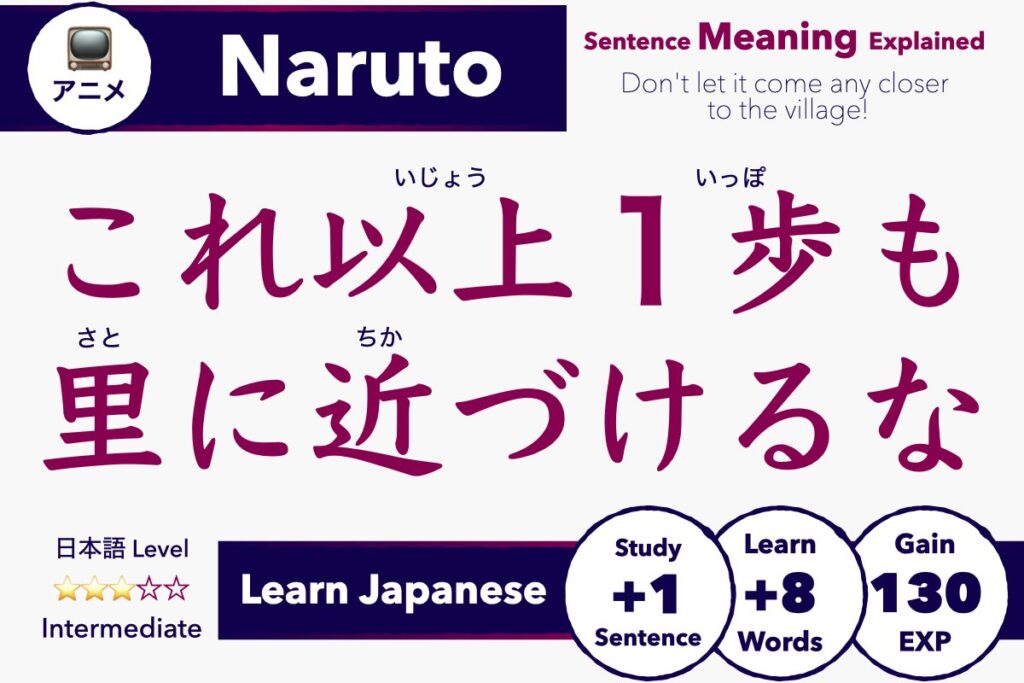
『Kore ijou ippo mo sato ni chikazukeru na(これ以上1歩も里に近づけるな)』means「Don’t let it come any closer to the village!」. A Konoha ninja shouts this command during the Nine-Tails attack at the beginning of Naruto Episode 1.
| Japanese: | これ以上1歩も里に近づけるな |
| Reading: | Kore ijou ippo mo sato ni chikazukeru na |
| Meaning: | Don’t let it come any closer to the village! |
In this sentence walkthrough, you’ll learn what each word means, how the sentence is built, and how 『〜な (~na)』 turns 「近づける (chikazukeru)」 into a command directed at the other Konoha ninjas.
Meaning: Kore ijou ippo mo sato ni chikazukeru na (Naruto)
Credit Attribution
- Sentence from Naruto (Anime)
© Masashi Kishimoto / Shueisha - Audio file generated with VOICEVOX:剣崎雌雄
Jump to: Words · Sentence · Grammar · Tone
Japanese
- Kanji: これ以上1歩も里に近づけるな
- Kana: これ いじょう いっぽ も さと に ちかづける な
- Romaji: Kore ijou ippo mo sato ni chikazukeru na
- Series: Naruto
- Speaker: Konoha Shinobi
- Source: Anime (Season 1, Episode 1)
English Meaning
- Don’t let it come any closer to the village.
- Don’t let it get one step closer to the village.
- Don’t let it take any step further toward the village.
Literal Translations
- Don’t let it get even one step closer to the village.
- Don’t let it approach the village even one step more.
- Don’t let it take even one more step toward the village.
My Preferred English Translation
Don't let it come any closer to the village!
While 『1歩も (ippo mo)』 is important, I decided to go with 「any closer」 since it feels more appropriate for a battlefield command in English. For 『近づける (chikazukeru)』, I chose 「come closer」 over 「approach」 since it captures the feeling of a dangerous threat moving toward the village while sounding less formal and more urgent.
Word Walkthrough: Learn Japanese Words & Phrases
Let’s look at the meaning of each word in this shouted command and see how words like 『近づける (chikazukeru)』 turn a simple idea of 「getting closer」 into a desperate order to stop the Kyuubi‘s advance.
Word | Hiragana | Romaji | Meaning |
|---|---|---|---|
これ | これ | kore | this |
以上 | いじょう | ijou | beyond, more than |
1歩 | いっぽ | ippo | one step |
も | も | mo | even (emphasis) |
里 | さと | sato | village |
に | に | ni | to, toward |
近づける | ちかづける | chikazukeru | to let (something) get close |
な | な | na | (negative command marker) |
1. 『これ (kore)』
- Top 100 Word
- Reading: これ (kore)
- Meaning: this, this point
『これ』 means 「this」 and points to the current situation or a point near the speaker. In this case, it refers to the present point beyond which the ninja refuses to let the Nine-Tailed Fox advance.
2. 『以上 (ijou)』
- Expression
- Reading: いじょう (ijou)
- Meaning: beyond, more than, and above
『以上』attaches after 『これ』 to draw a line at the present moment. Together, 『これ以上』 means 「beyond this point」 or 「any further than this」.
3. 『1歩 (ippo)』
- Noun (counter)
- Reading: いっぽ (ippo)
- Meaning: one step, small amount
『1歩』 literally means 「one step」. On its own, it’s just a simple measurement, but in this sentence it becomes the smallest amount of movement the Konoha ninja is willing to allow.
4. 『も (mo)』
- Top 25 Particle
- Reading: も (mo)
- Meaning: even, not even (with a negative)
『も (mo)』 is the Inclusion Particle. In this sentence it works with the negative command to mean 「not even」, making sure there’s no room to argue about how close is too close.
5. 『里 (sato)』
- Noun (compound)
- Reading: さと (sato)
- Meaning: village
『里』 refers to Konoha, the Hidden Leaf Village and home of our ninjas. The word itself is a general term for a village or hometown.
6. 『に (ni)』
- Top 25 Particle
- Reading: に (ni)
- Meaning: to, toward
『に (ni)』 is the Target Particle. Here it marks 『里 (sato)』 as the destination and the one place the Kyuubi must never get any closer to.
7. 『近づける (chikazukeru)』
- Verb
- Reading: ちかづける (chikazukeru)
- Meaning: to let (something) get close
『近づける』 describes someone letting or making an approach happen and is often translated as 「let (someone/something) get close」 or 「to let (someone/something) go near」.
It doesn’t mean 「to approach」 or 「to get close」, which is 「近づく (chikazuku)」, so it’s clear that it’s a command aimed at the other ninja, not the Kyuubi.
8. 『な (na)』
- Particle
- Reading: な (na)
- Meaning: don’t (command)
『な』 attaches directly to 「近づける (chikazukeru)」 and turns it into a blunt, forceful prohibition. It’s not a polite request but a firm order.
Useful Expressions
『これ以上 (kore ijou)』: is a common expression that’s well worth learning as a chunk. It means 「beyond this point」 or 「any further」 and is used to draw a clear line that something must not continue, go any farther, or happen any more.
Sentence Building: Learn Japanese Sentence Structure
Starting from 『これ (kore)』, we’ll add one word at a time until we reach the full command, 『これ以上1歩も里に近づけるな (Kore ijou ippo mo sato ni chikazukeru na)』.
| Step 1 |
|---|
| これ |
| this |
Romaji: kore
| Step 2 |
|---|
| これ以上 |
| beyond this point |
Romaji: kore ijou
| Step 3 |
|---|
| これ以上1歩 |
| beyond this point, one step |
Romaji: kore ijou ippo
| Step 4 |
|---|
| これ以上1歩も |
| beyond this point, even one step |
Romaji: kore ijou ippo mo
| Step 5 |
|---|
| これ以上1歩も里 |
| beyond this point, even one step, village |
Romaji: kore ijou ippo mo sato
| Step 6 |
|---|
| これ以上1歩も里に |
| beyond this point, even one step to the village |
Romaji: kore ijou ippo mo sato ni
| Step 7 |
|---|
| これ以上1歩も里に近づける |
| beyond this point, let (it) get even one step closer to the village |
Romaji: kore ijou ippo mo sato ni chikazukeru
| Step 8 (Final) |
|---|
| これ以上1歩も里に近づけるな |
| Beyond this point, don’t let (it) get even one step closer to the village! |
Romaji: Kore ijou ippo mo sato ni chikazukeru na
Sentence Grammar: Learn Japanese Grammar Patterns
Here’s exactly how the pieces work together: the emphatic particle 『〜も』, the transitive verb 『近づける (chikazukeru)』, and the negative command 『〜な (~na)』.
Particles
Particle も (mo)
『も』 usually means 「also」 or 「too」. But attach it to a quantity, an amount, or a number, and pair it with a negative verb, and it shifts meaning entirely to 「not even [that amount]」.
Pattern: [quantity] + も + negative = “not even that much”
Particle に (ni)
『に』 marks the destination or target of movement, the place something is headed toward. You’ll see it constantly with motion verbs like 「行く(iku, “to go”」, 「来る (kuru, “to come”)」, or 「着く (tsuku, “to arrive”)」.
Pattern: [place] + に + [motion verb]
Conjugations
How 『近づけるな (chikazukeru na)』 is formed: add 「~な (~na)」
Step | Japanese | How to Form | Label |
|---|---|---|---|
① | 近づける chikazukeru | plain form ending in る (ru) | dictionary form |
② | 近づけるな chikazukeru na | add な (na) | negative command |
More Examples
The same pattern applies to other verbs too:
Verb | Negative Command | Meaning |
|---|---|---|
食べる taberu | 食べるな taberu na | don’t eat |
飲む nomu | 飲むな nomu na | don’t drink |
行く iku | 行くな iku na | don’t go |
Sentence Tone: Nuance, Style & Cultural Notes
On the battlefield, one of the Hidden Leaf shinobi shouts this order to the other defenders, urging them to stop the Nine-Tailed Fox before it gets any closer to Konoha.
Word Choice
Why 『近づけるな (chikazukeru na)』 and not 「近づくな (chikazuku na)」? 「近づくな」 would mean 「Don’t come closer!」, shouting straight at the Kyuubi. 『近づけるな』 is directed to the ninjas around him instead, meaning 「Don’t let it come closer」. That’s the difference between yelling at the threat and giving your team an order.
Why is there no word for “it”? The word for the Kyuubi is dropped entirely, since everyone on the battlefield already knows what’s being talked about, so it just gets dropped.
Beyond the Translation
『〜な (~na)』 after a verb is a blunt, forceful way to tell someone not to do something. It’s used in situations where the speaker has the authority or urgency to give direct orders.
So it’s not something you’d normally say to your boss, a teacher, or someone you’ve just met. In those situations, 「〜ないでください (~naide kudasai)」 would be much more appropriate.
In this scene, the Hidden Leaf shinobi are fighting side by side to defend their village, and there’s no time for polite language.
Short, direct commands like 『近づけるな (chikazukeru na)』 are exactly what you’d expect to hear in the middle of a battle.
Level Up Your Japanese: Recap & Quiz
Test what you just learned with this quick quiz on the sentence.
① Quick Quiz
『これ以上1歩も里に近づけるな』
What’s the meaning of this sentence?
A) Get closer to the Nine-Tailed Fox
B) Don’t let anyone near the Nine-Tailed Fox
C) Don’t let the Nine-Tailed Fox get any closer
② Mini Quest
Which sentence sounds like the stronger command?
A) 動くな。
B) 動かないでください。
③ Final Challenge
『これ以上1歩も _____ に近づけるな』
Fill in the missing word to complete the sentence.
Answers
① C
② A
③ 里 (sato)
You leveled up your Japanese today:
✅ Japanese Sentences +1
✅ Japanese Words +8
✅ 日本語 EXP +130
Congratulations 🎉
おめでとう🎉
Learn More Japanese with…
Naruto
- 『俺はすごいんだってばよ (Ore wa sugoi n dattebayo)』
Another rough, confident Naruto line, this time built around his signature 『だってばよ (dattebayo)』.
Now you understand the meaning of 『これ以上1歩も里に近づけるな (Kore ijou ippo mo sato ni chikazukeru na)』. You now know what each word and particle means, why 『1歩も (ippo mo)』 insists on 「not even one step」, and how adding 『〜な (~na)』 turns a verb into a command.
Commands like this one are everywhere once you know what to listen for. Every 『な』, every dropped particle you catch, brings you closer to understanding Japanese the way it’s actually spoken, not just how it’s written in a textbook.
See you in our next Naruto lesson!
Alex 🥷✨