
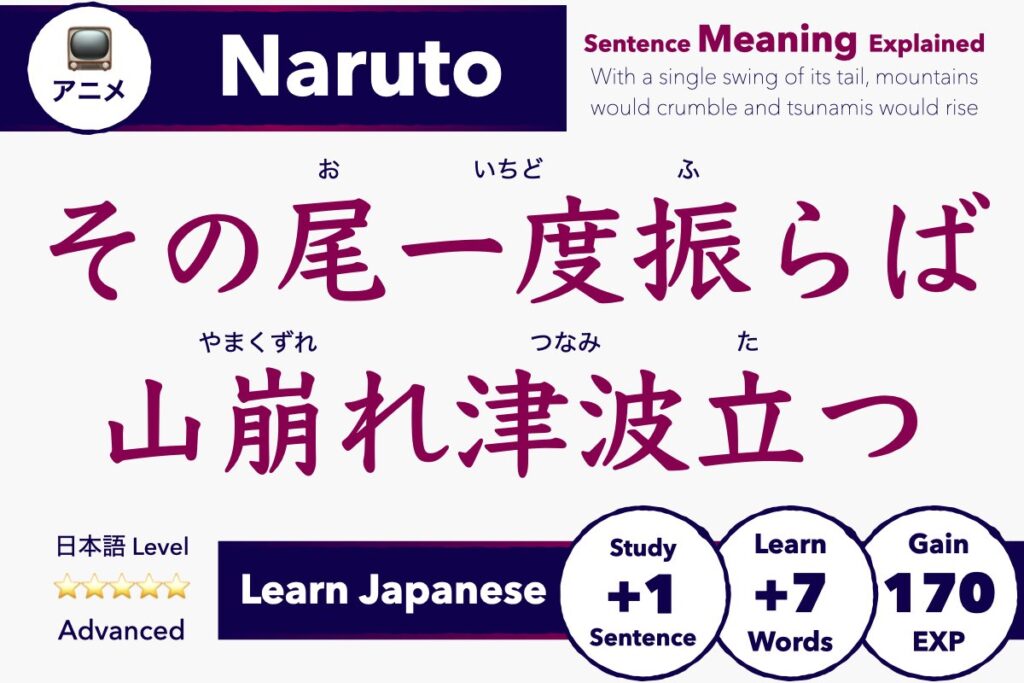
『Sono o ichido furaba yamakuzure tsunami tatsu』means「With a single swing of its tail, mountains would crumble, and tsunamis would rise」. This epic line in Naruto Episode 1 describes the terrifying power of the legendary Nine-Tailed Fox.
| Japanese: | その尾一度振らば山崩れ津波立つ |
| Reading: | Sono o ichido furaba yamakuzure tsunami tatsu |
| Meaning: | With a single swing of its tail, mountains would crumble, and tsunamis would rise |
In this sentence walkthrough, you’ll learn what each word means, how the sentence is built, and why the narrator uses the classical conditional 「〜らば (raba)」 instead of the modern 「〜れば (reba)」.
Meaning: Sono o ichido furaba yamakuzure tsunami tatsu (Naruto Japanese Explained)
Credit Attribution
- Sentence from Naruto (Anime)
© Masashi Kishimoto / Shueisha - Audio file generated with VOICEVOX:剣崎雌雄
Jump to: Words · Sentence · Grammar · Tone
Japanese
- Kanji: その尾 一度振らば山崩れ津波立つ
- Kana: その お いちど ふらば やま くずれ つなみ たつ
- Romaji: Sono o ichido furaba, yamakuzure, tsunami tatsu
- Series: Naruto
- Speaker: Narrator
- Source: Anime (Season 1, Episode 1)
English Meaning
- One swing of its tail would collapse mountains and unleash tsunamis.
- A single swing of its tail could bring down mountains and raise tsunamis.
- With just one swing of its tail, mountains would fall, and tsunamis would surge.
Literal Translations
- Should its tail be swung once, mountains collapse, tsunamis rise.
- If its tail were swung once, mountains would collapse, and tsunamis would rise.
- Were its tail to swing once, mountains would crumble, and tsunamis would stand.
My Preferred English Translation
With a single swing of its tail, mountains would crumble and tsunamis would rise.
I kept 「would」because 『振らば (furaba)』 expresses a hypothetical situation. The sentence isn’t describing something that actually happened. It’s describing what the Nine-Tailed Fox was said to be capable of.
I also chose 「crumble」 and 「rise」 because they preserve the dramatic, legendary feeling of the original Japanese better than simpler words like “fall” or “occur“.
Word Walkthrough: Learn Japanese Words & Phrases
Let’s break down every word in this line and see how each one adds to the sense of ancient, legendary scale. We’ll look at what each word means, its role here, and how the classical grammar shapes the whole feeling.
| Word | Hiragana | Romaji | Meaning |
|---|---|---|---|
| その | その | sono | that, its |
| 尾 | お | o | tail |
| 一度 | いちど | ichido | once, one time |
| 振らば | ふらば | furaba | if swung |
| 山崩れ | やまくずれ | yamakuzure | mountain collapse, landslide |
| 津波 | つなみ | tsunami | tsunami |
| 立つ | たつ | tatsu | rise, stand |
1. 『その (sono)』
- Modifier
- Reading: その (sono)
- Meaning: that, its, that kind of
『その』 points back to something that has already been mentioned. In this sentence, it refers to the Nine-Tailed Fox introduced in the previous line, so 『その尾』 naturally means 「its tail」.
2. 『尾 (o)』
- Noun
- Reading: お (o)
- Meaning: tail
『尾』 simply means 「tail」, such as an animal’s tail, the trailing end of a comet, or the rear end of an object. Here, it’s the Kyuubi’s tail.
3. 『一度 (ichido)』
- Adverb
- Reading: いちど (ichido)
- Meaning: once, one time
『一度』 means 「once」 or 「one time」. By placing it before the verb, the narrator emphasizes that just a single swing of the fox’s tail is enough to unleash enormous destruction.
4. 『振らば (furaba)』
- Dictionary: 振る (furu)
- Reading: ふらば (furaba)
- Meaning: if swung, were it to swing
『振らば』 is the classical conditional form of 『振る (furu)』, meaning “to wave“, “to swing” or “to shake“. It’s asking what would happen if the tail were swung. You’ll learn more about the classical conditional vs the modern conditional 「振れば (fureba)」 down below.
5. 『山崩れ (yamakuzure)』
- Noun (compound)
- Reading: やまくずれ (yamakuzure)
- Meaning: mountain collapse, landslide
『山崩れ』 combines 「山 (yama)」meaning 「mountain」 and 『崩れ (kuzure)』meaning 「collapse」. Together, they depict a mountain crumbling, illustrating the incredible force of the Nine-Tailed Fox‘s tail.
6. 『津波 (tsunami)』
- Noun
- Reading: つなみ (tsunami)
- Meaning: tsunami, tidal wave
『津波』 means 「tsunami」. By following 「mountains crumbling」 with 「tsunamis rising」, the narration shows that the Kyuubi’s power is so great it can devastate both land and sea.
7. 『立つ (tatsu)』
- Verb
- Reading: たつ (tatsu)
- Meaning: to rise, to stand, to rise up
『立つ』 usually means 「to stand」, but it can also describe something rising up, especially waves or smoke. In 『津波立つ (tsunami tatsu)』, it creates the vivid image of enormous tsunamis surging upward rather than simply happening.
Sentence Building: Learn Japanese Sentence Structure
Japanese sentences become much easier when you understand how each piece connects. Let’s build this line step by step, starting with 『その (sono)』 and working our way up to the full sentence: 『その尾一度振らば山崩れ津波立つ (Sono o ichido furaba yamakuzure tsunami tatsu)』.
| Step 1 |
|---|
| その |
| that |
Romaji: sono
| Step 2 |
|---|
| その尾 |
| its tail |
Romaji: sono o
| Step 3 |
|---|
| その尾一度 |
| its tail, once |
Romaji: sono o ichido
| Step 4 |
|---|
| その尾一度振らば |
| if its tail swung once |
Romaji: sono o ichido furaba
| Step 5 |
|---|
| その尾一度振らば山崩れ |
| if its tail swung once, mountains would crumble |
Romaji: sono o ichido furaba yamakuzure
| Step 6 (Final) |
|---|
| その尾一度振らば山崩れ津波立つ |
| If its tail swung once, mountains would crumble, and tsunamis would rise |
Romaji: Sono o ichido furaba yamakuzure tsunami tatsu
Sentence Grammar: Learn Japanese Grammar Patterns
Let’s see exactly how 『振る (furu)』 turns into 『振らば (furaba)』, and how that same classical shift works across other verbs too.
Conjugations
How 『振らば (furaba)』 is formed: classical Japanese shifts the 「る (ru)」 ending of 「振る (furu)」 to the a-row 「ら (ra)」 before adding 「ば (ba)」, instead of the modern e-row shift used in 「振れば (fureba)」.
| Step | Japanese | How to Form | Label |
|---|---|---|---|
| ① | 振る furu | plain form ending in る (ru) | dictionary form |
| ② | 振ら fura | shift る (ru) to a-row ら (ra) | a-row stem |
| ③ | 振らば furaba | add ば (ba) | classical conditional |
More Examples
The same modern-to-classical shift shows up across other verbs too:
| Verb | Modern | Classical | Meaning |
|---|---|---|---|
| 飲む nomu | 飲めば nomeba | 飲まば nomaba | if one drinks |
| 話す hanasu | 話せば hanaseba | 話さば hanasaba | if one talks |
| 行く iku | 行けば ikeba | 行かば ikaba | if one goes |
Sentence Tone: Nuance, Style & Cultural Notes
This line appears in Naruto Episode 1‘s opening narration, where the Nine-Tailed Fox is introduced as a legendary force of destruction. The old-fashioned wording gives the scene the feeling of an ancient tale being told.
Particle Choice
The narration omits both particles here, giving the line a shorter, more condensed rhythm that fits its ancient, legendary tone. Here’s what this line looks like with every particle restored:
| Base Sentence | Meaning |
|---|---|
| 尾を振る o o furu | swing (its) tail(s) |
| 山が崩れる yama ga kuzureru | mountain(s) collapse |
| 津波が立つ tsunami ga tatsu | tsunami(s) rise |
Particle 「を (o)」:「振る (furu)」 is a transitive verb, so 『尾 (o)』 would normally take 「を (o)」 in front of it.
Particle 「が (ga)」: 「崩れる (kuzureru)」 and 『立つ (tatsu)』 are both intransitive verbs, so 『山 (yama)』 and 『津波 (tsunami)』 would normally take 「が (ga)」 in front of them.
Why does dropping the particles matter here, beyond just grammar? Dropping 「を (o)」 and 「が (ga)」 does more than shorten the sentence. It strips the line down to its most important images, making it feel less like everyday speech and more like an old legend being told. The result is a dramatic, timeless style that perfectly matches the opening narration.
Beyond the Translation
『振らば (furaba)』 is the classical conditional, the older version of 「if it swings」. It’s the kind of Japanese you’d expect to find in an old legend, not a modern conversation.
Nobody says 「〜らば (~raba)」 in everyday Japanese anymore, but it still appears in old literature, historical fiction, and fantasy whenever the writer wants the narration to sound ancient or legendary.
That’s exactly why it’s used here. The moment the narrator says 『振らば』, the Nine-Tailed Fox stops feeling like an ordinary monster and starts feeling like a legendary creature whose story has been passed down for generations.
You may have even heard this pattern before. The old-fashioned farewell 「さらば (saraba)」 comes from 「然らば (saraba, “if that’s the case”)」 and uses the same classical 「〜らば」 form.
Level Up Your Japanese: Recap & Quiz
Check what you picked up about this legendary line with a quick quiz.
① Quick Quiz
『その尾一度振らば山崩れ津波立つ』
What’s the meaning of this sentence?
A) The Nine-Tailed Fox can only swing one of its tails
B) Just one swing of the Kyuubi’s tail would be destructive
C) With one swing of its tail, it caused a landslide and a tsunami
② Mini Quest
Which sentence uses the modern conditional?
A) 雨が降らば、行かない。
B) 雨が降れば、行かない。
③ Final Challenge
『その _____ 一度振らば 山崩れ 津波立つ』
Fill in the missing word to complete the sentence.
Answers
① B
② B
③ 尾 (o)
You leveled up your Japanese today:
✅ Japanese Sentences +1
✅ Japanese Words +7
✅ 日本語 EXP +170
Congratulations 🎉
おめでとう🎉
Learn More Japanese with…
Naruto
- 『昔妖狐ありけり (Mukashi youko arikeri)』
Learn the classical storytelling ending 「〜けり (keri)」, another piece of the same old narration style.
Final Fantasy 1
- 『偶然とは思えぬ (Guuzen to wa omoenu)』
Learn the archaic negative ending 「〜ぬ (nu)」, a classical way to say “not” that gives the line a more literary tone.
Now you understand what each word means, how this Naruto sentence is built, why the narration uses the classical 『振らば (furaba)』 instead of the modern 「振れば (fureba)」, and how omitted particles create the powerful rhythm of old Japanese storytelling.
Every time you learn an old form like 『振らば』, you’re understanding more than just one sentence. You’re training your ear for the kind of Japanese that makes stories feel like legends instead of scripts. That’s something worth building one sentence at a time.
See you in our next Naruto lesson!
Alex 🥷✨