
『昔 妖狐ありけり』 means 「Long ago, there was a fox spirit」. It’s the very first line of Naruto‘s opening narration, using the classical Japanese ending 「〜けり」 to present the tale of the Nine-Tails as an old legend before Naruto himself ever appears.
- 昔
long ago - 妖狐
a fox spirit - ありけり
there was
With just four words, the narrator sets up an ancient legend that’s still shaping the world today. That’s not just because of what’s being said, but because of how it’s being said. Let’s break it down one word at a time.
✅ 1 Japanese Sentence
✅ 4 Japanese Words
✅ +140 EXP
Original Japanese Sentence (Naruto)
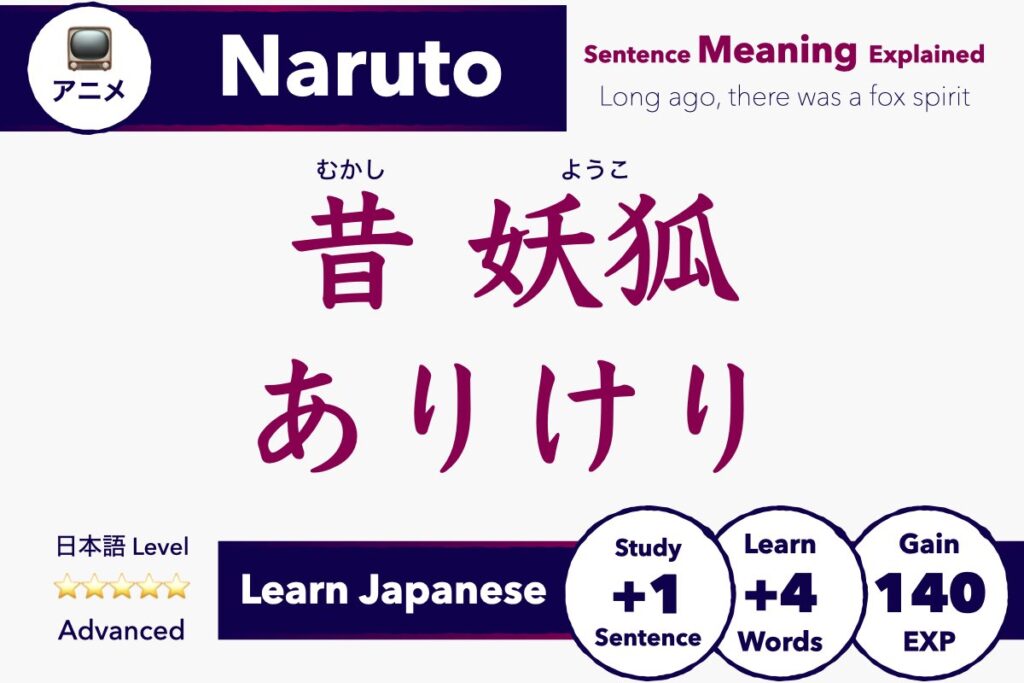
Credit Attribution
- Sentence from Naruto (Anime)
© Masashi Kishimoto / Shueisha - Audio file generated with VOICEVOX:剣崎雌雄
日本語
昔 妖狐ありけり
カナ
むかし ようこ あり けり
Romaji
Mukashi youko ari keri
Possible English Translations
Please note: There isn’t just one correct translation. Japanese sentences can often be translated in several natural ways, and more than one translation may be correct.
Natural Translations
- Long ago, there was a fox spirit.
- Long ago, there lived a mystical fox.
- Once upon a time, there was a fox spirit.
Literal Translations
- Long ago, a supernatural fox existed.
- In the past, there was a supernatural fox.
- In ancient times, there existed a fox spirit.
My Preferred Translation
Long ago, there was a fox spirit.
「Once upon a time」 is tempting since it’s the classic English fairy-tale opener, but it leans a little too Western-storybook for this line.
『昔』 more plainly means 「long ago」 or 「in the past」, and 『妖狐』 is best rendered as 「fox spirit」, since it’s a familiar English phrase that keeps the supernatural weight without sounding overly dramatic.
The heavy lifting on tone actually comes from 『ありけり』, and that deserves its own explanation below.
Japanese Meaning Explained
This line opens the very first episode of Naruto, spoken by an unseen narrator as the story recounts the legend of a nine-tailed fox spirit that once attacked a hidden village.
The lines that follow describe the fox’s power in detail. A single swing of its tail could level mountains and summon tsunamis, and it took a single shinobi risking his life to seal it away.
Rather than jumping straight into the story, the anime first steps back to recount an old legend. That framing does real narrative work before Naruto himself ever appears on screen.
『昔』
Meaning: 「long ago」
『昔(むかし)』 means 「long ago」, 「in the past」, or 「once upon a time」.
In our Naruto sentence, 『昔』 sets the story in the distant past. It tells us that what we’re about to hear is an old legend that happened a long time ago.
You’ll hear 『昔』 a lot in everyday Japanese, in phrases like 「昔は(むかしは)」 (“back then”) or 「昔話(むかしばなし)」 (“folktale” or “old tale”) to talk about the past. So while the grammar around it here is archaic, the word itself is very common today.
『妖狐』
Meaning: 「fox spirit」
『妖狐(ようこ)』 means 「fox spirit」 or 「supernatural fox」.
It’s made up of two words:
- 妖(よう): supernatural, mystical
- 狐(きつね): fox
Here, 『妖狐』 is used to refer to the Nine-Tails (九尾, Kyuubi) before it was sealed into Naruto.
You’ll mostly encounter 『妖狐』 in anime, manga, games, and Japanese folklore. It’s not an everyday word, but it’s a common one in fantasy stories.
『あり』
Meaning: 「is」
Dictionary: 「ある」
- to be
- to exist
『あり』 is the stem form of 「ある」, meaning 「to exist」 or 「to be」. In modern Japanese, it’s normally used for things, while 「いる」 is used for people and animals.
However, in classical Japanese, even living beings were often introduced with 『あり』 when simply establishing that they existed. Modern Japanese would normally use 「いる」 here instead.
That’s why in this Naruto sentence, the word 『あり』 is used to tell us about the existence of the fox spirit long ago, before 『けり』 gives the whole sentence that legendary, storyteller feel.
「ある」 is one of the Top 25 most common Japanese verbs, so you’ll encounter it constantly.
How to Form the Stem Form
| Step | Word | Form |
|---|---|---|
| ① | ある | dictionary form |
| ② | あり | stem form (る→り) |
『けり』
Function: Poetic Past Tense「〜けり Auxiliary Verb」
『けり』 is a classical auxiliary verb used in old Japanese storytelling and marks something as being recalled or narrated as a past event. It gives the sentence a legendary, narrated, or poetic feeling, as though the speaker is recalling an old tale rather than simply stating a fact.
In our Naruto sentence, 『けり』 is what transforms the plain statement 「There was a fox spirit」 into 「Long ago, there was a fox spirit」, immediately making it feel like the opening of a legend and giving it a classic folktale atmosphere.
You won’t come across 『けり』 in everyday Japanese. It’s a literary expression that’s almost exclusively found in classical literature, traditional folktales, historical works, and fantasy stories. That’s exactly why it works so well here. The moment a Japanese reader or viewer sees 『けり』, they instantly know they’re stepping into an old legend.
Note: Modern Japanese almost always uses 「〜た」 to talk about the past. Classical Japanese relied on endings like 「けり」 instead, which is why you’ll still find it in works that deliberately want to recreate that timeless “once upon a time” feeling.
Build Japanese Sentences
| Building Blocks | Japanese Sentence |
|---|---|
| Time (When?) | 昔 long ago |
| Subject (What existed?) | 妖狐 a fox spirit |
| Verb (What action?) | ありけり there was (literary past) |
昔 妖狐ありけり。
Long ago, there was a fox spirit.
Real-Life Usage Examples
Let’s look at a few natural, everyday examples using today’s vocabulary and sentence patterns.
- 昔: talking about the distant past
- あり: indicating that something is available or included
Example 1
朝食あり
→ breakfast included
Example 2
駐車場あり
→ parking available
Example 3
露天風呂あり、禁煙部屋。
A non-smoking room, with an open-air bath.
Example 4
昔はここに大きな木があった。
Long ago, there was a big tree here.
Example 5
このお祭りは昔から続いている。
This festival has continued since long ago.
How useful is today’s Japanese in real life?
『昔』 is still used constantly in modern Japanese, so it’s a word you’ll hear and use all the time.
『あり』 also appears regularly today, although usually in set expressions like 「空きあり」 (“vacancy available”) or 「在庫あり」 (“in stock”), rather than in the classical sense you learned in this sentence.
『けり』 is the odd one out. It’s almost exclusively found in classical literature, folktales, historical works, and fantasy stories. You may never use it yourself, but you’ll definitely start recognising it whenever Japanese wants to create an old, legendary atmosphere.
| Word | Frequency |
|---|---|
| ある | ~20 |
| 昔 | ~350 |
| 妖狐 | ~45,000 |
| 〜けり | ~154,000 |
Beyond the Translation
The choice of 『妖狐』 here is interesting. It isn’t just the Japanese word for a monster.
In Japanese folklore, foxes 「狐(きつね)」 are some of the most famous supernatural creatures, appearing in countless legends with magical powers and the ability to transform.
The very next line reveals that this fox has nine tails. More tails mean greater age and power. So before Naruto ever calls it the Nine-Tails, a Japanese audience already knows this is no ordinary fox.
One thing I love is the contrast it builds. The story opens with calm, classical Japanese that sounds like an old legend, then almost immediately cuts to Naruto’s loud, casual 「〜ってばよ」 speech. Before the plot has really begun, you’ve already met two completely different versions of Japanese.
Use the Sentence Pattern
Pattern to Remember
Classical Past Tense
(verb)た → (verb stem)けり
used to narrate legendary or literary events
『〜けり』 attaches to the verb stem and gives the sentence an old-fashioned, storybook feeling. Modern Japanese usually uses 「〜た」 instead, but classical Japanese often used 「〜けり」 when telling legends or recounting past events.
- 住んだ → 住みけり (lived)
- あった → ありけり (there was)
- 現れた → 現れけり (appeared)
- 旅立った → 旅立ちけり (set out on a journey)
① Quick Quiz
What’s the meaning of:
『昔 妖狐ありけり』
A) There is a fox spirit.
B) Long ago, there was a fox spirit.
C) Long ago, a fox spirit destroyed a village.
② Mini Quest
Which sentence uses the classical “there was” ending?
A)鬼がいた。
B) 鬼ありけり。
③ Final Challenge
Complete the sentence:
『昔 _____ ありけり』
Answers
① B
② B
③ 妖狐
What you achieved today:
✅ Japanese Sentences +1
✅ Japanese Words +4
✅ 日本語 EXP +140
Congratulations 🎉
おめでとう🎉
Learn More Japanese with…
Final Fantasy 1
- 『偶然とは思えぬ。』
Learn another line built on classical Japanese using 「〜ぬ」
Now you know why 『ありけり』 feels so different from everyday Japanese. It’s not just an old way of saying 「there was」. It’s a storytelling device that instantly tells Japanese readers and viewers they’re hearing an old legend.
The next time an anime, game, or folktale opens with classical Japanese like this, you’ll recognise it instantly and know exactly why the writer chose it.
See you soon!
またね 🦊✨
Alex