
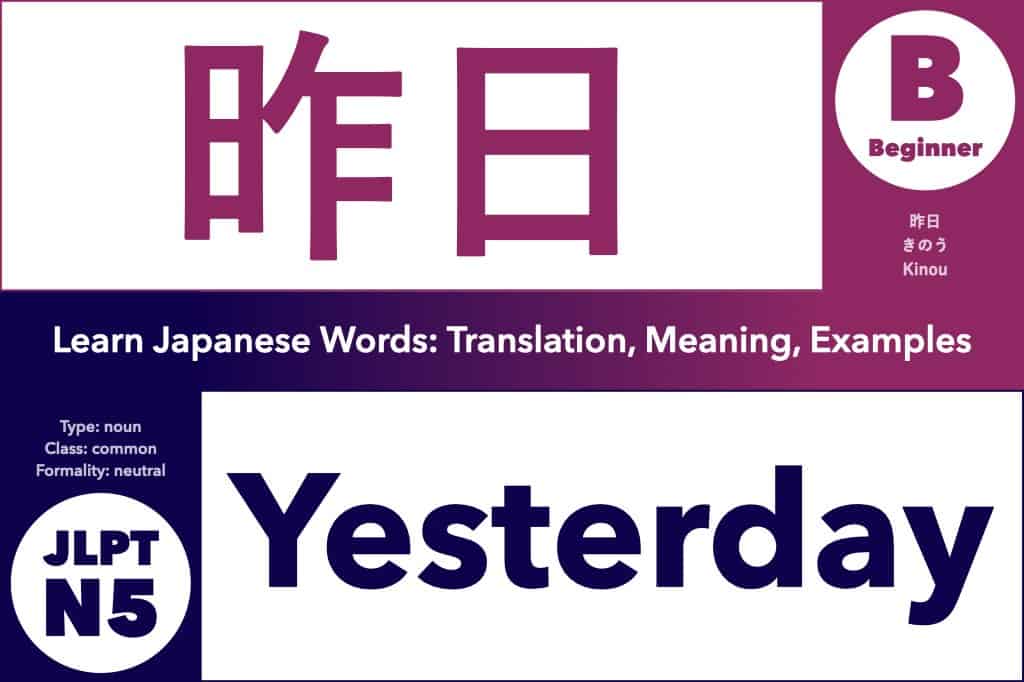
昨日 (きのう, kinou) means “yesterday” in Japanese. It’s a common time word used to talk about events that happened the day before today. In Japanese sentences, 昨日 often appears at the beginning and doesn’t require a particle. It’s commonly taught at the JLPT N5 level and used in everyday conversation.
昨日
きのう
kinou
yesterday
In this post, you will learn the full meaning and common translations of 昨日 (きのう, kinou) and see how it is used in real Japanese sentences to describe events and actions from yesterday. I will provide plenty of example sentences to help you use 昨日 naturally in your speaking and writing, just like a native speaker.
昨日 Means “Yesterday” in Japanese
Word: 昨日
Kana: きのう
Romaji: kinou
Meaning: yesterday
Type: noun, adverb
Class: common, JLPT N5
Formality: neutral, general use
1. English Translations of 昨日
| 昨日 |
|---|
| [noun, adverb] yesterday |
2. Japanese Meaning of 昨日
昨日 (きのう, kinou) means “yesterday” in Japanese.
It is a very common time word used to talk about events that happened the day before today.
昨日 does not need a particle like に (ni) or で (de). You simply place it directly in the sentence, most often at the beginning, to clearly mark the time. It can also appear before the verb for emphasis.
Because it refers to a past time, it naturally appears with past-tense verbs.
昨日 is used in both casual and polite Japanese.
3. How to Use 昨日 in a Sentence
- 昨日 (sentence)。
- 昨日、 (sentence)。
- 昨日の(noun) (sentence)。
Example Sentences
| 昨日岡山できびだんご食べた🤓 |
|---|
| きのう おかやま で きびだんご たべた 🤓 |
| I ate kibidango in Okayama yesterday 🤓 I had kibidango in Okayama yesterday 🤓 Yesterday, I ate kibidango in Okayama 🤓 |
| Kinou Okayama de kibidango tabeta 🤓 |
| Free Lesson: J-Pop Stars #7 (DXTEEN, Ken) |
More examples will be added in the future…