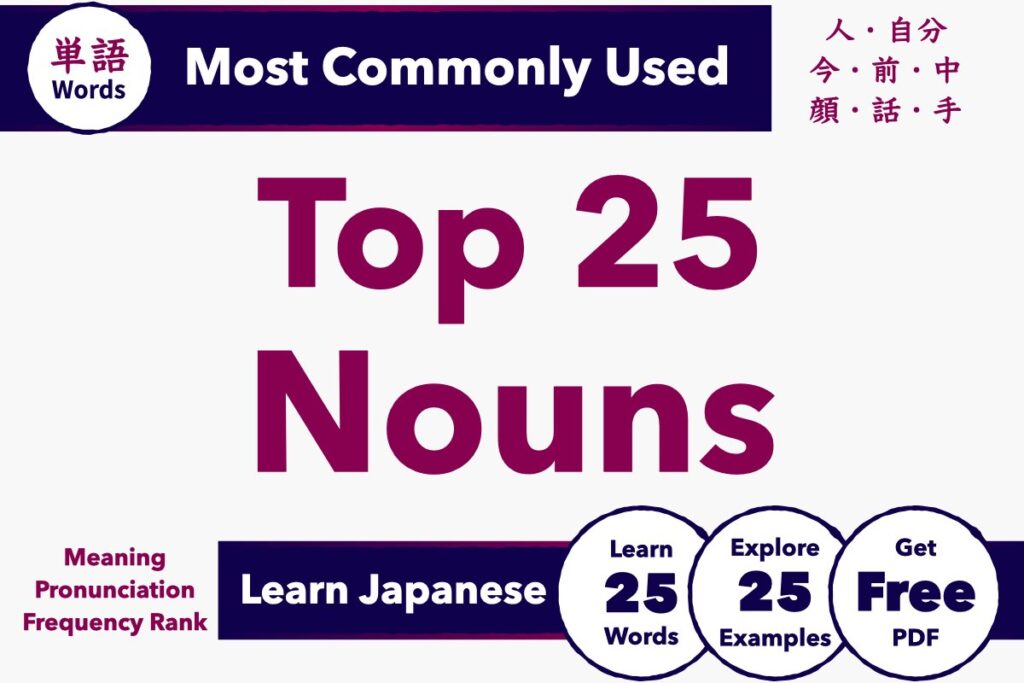
If verbs help you build sentences, nouns give you something to talk about. This list covers 25 of the most essential and useful Japanese nouns, chosen based on real usage frequency in everyday Japanese.
These 25 nouns cover a huge range of everyday topics, from people (人, 自分, 男) and time (今, 時間, 今日) to feelings and ideas (気持ち, 問題, 関係). Bookmark this page and come back to it as your vocabulary grows, or download the free PDF below so you can take the list with you wherever you go.
Each noun comes with its hiragana reading, English meaning, and a beginner-friendly example sentence so you can see it used in context. Combine these with the verbs from our Top 25 Japanese Verbs Frequency List, and you’ll already be able to build a surprising number of real sentences.
Credit Attribution
- Audio file generated with VOICEVOX:四国めたん, VOICEVOX:冥鳴ひまり, VOICEVOX:ずんだもん
1. 『人』
- Noun: hito
- Hiragana: ひと
- Meaning: person
Example Sentence
知らない人です。
Shiranai hito desu.
It’s a person I don’t know.
2. 『自分』
- Noun: jibun
- Hiragana: じぶん
- Meaning: oneself, myself
Example Sentence
自分でする。
Jibun de suru.
I do it myself.
3. 『今』
- Noun: ima
- Hiragana: いま
- Meaning: now
Example Sentence
今、何時?
Ima, nanji?
What time is it now?
4. 『前』
- Noun: mae
- Hiragana: まえ
- Meaning: front, before
Example Sentence
カフェの前で待つ。
Kafee no mae de matsu.
I wait in front of the cafe.
5. 『中』
- Noun: naka
- Hiragana: なか
- Meaning: inside, middle
Example Sentence
中に入る。
Naka ni hairu.
I go inside.
6. 『顔』
- Noun: kao
- Hiragana: かお
- Meaning: face
Example Sentence
顔を見る。
Kao o miru.
I look at your face.
7. 『話』
- Noun: hanashi
- Hiragana: はなし
- Meaning: talk, story
Example Sentence
その話は面白い。
Sono hanashi wa omoshiroi.
That story is interesting.
8. 『手』
- Noun: te
- Hiragana: て
- Meaning: hand
Example Sentence
手を洗う。
Te o arau.
I wash my hands.
9. 『目』
- Noun: me
- Hiragana: め
- Meaning: eye
Example Sentence
目がきれい。
Me ga kirei.
Your eyes are beautiful.
10. 『方』
- Noun: hou
- Hiragana: ほう
- Meaning: direction, way, side
Example Sentence
こちらの方です。
Kochira no hou desu.
It’s this way.
11. 『男』
- Noun: otoko
- Hiragana: おとこ
- Meaning: man
Example Sentence
男の人です。
Otoko no hito desu.
He’s a man.
12. 『今日』
- Noun: kyou
- Hiragana: きょう
- Meaning: today
Example Sentence
今日、友達に会う。
Kyou, tomodachi ni au.
Today, I meet a friend.
13. 『言葉』
- Noun: kotoba
- Hiragana: ことば
- Meaning: word, language
Example Sentence
言葉がわかる。
Kotoba ga wakaru.
I understand the words.
14. 『時』
- Noun: toki
- Hiragana: とき
- Meaning: time, moment
Example Sentence
忙しい時が来る。
Isogashii toki ga kuru.
A busy time is coming.
15. 『家』
- Noun: ie
- Hiragana: いえ
- Meaning: house, home
Example Sentence
家にいる。
Ie ni iru.
I am at home.
16. 『人間』
- Noun: ningen
- Hiragana: にんげん
- Meaning: human, human being
Example Sentence
人間について考える。
Ningen ni tsuite kangaeru.
I think about humans.
17. 『上』
- Noun: ue
- Hiragana: うえ
- Meaning: above, on top of
Example Sentence
机の上に本がある。
Tsukue no ue ni hon ga aru.
There is a book on the desk.
18. 『時間』
- Noun: jikan
- Hiragana: じかん
- Meaning: time (duration)
Example Sentence
時間がない。
Jikan ga nai.
There is no time.
19. 『世界』
- Noun: sekai
- Hiragana: せかい
- Meaning: world
Example Sentence
世界に出る。
Sekai ni deru.
I go out into the world.
20. 『仕事』
- Noun: shigoto
- Hiragana: しごと
- Meaning: work, job
Example Sentence
仕事をする。
Shigoto o suru.
I work.
21. 『気持ち』
- Noun: kimochi
- Hiragana: きもち
- Meaning: feeling, mood
Example Sentence
気持ちがわかる。
Kimochi ga wakaru.
I understand your feelings.
22. 『問題』
- Noun: mondai
- Hiragana: もんだい
- Meaning: problem
Example Sentence
問題がない。
Mondai ga nai.
There is no problem.
23. 『関係』
- Noun: kankei
- Hiragana: かんけい
- Meaning: relationship
Example Sentence
関係が深い。
Kankei ga fukai.
They have a close relationship.
24. 『場所』
- Noun: basho
- Hiragana: ばしょ
- Meaning: place, location
Example Sentence
きれいな場所だ。
Kirei na basho da.
It’s a beautiful place.
25. 『体』
- Noun: karada
- Hiragana: からだ
- Meaning: body
Example Sentence
体が痛い。
Karada ga itai.
My body hurts.
完璧🎉
Perfect! 🎉
You’ve just learned 25 of the most common Japanese nouns, and you’ll start spotting many of them everywhere, from everyday conversations to anime, manga, games, songs, and the posts of your favorite stars.
Combined with the verbs you already know, these nouns are enough to start building real, useful Japanese sentences. Try mixing a few together yourself, or head over to my Beginner Japanese Sentences and see how many you can already understand.
Hungry for more? Check out my Top 25 Japanese Verbs, Top 25 Japanese Adjectives, and Top 25 Japanese Particles next, or subscribe below to download the free PDF list and get future vocabulary packs sent straight to your inbox.
Learn More Japanese with…
- Top 25 Most Common Japanese Verbs
Learn the Top 25 Japanese Verbs with audio and examples - Top 25 Most Common Japanese Nouns
Learn the Top 25 Japanese Nouns with audio and examples - Top 25 Most Common Japanese Particles
Learn the Top 25 Japanese Particles with audio and examples - Top 25 Most Common Japanese Adjectives
Learn the Top 25 Japanese Adjectives with audio and examples