
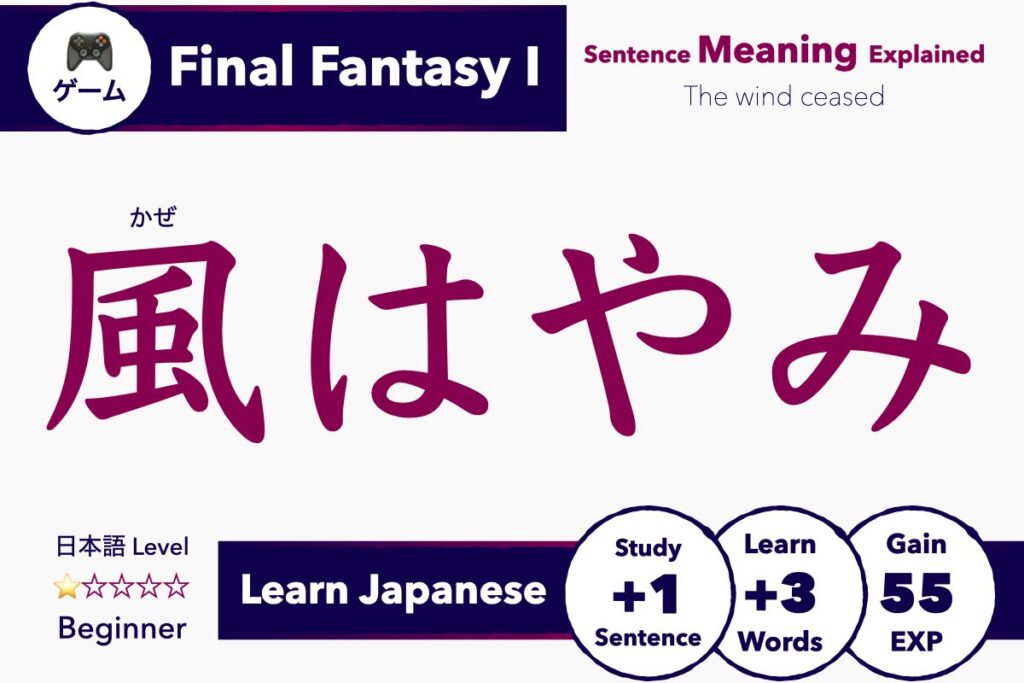
『風はやみ』 means 「The wind ceased」. It’s a short, literary line from Final Fantasy 1‘s opening narration, using the stem form of 「やむ (to stop) 」 rather than its plain past tense.
- 風は
as for the wind - やみ
ceased
This line comes right before two more just like it, each painting the world falling apart in just a few words. Let’s see how such a short sentence carries so much weight.
✅ 1 Japanese Sentence
✅ 3 Japanese Words
✅ +55 EXP
Original Japanese Sentence (Final Fantasy I)
Credit Attribution
- Sentence from Final Fantasy I (© SQUARE ENIX)
- Audio file generated with VOICEVOX:冥鳴ひまり
日本語
風はやみ
カナ
かぜ は やみ
Romaji
Kaze wa yami
Possible English Translations
Please note: There isn’t just one correct translation. Japanese sentences can often be translated in several natural ways, and more than one translation may be correct.
Natural Translations
- The wind ceased
- The winds fell silent
- The wind died down
Literal Translations
- The wind stopped
- The wind became still
- As for the wind, it stopped
My Preferred Translation
The wind ceased
This is my favorite translation because it’s short, natural, and matches the dramatic style of the original narration.
The word 「ceased」 preserves the brief, ominous, yet poetic feeling of 『やみ』 the best.
Japanese Meaning Explained
Today’s sentence 『風はやみ』 appears in the opening narration of Final Fantasy I. It is one of several short narration lines describing a world falling apart.
The sentence creates an ominous atmosphere. The wind has suddenly gone still, making the world feel unnaturally quiet and hinting that something is deeply wrong.
『風』
Meaning: 「wind」
『風(かぜ)』 means 「wind」. It can refer to a gentle breeze, strong winds, or wind as a natural force.
You don’t need a game to hear 『風』. It’s one of the first words you’ll pick up just by checking the weather forecast.
『は』
Function: Topic Marker 「は Particle」
- 「〇〇は」 means 「As for 〇〇」
- 『風は』 means 「As for the wind」
The particle 『は』 marks the topic of the sentence.
In this Final Fantasy I line, it tells us that the sentence is talking about the wind, and what follows explains what happened to it.
You’ll see 『は』 constantly in Japanese, making it one of the first particles you’ll naturally become comfortable with.
『やみ』
Translation: 「ceased」
- 「やむ」 means 「to stop」, 「to cease」, 「to be over」
- 『やみ』 is the 「Stem Form」 of 「やむ」
『やみ』 translates naturally as 「ceased」. Since the verb is in its 「Stem Form」, it also carries the sense of 「ceased, …」, linking smoothly to the narration that follows.
In this narration, ending the sentence in this form does two things. It creates a short, literary feeling, while also smoothly connecting the sentence to the next line.
「人々は ひとつの予言を信じ それを待っていた」 uses the 「Stem Form」 the same way, there it links two actions, 「believed」 and 「waited」, into one sentence, while here 『やみ』 creates a literary transition into the next narration line.
You’ll hear 「やむ」 frequently in everyday Japanese whenever rain, snow, wind, or other natural phenomena come to an end.
Build Japanese Sentences
| Building Blocks | Japanese Sentence |
|---|---|
| Topic (What about?) | 風は the wind |
| Verb (What happens?) | やみ ceased |
風はやみ
The wind ceased
Real-Life Usage Examples
Let’s look at a few natural, everyday examples using the words and patterns from today’s sentence.
- 〜がやむ: something stops naturally
- 〜がやんだ: something stopped or came to an end
- V(stem): connects actions in a smooth, literary style
Example 1
風がやむ
→ the wind stops
Example 2
雨がやむ
→ the rain stops
Example 3
風がやんだ。
The wind stopped.
Example 4
雪がやんだ。
The snow stopped.
Example 5
風はやみ、海は荒れた。
The wind ceased, and the sea grew rough.
How useful is today’s Japanese in real life?
「やむ」 is a very practical everyday verb. Japanese speakers commonly use it for rain stopping, snow stopping, wind stopping, or other things that naturally come to an end.
While today’s sentence uses the 「Stem Form」 in a literary style, you’ll encounter this pattern regularly in novels, game dialogue, narration, newspapers, and formal speeches.
In the opening narration of Final Fantasy I alone, you’ll see the 「Stem Form」 a couple of times. Another example appears in 「人々は ひとつの予言を信じ それを待っていた」, where 「信じ」 smoothly connects one action to the next.
| Word | Frequency Rank |
|---|---|
| は | Top 10 |
| 風 | ~900 |
| やむ | ~5000 |
Beyond the Translation
One thing I really love about today’s sentence is the use of 『やみ』.
Instead of saying 「風はやんだ」, which simply translates as 「the wind stopped」, the game uses the stem form 『やみ』.
In the opening narration of Final Fantasy I, the story continues like this:
風はやみ
海は荒れ・・・
大地は腐ってゆく
The 「Stem Form」 of the first two verbs creates a smooth, rhythmic flow, allowing one image to lead naturally into the next.
Each line works as a complete image on its own, but together they paint a vivid picture of a world slowly falling apart.
First, the wind falls silent.
Then, the seas grow rough.
Finally, the land itself begins to decay.
It’s a small grammatical choice, but it gives the narration a poetic feeling that’s difficult to capture in English.
Use the Sentence Pattern
Pattern to Remember
Connecting Events (Literary Japanese)
『〇〇は V(stem)、…』
「〇〇 (verb), and then …」
- 雪は降り、… → the snow fell, and then …
- 太陽は沈み、… → the sun set, and then …
- 花は咲き、… → the flowers bloomed, and then …
- 雨はやみ、風が吹いた → The rain stopped, and the wind blew
① Quick Quiz
What’s the meaning of:
『風はやみ』
A) The wind stopped.
B) The breeze picked up.
C) The winds stopped for a while.
② Mini Quest
Which sentence uses the same literary style as our FF1 sentence?
A) 花が咲いた。
B) 花は咲き、春が来た。
③ Final Challenge
Complete the sentence:
『風 _____ やみ』
Answers
① A
② B
③ は
What you achieved today:
✅ Japanese Sentences +1
✅ Japanese Words +3
✅ 日本語 EXP +55
Congratulations 🎉
おめでとう🎉
Learn More Japanese with…
Final Fantasy 1
- 『大地は腐ってゆく』
Learn another line of the opening movie passage - 『人々は ひとつの予言を信じ それを待っていた』
See another example of the 「Stem Form」 connecting actions
Now you know why the game reaches for the stem form 『やみ』 instead of the plain past tense 「やんだ」, and how that one small choice sets the rhythm for the lines that follow it.
The next time a JRPG‘s opening narration ends a verb in its stem form instead of 「〜た」, you’ll recognize that same quiet, literary momentum building toward what comes next.
See you for the next line of FF1! 🎮✨
Alex