
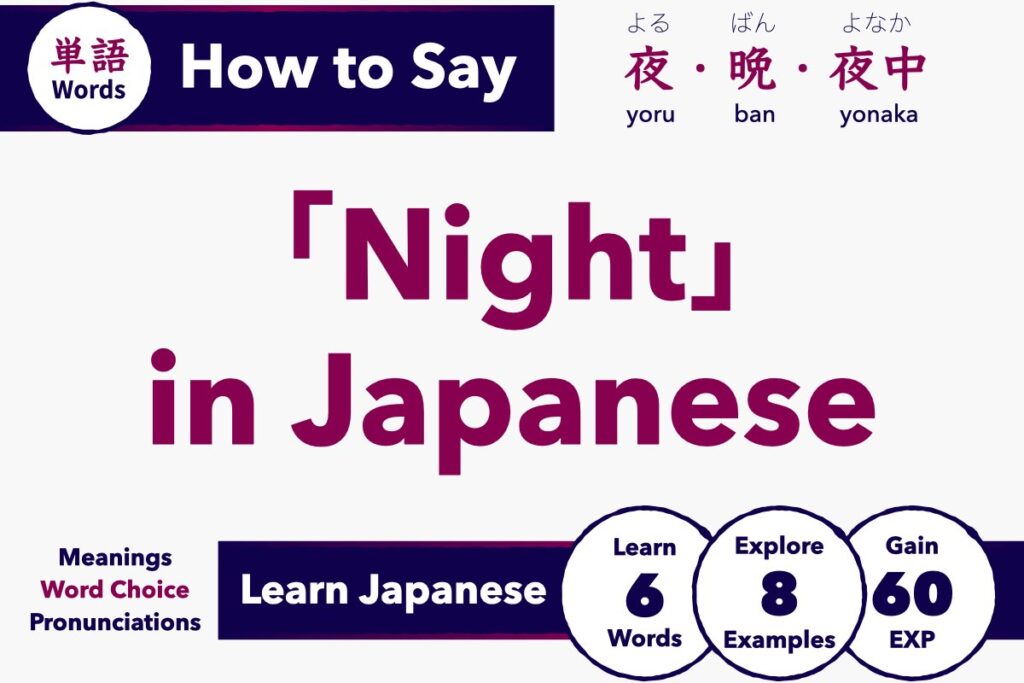
The most common way to say night in Japanese is 夜 (よる, yoru). For the early part of the night, especially around dinnertime, 晩 (ばん, ban) is more natural. For the middle of the night, when most people are asleep, Japanese uses 夜中 (よなか, yonaka).
- 夜 (よる, yoru)
the general, everyday word for night - 晩 (ばん, ban)
early part of the night, often around dinner - 夜中 (よなか, yonaka)
the middle of the night or the late-night hours
Japanese has several words for night, each covering a slightly different stretch of time or level of formality. Below, you’ll learn each word’s meaning, pronunciation, kanji, hiragana, and usage, with examples from anime, manga, games, songs, and everyday Japanese.
Credit Attribution
- Audio file generated with VOICEVOX:四国めたん, VOICEVOX:冥鳴ひまり, VOICEVOX:ずんだもん
Common Japanese Words for Night
| Kanji | Hiragana | Romaji | Meaning |
|---|---|---|---|
| 夜 | よる | yoru | night, evening |
| 晩 | ばん | ban | evening, early night |
| 夜中 | よなか | yonaka | the middle of the night |
| ナイト | ないと | naito | night (loanword) |
| 夜分 | やぶん | yabun | night (formal/polite) |
| 夜間 | やかん | yakan | nighttime, night hours |
夜 (よる, yoru) is the Japanese word for night that you’ll encounter and use most often. It’s the standard, everyday term and the safest choice when you’re not sure which word to use.
- 夜 (yoru): Your go-to word for night. It works in almost any situation.
- 晩 (ban): The early part of the night, or evening. Also used for “tonight” and “every night”.
- 夜中 (yonaka): Use this for the deep, quiet hours after midnight, when most people are asleep.
- ナイト (naito): Borrowed from English, mostly used in names. Sometimes it means “knight”.
- 夜分 (yabun): A polite word for night, mostly used when apologising for contacting someone late.
- 夜間 (yakan): Night as an official time period, the kind of word you’d see on a sign or a schedule.
Before we look at each word in more detail, there’s one interesting thing worth pointing out about the loanword ナイト (naito).
The Loanword Trap: 『ナイト』 (Night vs Knight)
『ナイト (naito)』 can mean either 「night」 or 「knight」, and the only way to tell which one is meant is context. Here’s why.
Why 『ナイト 』 Covers Both Meanings
In English, night and knight are homophones, which means they sound exactly the same. Since Japanese borrowed both words from English, they both became the same katakana word 『ナイト (naito)』.
This isn’t a translation error or a coincidence. It’s simply what happens when two identical-sounding English words both get borrowed into a language that writes them out phonetically.
How to tell them apart
Context does almost all the work here:
- 『ナイトプール (naito puuru)』
means 「night pool」 - 『ブラックナイト (burakku naito)』
means 「black knight」
So when you’re playing a fantasy RPG or watching an anime, and someone says 『ナイト (naito)』, don’t automatically assume they’re talking about nighttime. There’s a good chance they’re referring to a knight instead.
Native speakers rarely confuse the two because the surrounding context almost always makes the intended meaning obvious.
夜 (yoru)
- Kanji: 夜
- Romaji: yoru
- Hiragana: よる
- Meaning: night, evening
『夜』 is the most common Japanese word for night. It’s the default word Japanese speakers use, whether they’re talking about tonight, last night, or night in general.
You’ll hear 『夜』 everywhere, in everyday conversation, anime, manga, games, songs, and books. If you’re not sure which word to use, this is almost always the safest choice.
Unlike 「晩 (ban)」, 『夜』 isn’t tied to any specific part of the night. 「晩 (ban)」 usually refers to the earlier hours around dinner, while 『夜』 can refer to the entire night from sunset until morning.
Example:
夜になると星が見える。
You can see stars once it becomes night.
晩 (ban)
- Kanji: 晩
- Romaji: ban
- Hiragana: ばん
- Meaning: night, evening (early night)
『晩』 refers to the earlier part of the night, usually around the time people finish work, eat dinner, or make plans for the evening.
You’ll often see it in common words like 「今晩 (tonight)」 and 「毎晩 (every night)」, even if you don’t use 『晩』 by itself very often.
「夜 (yoru)」 is night in general. 『晩』 is the earlier part of it, when people are still awake and going about their evening.
Example:
今晩は何を食べますか?
What are you eating tonight?
夜中 (yonaka)
- Kanji: 夜中
- Romaji: yonaka
- Hiragana: よなか
- Meaning: the middle of the night, late night hours
『夜中』 means the middle of the night or late at night, when most people are already asleep.
You’ll hear this word when someone talks about waking up unexpectedly, getting home very late, or hearing strange noises while everyone else is sleeping.
Unlike 「夜 (yoru)」, which covers the whole night, 『夜中』 points to one specific stretch of it, the quiet hours after midnight, and usually implies really late, not just at night.
Example:
夜中に目が覚めた。
I woke up in the middle of the night.
ナイト (naito)
- Kanji: (katakana word, no kanji)
- Romaji: naito
- Hiragana: ないと
- Meaning: night (loanword)
『ナイト』 is a loanword borrowed from English, but you won’t hear people using it instead of 「夜 (yoru)」 in everyday conversation.
Instead, you’ll mostly see it in business names, events, and advertisements. Things like 「ナイトプール (night pool)」, 「ナイトマーケット (night market)」, or 「ナイトツアー (night tour)」.
Unlike 「夜 (yoru)」, which is the normal Japanese word for night, 『ナイト』 usually adds a modern, stylish, or international feel.
And remember, as we mentioned above, it can just as easily mean 「knight」 instead.
Example:
このホテルはナイトプールが人気だ。
This hotel’s night pool is popular.
夜分 (yabun)
- Kanji: 夜分
- Romaji: yabun
- Hiragana: やぶん
- Meaning: night (formal, polite)
『夜分』 is a polite, formal word for night. Most learners won’t hear it very often in everyday conversation, but you’ll occasionally see it in business emails, announcements, or very polite speech.
The most common expression is 「夜分遅くに (yabun osoku ni)」, used when apologising for contacting someone late at night. If a message opens with 「夜分遅くに失礼します (yabun osoku ni shitsurei shimasu)」, the sender is politely acknowledging they’re disturbing you at a late hour.
Unlike 「夜 (yoru)」 or 「晩 (ban)」, 『夜分』 isn’t there to describe the time of day. It’s there to make your message sound considerate.
Example:
夜分遅くにすみません。
Sorry for contacting you so late at night.
夜間 (yakan)
- Kanji: 夜間
- Romaji: yakan
- Hiragana: やかん
- Meaning: nighttime, night hours
『夜間』 refers to nighttime as a period of time, rather than the feeling of night itself.
You’ll mostly see it on signs, schedules, official documents, and news reports. Common examples include 「夜間営業 (open at night)」, 「夜間工事 (nighttime construction)」, and 「夜間飛行 (night flight)」.
When chatting with a friend, you’d say 「夜 (yoru)」. Reading a train notice or a hospital sign, you’re far more likely to see 『夜間』.
Example:
このコンビニは夜間も営業している。
This convenience store is open at night too.
Quick Comparison Chart
| Word | Key Difference |
|---|---|
| 夜 (yoru) | night (general) |
| 晩 (ban) | evening or early night |
| 夜中 (yonaka) | the middle of the night |
| ナイト (naito) | night (modern, international feel) |
| 夜分 (yabun) | night (formal, polite) |
| 夜間 (yakan) | nighttime (formal) |
Choose the Right Japanese Word for Night
Still not sure which word to use? The tables below will help. The first shows the best word for different situations, while the second gives you an idea of how common each word is.
By Situation
| If you’re talking about… | Use… |
|---|---|
| night in general | 夜 (yoru) |
| tonight or plans for this evening | 晩 (ban) |
| the middle of the night, midnight | 夜中 (yonaka) |
| apologizing for contacting someone late at night | 夜分 (yabun) |
| official schedules, signs, or announcements | 夜間 (yakan) |
| business names or marketing | ナイト (naito) |
By Frequency
| Word | Frequency Rank |
|---|---|
| 夜 (yoru) | ~300 |
| 夜中 (yonaka) | ~3000 |
| 晩 (ban) | ~4000 |
| 夜間 (yakan) | ~12,000 |
| ナイト (naito) | ~17,000 |
| 夜分 (yabun) | ~19,000 |
If you only remember one word from this post, make it 『夜 (よる, yoru)』. It’s by far the most common and the one you’ll use in almost every situation.
For Learning Japanese
If you want to learn Japanese, start with:
① 夜 (よる, yoru)
The default word for night. You’ll use this constantly.
② 晩 (ばん, ban)
Learn this next so expressions like 今晩 (tonight) and 毎晩 (every night) make perfect sense.
③ 夜中 (よなか, yonaka)
Useful the moment you want to describe something happening late at night.
The remaining words are less common and can be learned naturally as you come across them.
FAQ: Last Night, Every Night & Other Night Phrases
How do you say “last night” in Japanese? Last night is 昨夜 (さくや, sakuya). You’ll also hear 昨日の夜 (きのうのよる, kinou no yoru) in everyday conversation, which literally means “yesterday’s night”.
How do you say “every night” in Japanese? Every night is 毎晩 (まいばん, maiban). Even though 夜 is the most common word for “night”, this expression uses 晩, not 夜.
How do you say “day and night” in Japanese? Day and night is 昼夜 (ちゅうや, chuuya). You’ll often see this expression in writing, news articles, and phrases describing something that continues “day and night”.
How do you say “one night” in Japanese? One night is 一夜 (いちや, ichiya), often used in stories or narration to describe something that happened over the course of a single night.
How do you say “night sky” in Japanese? Night sky is 夜空 (よぞら, yozora), a common, slightly poetic word you’ll see often in songs and anime.
How do you say “night shift” in Japanese? Night shift is 夜勤 (やきん, yakin). This is the standard word for working overnight hours.
How do you say “stay up all night” in Japanese? Staying up all night is 徹夜 (てつや, tetsuya), used for pulling an all-nighter, whether for work, study, or binge-watching your favorite anime.
How do you say “night owl” in Japanese? A night owl is often described as 夜型人間 (よるがたにんげん, yorugata ningen), literally meaning a “night-type person”.
What about phrases like “date night” or “movie night”? These aren’t fixed Japanese words. They’re just descriptive English combinations. In Japanese, you’d simply describe the night itself, like デートの夜 (a date night) or 映画を見る夜 (a movie-watching night).
How do you say “good night” in Japanese? Good night is おやすみ (oyasumi), or the more polite おやすみなさい (oyasumi nasai) when you’re not on casual terms with someone. In contrast to English, Japanese doesn’t literally say “good night”.
- Want to learn when to use おやすみ and おやすみなさい naturally?
Check out my complete guide to the meaning of おやすみ (good night) in Japanese. - And once you’ve mastered saying good night, why not learn how to say goodbye in Japanese too?
How do you write “night” in hiragana? The most common way to write “night” in hiragana is よる (yoru). 晩 is written ばん, and 夜中 is written よなか.
Learn Japanese with Real Examples from…
| Source | Example | Word |
|---|---|---|
| Jujutsu Kaisen | 『夜のお散歩かな?』 | 夜 (yoru) |
| Kimetsu no Yaiba | 『だから 夜 歩き回るもんじゃねえ』 | 夜 (yoru) |
| YOASOBI (ikura) | 『第一夜いかがでしたか?』 | 夜 (yoru) |
| Akatsuki no Yona (ED) | ♪ 夜 | 夜 (yoru) |
Learn More Japanese with…
Related Words
- 星 (ほし, hoshi) — star
- 月 (つき, tsuki) — moon
- 朝 (あさ, asa) — morning
- 昼 (ひる, hiru) — daytime, noon
- 夕方 (ゆうがた, yuugata) — evening
- How to Say 「Darkness」 in Japanese
Most Common Japanese Words
- Top 25 Most Common Japanese Verbs
Learn the Top 25 Japanese Verbs with audio and examples - Top 25 Most Common Japanese Nouns
Learn the Top 25 Japanese Nouns with audio and examples - Top 25 Most Common Japanese Particles
Learn the Top 25 Japanese Particles with audio and examples - Top 25 Most Common Japanese Adjectives
Learn the Top 25 Japanese Adjectives with audio and examples
Now you know exactly why 『晩 (ban)』 shows up at dinnertime, why 『夜中 (yonaka)』 means someone’s still awake at 3 am, and why 『ナイト (naito)』 might be talking about a knight, not bedtime at all.
The next time one of these words shows up in an anime, manga, game, or song, or even a text from a friend late at night, you’ll know exactly what part of the night they mean.
Keep leveling up your Japanese, and see you soon! 🌉 ✨
Alex